
The 1967 Naksa: When Israel Occupied the Remaining 22% of Palestine
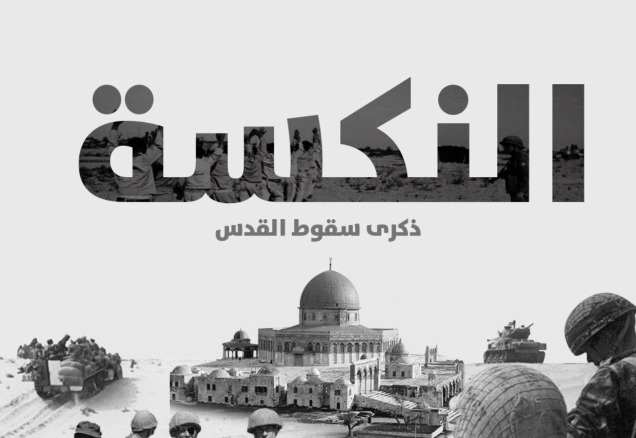
On the morning of 5 June 1967 the Israeli occupation army launched a surprise assault on Egypt and within hours extended it to Jordan and Syria. In six days it occupied the West Bank, including East Jerusalem, and the Gaza Strip – the remaining 22 per cent of historic Palestine that had not fallen in the Nakba – together with Egypt’s Sinai and the Syrian Golan, seizing close to seventy thousand square kilometres in a matter of days. [1][2]
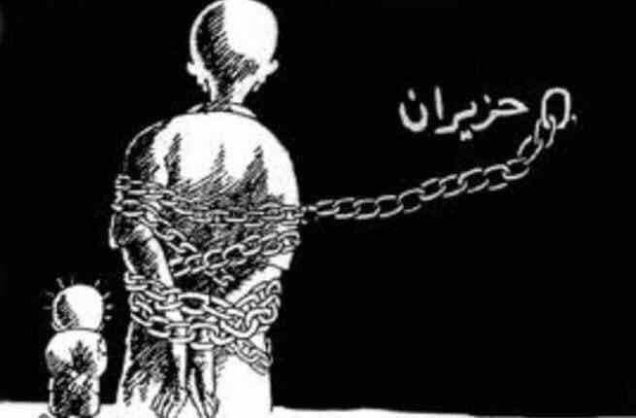
Arabs call the war the “Naksa” (setback), but for Palestinians it was more than a military defeat: it completed what the Zionist militias had begun in 1948, placing all of Palestine, from the river to the sea, under occupation. Hundreds of thousands were driven from their homes, many of them refugees since the Nakba uprooted for a second time in less than twenty years. In the first days of the occupation the Moroccan Quarter of Jerusalem was levelled, the three Latrun villages were wiped out, and the policy of annexation and settlement began that has not stopped to this day. [3][4][5]
Contents
- At a glance
- From the Nakba to the Naksa
- The road to the assault
- 5 June: the air strike
- The occupation of Gaza and Sinai
- The occupation of the West Bank
- The fall of East Jerusalem
- The destruction of the Moroccan Quarter
- The erasure of Imwas, Yalu and Beit Nuba
- The destruction of Qalqilya
- The occupation of the Golan
- The territories occupied in 1967
- The second displacement
- Refugees twice over
- Security Council Resolution 237
- The annexation and expansion of Jerusalem
- The start of settlement and the Allon Plan
- Resolution 242 and the erasure of the Palestinian people
- The Khartoum summit
- Out of the defeat
- An occupation that never ended
- Between the accounts
- Timeline
- Frequently asked questions about the Naksa
At a glance
| Item | Details |
|---|---|
| Date | 5–10 June 1967 |
| Parties | The Israeli occupation army against Egypt, Jordan and Syria, with an Iraqi brigade on the Jordanian front |
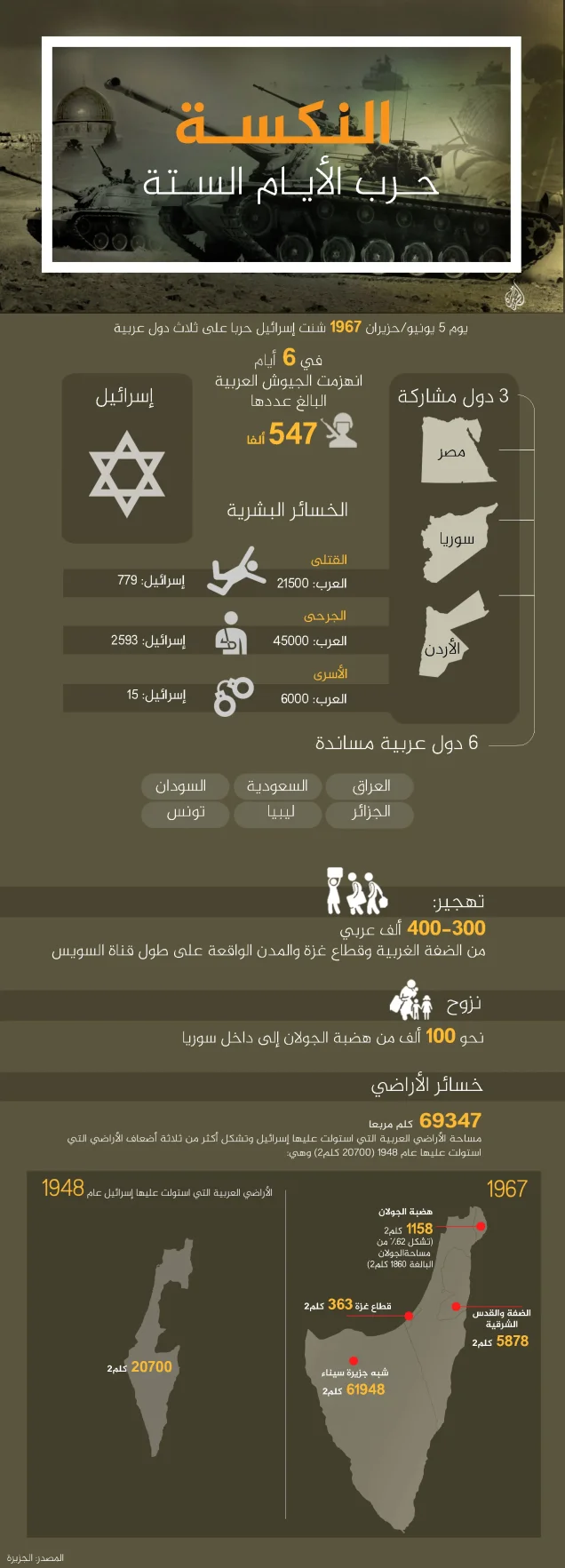
| Palestinian territory occupied | The West Bank including East Jerusalem (5,878 km²) and the Gaza Strip (363 km²) |
| Arab territory occupied | Sinai (61,948 km²) and the Golan (1,158 km²) |
| Total area occupied | 69,347 km² according to Al Jazeera Net, roughly three and a half times the area seized in 1948 |
| Displaced | About 300,000 Palestinians according to Palestinian statistics, and about half a million Arabs across all fronts |
| Arab dead | Between 15,000 and 25,000 according to estimates |
| Key crimes | Demolition of the Moroccan Quarter, erasure of Imwas, Yalu and Beit Nuba, destruction of homes in Qalqilya, annexation of Jerusalem |
| International resolutions | Security Council 237 and 242, General Assembly 2253 and 2254, then 252 in 1968 |
From the Nakba to the Naksa
The Naksa came less than twenty years after the Nakba. In 1948 the Zionist militias occupied about 78 per cent of Palestine, destroyed hundreds of villages and expelled their people, while the West Bank and East Jerusalem remained under Jordanian rule and the Gaza Strip under Egyptian administration. Hundreds of thousands of the displaced took refuge in these two areas, living in camps in the hope of an early return.
Gaza had already tasted occupation once, when the Israeli army seized it during the Tripartite Aggression against Egypt in 1956 and then withdrew, only to return a decade later.
The road to the assault
On the morning of 13 November 1966 occupation forces stormed the town of al-Samu, south of Hebron, with tanks and aircraft, in a battle of about five hours in which 13 Jordanian soldiers and a number of civilians were killed and homes in al-Samu and Rafat were demolished. Israel used as a pretext mine explosions near Battir that it blamed on Fatah guerrillas. The Security Council unanimously condemned the attack in Resolution 228 of 25 November, and Arab analysts saw it as a rehearsal for a wider war. [6]
In May 1967 a Soviet delegation informed Cairo that Israel had massed 11 brigades on the Syrian border; President Gamal Abdel Nasser moved troops into Sinai, Egypt asked in mid-May for the withdrawal of the UN Emergency Force stationed there since 1956, and on 22 May it closed the Straits of Tiran to Israeli shipping. [2][1]
On 30 May 1967 Jordan and Egypt signed a joint defence agreement in Cairo, which Nasser ratified by presidential decree on 1 June, and an Iraqi brigade arrived on the Jordanian front. Israel later presented its assault as a “pre-emptive strike” – a narrative that obscures the fact that it was Israel that opened the war, and that it had long been waiting for the chance to seize the rest of Palestine. [7][2]
5 June: the air strike
At 8:45 on the morning of Monday 5 June the Israeli air force struck Egyptian airfields in three successive waves, about 492 sorties, destroying 25 Egyptian airfields and most of the aircraft on the ground. The raids then spread to Jordanian, Syrian and Iraqi air bases. Israel claims to have destroyed 416 Arab aircraft in the war, against a loss of 26 of its own. [2][1]
With the Egyptian air force destroyed in the first hours, the skies over every front lay open to Israeli aircraft, which decided the outcome of the ground battles that followed.
The occupation of Gaza and Sinai
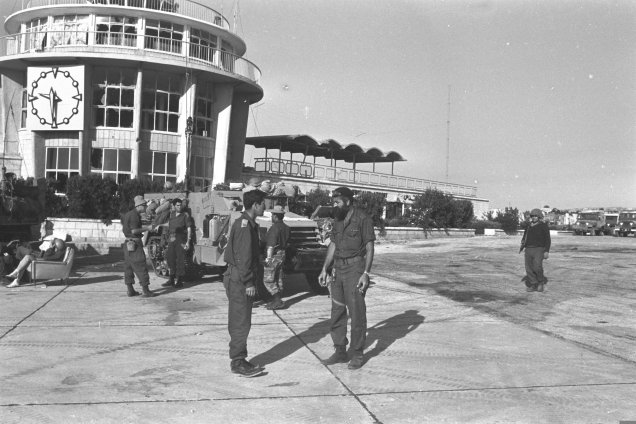
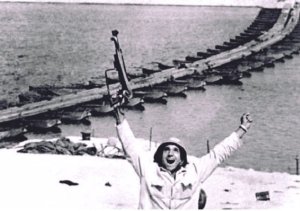
The air raids coincided with the advance of Israeli armour into the Gaza Strip and Sinai. Egyptian and Palestinian soldiers in Gaza fought under open skies until the Strip fell, and occupation forces then pushed across Sinai to the east bank of the Suez Canal. [1]
In the wake of the defeat Nasser announced his resignation; crowds poured into the streets to reject it, and he withdrew it. [1]
The occupation of the West Bank
The war reached the Jordanian front on the first day. Battles were fought in Jerusalem, Latrun, Jenin and Qalqilya, with the participation of an Iraqi brigade. Occupation forces reached Jenin on the first day and took Nablus on the second; the cities of the West Bank then fell one after another – Ramallah, Bethlehem, Hebron and Jericho – and the Jordanian army withdrew east of the river. [2]
Thus the Palestinians who had escaped occupation in 1948 now came under Israeli military rule as well, along with the hundreds of thousands of Nakba refugees in the camps of the West Bank.
The fall of East Jerusalem
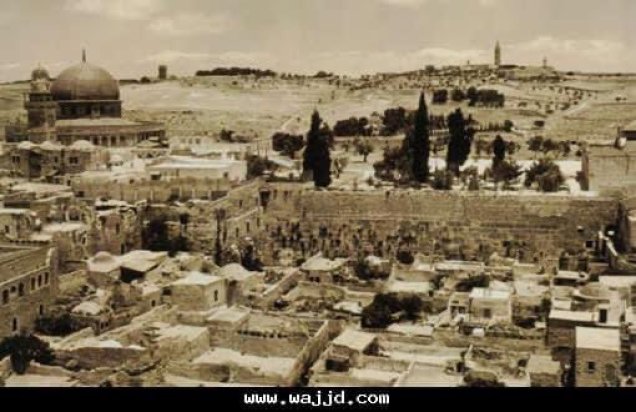
Since 1948 Jerusalem had been divided: its west under occupation and its east, including the Old City, under Jordanian rule. On the third day of the war, 7 June 1967, occupation forces stormed the Old City, reached the Buraq (Western) Wall at about ten in the morning, and had the city under control by evening. [2]
Al-Aqsa Mosque, the Church of the Holy Sepulchre and all of the city’s holy places thus came under occupation, opening a new chapter of Judaisation that Jerusalemites still confront today.
The destruction of the Moroccan Quarter
Only three days after the city fell, on the evening of 10 June 1967, the residents of the Moroccan Quarter, adjoining the Buraq Wall, were ordered to leave their homes within two hours – fifteen minutes, by another account. The bulldozers then moved in, and by the evening of 11 June most of the quarter had been wiped out. [4]
About 135 homes were demolished, along with a mosque near Bab al-Maghariba and the al-Fakhriyya zawiya; some 650 people from around a hundred families were made homeless, and one woman was buried under the rubble. Sa’diyya Rizq al-Khatib, a resident of the quarter, recalls that “the bullets were like rain” in those days. In April 1968, 116 dunums in the area were confiscated, and the displaced were offered compensation of no more than two hundred dinars. [4][8]
On the ruins of the quarter, founded under Saladin and endowed for North African Muslims, the occupation built the wide plaza in front of the Buraq Wall – the first act of urban erasure in occupied Jerusalem. [8]
The erasure of Imwas, Yalu and Beit Nuba
In the Latrun area, the people of Imwas, Yalu and Beit Nuba fled under fire on 6 June, and some ten thousand people were forcibly displaced. From 7 June the bulldozers moved in, demolishing homes, mosques, schools and the clinic, and the villagers were barred from returning. [5]
In 1970 the settlement of Mevo Horon was built on the lands of Beit Nuba, and in 1973 the so-called “Canada Park” was laid out on some seven thousand dunums of the three villages’ land, so that picnic grounds now cover the ruins of centuries-old villages. [5]
The destruction of Qalqilya
Qalqilya was occupied on 7 June and its people evacuated by force. In a letter to the UN Secretary-General dated 22 June 1967, Jordan reported that all the town’s houses were being demolished as of 20 June, that 12,000 of its inhabitants were living in the open and being refused return, and that 150,000 Palestinians had by then been forced out of the West Bank. [9]
The occupation of the Golan
Having finished with the Egyptian and Jordanian fronts, the occupation turned on Syria, attacking the Golan on the fifth day and reaching Quneitra on the sixth. Fighting stopped on the evening of 10 June, and on 11 June the Security Council adopted Resolution 236 on the ceasefire. Some one hundred thousand people were driven from the Golan. [2][1]
The territories occupied in 1967
| Area | Size (km²) | Rule before occupation |
|---|---|---|
| The West Bank including East Jerusalem | 5,878 | Jordan |
| The Gaza Strip | 363 | Egyptian administration |
| The Sinai Peninsula | 61,948 | Egypt |
| The Golan Heights | 1,158 | Syria |
| Total | 69,347 |
For Palestine, this meant that the last of its land still outside the occupation’s grip after 1948 – some 22 per cent – had fallen too. [2]
The second displacement
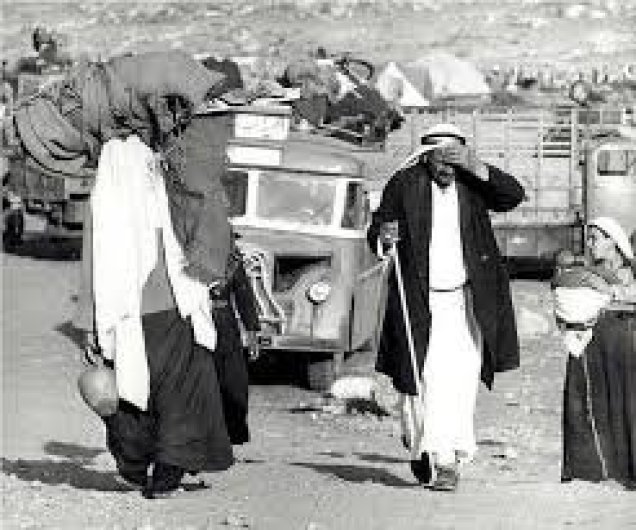
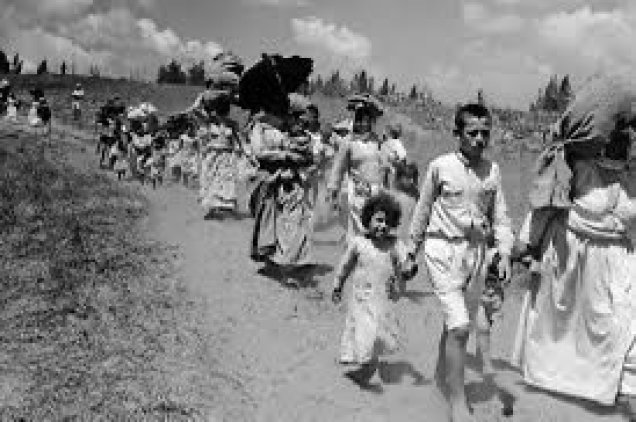
The Naksa unleashed a new wave of expulsion. According to Palestinian statistics about 300,000 Palestinians were displaced from the West Bank and Gaza, most of them to Jordan; Al Jazeera Net estimates the Palestinian displaced at 300,000–400,000 and speaks of nearly half a million Arabs forced from their homes in the West Bank, Gaza, the Golan and the Suez Canal cities. [3][2][1]
In a report to the UN Secretary-General on 13 June 1967, three days after the fighting stopped, the UNRWA Commissioner-General provisionally estimated that some 100,000 people had crossed from the West Bank to the east bank, perhaps 80,000 of them refugees since 1948; that the Jericho camps were almost empty after perhaps 45,000 had fled; and that 50,000 had moved into southern Syria. [10]
Families crossed the Jordan River over shattered bridges and fords, carrying whatever they could, and sheltered in schools, mosques and tents until new emergency camps were set up for them.
Refugees twice over
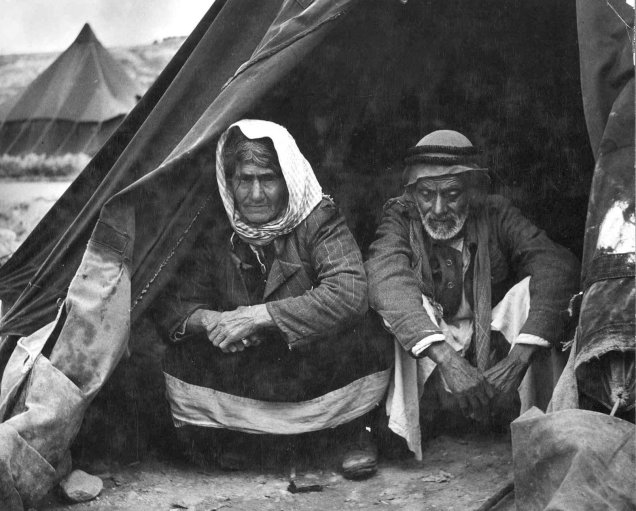
The cruellest aspect of the Naksa was that it uprooted again those uprooted in the Nakba. A family driven from a village near Jaffa, Lydda or Ramla in 1948, which had rebuilt its life in one of the Jericho camps, found itself crossing the river once more in June 1967. That is why Palestinians see the Nakba and the Naksa not as separate events but as two chapters of a single, continuing crime of uprooting. [10]
Security Council Resolution 237
On 14 June 1967 the Security Council unanimously adopted Resolution 237, calling on the Israeli government to ensure the safety, welfare and security of the inhabitants of the areas where military operations had taken place and to facilitate the return of those inhabitants who had fled the areas since the outbreak of hostilities. The resolution was never implemented, and the displaced of 1967 joined the Nakba refugees still waiting to return. [11]
The annexation and expansion of Jerusalem
On 28 June 1967, two and a half weeks into the occupation, the occupation authorities expanded the boundaries of the Jerusalem municipality from 6.5 to 70.5 square kilometres, annexing the lands of 28 Palestinian villages while excluding their populated areas – taking the land and leaving the people outside. The “Absentee Property” law was applied to the property of anyone absent during the census the occupation conducted in 1967. [12]
On 4 July 1967 the UN General Assembly, in Resolution 2253, called on Israel to rescind the measures it had taken to alter the status of Jerusalem; when Israel did not comply, it adopted Resolution 2254 on 14 July, deploring the failure to implement the earlier resolution and repeating its demand. The Security Council then declared, in Resolution 252 of 21 May 1968, that all the occupation’s measures aimed at changing the status of Jerusalem were invalid. [13][14]
The start of settlement and the Allon Plan
The occupation did not wait long. On 15 July 1967 the first settlement in the occupied Golan, Merom Golan, was established. In the same month minister Yigal Allon drew up a plan for the West Bank: annexing a strip 10 to 15 kilometres wide along the Jordan Valley from Beisan to the north of the Dead Sea, with as few Arab inhabitants as possible, a strip north of the Jerusalem–Dead Sea road, and the Hebron desert or hills, with permanent settlements and military bases and Jewish suburbs east of Jerusalem. [15][16]
The essence of the plan was to take the most land with the fewest Palestinians – the formula that has governed settlement ever since, from the Jordan Valley to the surroundings of Jerusalem and Hebron. [16]
Resolution 242 and the erasure of the Palestinian people
On 22 November 1967 the Security Council unanimously adopted Resolution 242, which emphasised “the inadmissibility of the acquisition of territory by war” and called for the withdrawal of Israeli armed forces from territories occupied in the recent conflict. The difference between “territories” in the English text and “the territories” in the French text became a loophole the occupation clung to in refusing full withdrawal; the British text was drafted by Lord Caradon. [17][18]
The Palestinian people appeared in the resolution only in the phrase “a just settlement of the refugee problem,” with no mention of their right to self-determination or to their land. That is why the Palestinian national movement rejected it: it reduced the cause of a people uprooted from its homeland to a humanitarian issue between states. [18]
The Khartoum summit
Arab leaders met in Khartoum from 29 August to 1 September 1967 and adopted the principle of “no peace, no negotiation and no recognition of Israel,” known as the Three No’s; they affirmed the Palestinian people’s right to their homeland, and the oil states pledged financial support to Egypt and Jordan until the effects of the aggression were removed. [19]
Out of the defeat
The six days of June shattered the hope that Palestine would be liberated by regular armies alone. Thousands of young Palestinians flocked to the ranks of the fedayeen, Palestinians took their cause into their own hands, and the resistance moved from the margins to the centre of the stage.
An occupation that never ended
What many thought would be a temporary military occupation became a permanent system of control: military orders governing land, water, movement and detention; confiscation in the name of “state land,” “absentee property” and “military zones”; and relentless settlement. In 1981 the occupation imposed its laws on the occupied Syrian Golan, and the Security Council, in Resolution 497, declared that decision “null and void and without international legal effect.” [20]
In 2005 the occupation pulled its settlements out of the Gaza Strip but kept it besieged and occupied; today it is waging a war of genocide on it, while expulsion and settlement continue in the West Bank and Jerusalem – as though June 1967 had never left Palestine. [3]
Between the accounts
Numbers displaced: estimates vary with the period and the categories counted. UNRWA’s report of 13 June 1967 spoke provisionally of 100,000 who had crossed the river and 45,000 from the Jericho camps; Jordan spoke on 22 June of 150,000; Palestinian statistics give 300,000; Al Jazeera Net gives 300,000–400,000 Palestinians and about half a million Arabs across all fronts. The earliest figures were gathered while the expulsions were still under way. [10][9][3][2][1]
The Moroccan Quarter eviction deadline: two hours by one account, fifteen minutes by another. [4]
Invalidity of the Jerusalem measures: Resolution 2253 is sometimes said to have declared the measures “invalid”; in fact it called for their rescission, and the explicit declaration of invalidity came in Security Council Resolution 252 of 1968. [13][14]
Aircraft losses: the figure of 416 Arab aircraft destroyed comes from Israel itself. [1]
Timeline
| Date | Event |
|---|---|
| 13 November 1966 | The assault on al-Samu, south of Hebron [6] |
| Mid-May 1967 | Egypt asks for the withdrawal of the UN Emergency Force [2] |
| 22 May 1967 | Closure of the Straits of Tiran [2] |
| 30 May 1967 | Jordan–Egypt joint defence agreement [7] |
| 5 June 1967 | Air strike on Egyptian airfields and start of the assault on three fronts [2] |
| 6 June 1967 | Expulsion of the people of Imwas, Yalu and Beit Nuba [5] |
| 7 June 1967 | Fall of East Jerusalem and occupation of Qalqilya [2] |
| 10 June 1967 | Fighting stops; demolition of the Moroccan Quarter begins that evening [4] |
| 14 June 1967 | Security Council Resolution 237 [11] |
| 28 June 1967 | Expansion and annexation of the Jerusalem municipality [12] |
| 4 and 14 July 1967 | General Assembly Resolutions 2253 and 2254 on Jerusalem [13] |
| 15 July 1967 | Establishment of the Merom Golan settlement [15] |
| 29 Aug – 1 Sep 1967 | The Khartoum summit and the Three No’s [19] |
| 22 November 1967 | Security Council Resolution 242 [17] |
| 21 May 1968 | Security Council Resolution 252 declares the Jerusalem measures invalid [14] |
Frequently asked questions about the Naksa
What is the Naksa?
It is the assault launched by the Israeli occupation on 5 June 1967 against Egypt, Jordan and Syria, in which it occupied the West Bank, East Jerusalem, the Gaza Strip, Sinai and the Golan in six days. [1]
Why is it said the occupation took the remaining 22 per cent of Palestine?
Because the West Bank and Gaza were all that remained of Palestine outside occupation after 1948, together about 22 per cent of historic Palestine; with their occupation, all of Palestine fell under occupation. [2]
How many Palestinians were displaced in the Naksa?
About 300,000 according to Palestinian statistics, and 300,000–400,000 by other estimates, many of them refugees since the Nakba. [3][2]
What happened to the Moroccan Quarter?
The occupation demolished it between the evenings of 10 and 11 June 1967, destroying about 135 homes and displacing some 650 residents, and built the Buraq Wall plaza in its place. [4]
What became of Imwas, Yalu and Beit Nuba?
Some ten thousand inhabitants were expelled, the villages were completely destroyed and return was barred; a settlement and “Canada Park” were built on their land. [5]
Does Resolution 242 guarantee Palestinian rights?
No. It mentions Palestinians only in the phrase “a just settlement of the refugee problem” and does not recognise their right to self-determination, which is why the Palestinian national movement rejected it. [18]
Read also on Palestinuna
Sources and references
- Al Jazeera Net, “The June 1967 Naksa: a defeat the Arabs are still paying for,” 5 June 2022 (in Arabic).
- Al Jazeera Net, special file: “The 1967 Naksa: when Israel defeated the Arabs in six days” (in Arabic).
- Arabi Post, “From the 1967 Naksa to the war on Gaza: 57 years of genocide and displacement,” 5 June 2024 (in Arabic).
- Thomas Abowd, “The Moroccan Quarter: A History of the Present,” Institute for Palestine Studies (Arabic edition).
- Al-Haq, “The Ghost of the Latroun Area,” 13 June 2013.
- Al Jazeera Encyclopedia, “The Battle of al-Samu: five hours that paved the way for the 1967 war” (in Arabic).
- Manshurat archive, UAR Presidential Decree No. 1335 of 1967 approving the joint defence agreement with Jordan signed in Cairo on 30 May 1967 (in Arabic).
- Arabi Post, “Founded by Saladin and destroyed by the Israeli occupation: the Moroccan Quarter of Jerusalem,” 9 October 2023 (in Arabic).
- Letter from the Permanent Representative of Jordan to the UN Secretary-General, UN document S/8004, 22 June 1967.
- Report of the UNRWA Commissioner-General to the UN Secretary-General, UN document S/8001, 13 June 1967.
- UN Security Council Resolution 237 (1967), 14 June 1967.
- Khalil Tafakji, “The Jerusalem municipality expands its borders through expulsion,” Al Jazeera Net, 3 April 2016 (in Arabic).
- UN General Assembly Resolution 2254 (ES-V), 14 July 1967.
- PalQuest (Institute for Palestine Studies), text of UN Security Council Resolution 252, 21 May 1968 (in Arabic).
- Institute for Palestine Studies, document on the establishment of the Merom Golan settlement in the occupied Golan, 15 July 1967.
- Institute for Palestine Studies, “The Yigal Allon Plan,” July 1967 (Arabic text of the document).
- PalQuest (Institute for Palestine Studies), text of UN Security Council Resolution 242, 22 November 1967 (in Arabic).
- Al Jazeera Encyclopedia, “Resolution 242” (in Arabic).
- Al Jazeera Encyclopedia, “The 1967 Khartoum Conference: the summit of the three no’s” (in Arabic).
- PalQuest (Institute for Palestine Studies), text of UN Security Council Resolution 497, 17 December 1981 (in Arabic).
Photo gallery
More from the archive


 Download Our Palestine App
The whole archive in the palm of your hand: depopulated villages, the Nakba, the massacres and Al-Aqsa — free, with no ads to erase the story.



Comments
No comments yet — be the first to write one.
Add your comment
Name and email are optional. Comments appear after review.