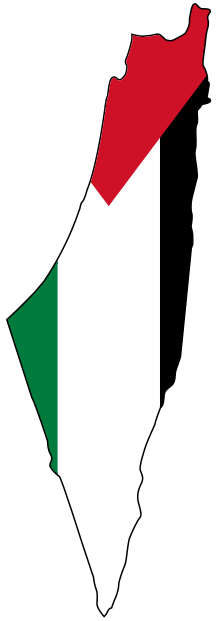
The 1967 Occupation of Palestine: When Israel Occupied the Remaining 22% of Historic Palestine
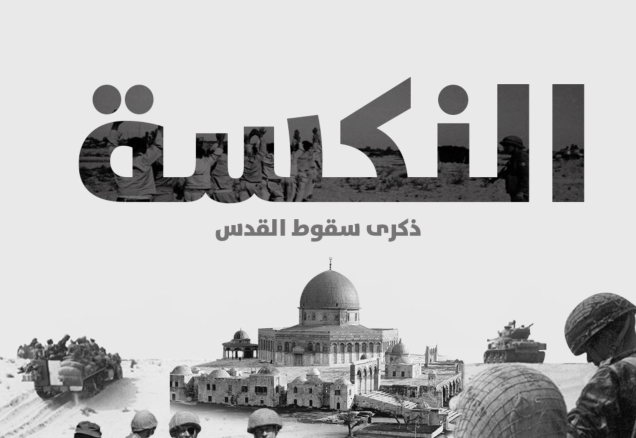
The 1967 Occupation of Palestine: When Israel Occupied the Remaining 22% of Historic Palestine
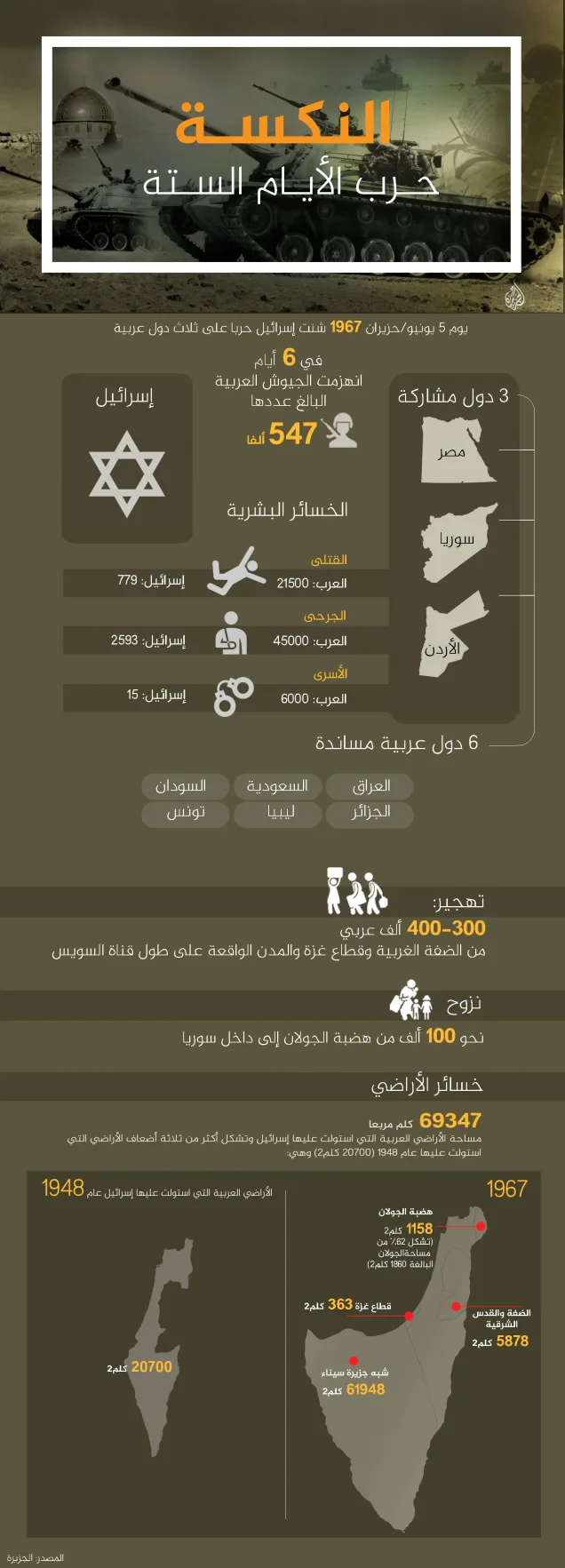
On June 5, 1967, Israel launched a major military offensive against Egypt and soon entered direct fighting with Jordan and Syria. Within six days, Israeli forces had occupied the West Bank, including East Jerusalem, and the Gaza Strip—the approximately 22 percent of Mandatory Palestine that had remained outside Israeli control after the Nakba of 1948.
Israel also occupied Egypt's Sinai Peninsula and Syria's Golan Heights.
For Palestinians, June 1967 marked another decisive stage in the dispossession of their homeland.
In 1948, Israel had emerged controlling approximately 78 percent of Mandatory Palestine. The West Bank, including East Jerusalem, remained under Jordanian rule, while the Gaza Strip was administered by Egypt.
In June 1967, Israel occupied those remaining Palestinian territories.
From that moment, for the first time since the end of the British Mandate, Israel exercised military control over virtually all of historic Palestine west of the Jordan River.
From the Nakba to the 1967 Occupation
The occupation of 1967 came less than two decades after the Nakba of 1948.
The Nakba had transformed Palestinian society through mass displacement, destruction of towns and villages, and the creation of a refugee population numbering approximately three-quarters of a million people.
The territory of Palestine was then divided.
Israel controlled approximately 78 percent of the country.
The West Bank, including East Jerusalem, came under Jordanian rule, while the Gaza Strip was administered by Egypt.
Hundreds of thousands of Palestinian refugees displaced in 1948 were living in these two territories.
When Israel occupied them in 1967, many Palestinian families were uprooted for a second time.
The Road to June 1967
The occupation followed a period of rapidly escalating regional confrontation.
Palestinian armed organizations had begun increasing operations against Israel during the mid-1960s, while Israel continued carrying out cross-border military reprisals against Palestinian communities and Arab states.
In November 1966, Israeli forces launched a major attack on the Palestinian town of al-Samu in the Jordanian-controlled West Bank, demolishing more than one hundred homes and other buildings.
Tensions between Israel and Syria also intensified along their frontier.
On April 7, 1967, a major confrontation between Israel and Syria involved artillery, tanks, and aircraft.
The regional crisis deepened in May after the Soviet Union transmitted reports of an Israeli military concentration threatening Syria. Those reports were subsequently shown to be inaccurate.
Egypt and Syria had already concluded a mutual-defense agreement, and Egyptian President Gamal Abdel Nasser responded by moving Egyptian forces into the Sinai Peninsula.
The Withdrawal of the United Nations Emergency Force
On May 16, 1967, Egypt requested the withdrawal of the United Nations Emergency Force, which had been stationed on Egyptian territory and in Gaza following the 1956 Tripartite Aggression.
UN Secretary-General U Thant agreed to the request, and the international force began withdrawing.
Several days later, Egypt announced restrictions on Israeli shipping through the Straits of Tiran.
Israel regarded the closure as a major strategic threat.
Military mobilization accelerated across the region.
On May 30, Jordan entered a defense agreement with Egypt, while Iraqi troops began arriving in Jordan.
By early June, Egypt, Jordan, Syria, and Israel had mobilized significant forces.
June 5: Israel Launches Its Offensive
On the morning of June 5, 1967, Israel launched a surprise air offensive against Egyptian military airfields.
Israeli aircraft flew at low altitude toward Egyptian bases and struck aircraft, runways, command facilities, and military installations.
More than 300 Egyptian aircraft were destroyed or disabled, most while still on the ground.
The destruction of Egyptian air power during the opening hours gave Israel decisive air superiority.
Israeli aircraft subsequently attacked Jordanian, Syrian, and Iraqi air bases.
The Occupation of Sinai and Gaza
Israeli ground forces simultaneously advanced against Egyptian positions in the Sinai Peninsula and the Gaza Strip.
Egyptian forces initially maintained extensive defensive positions, but the loss of air cover, command failures, contradictory orders, and rapid Israeli armored advances contributed to the collapse of Egyptian defenses.
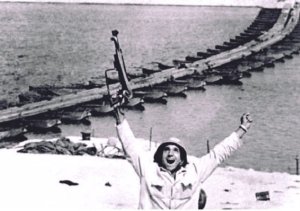
Israeli troops occupied the Gaza Strip and advanced across Sinai until they reached the eastern bank of the Suez Canal.
For Palestinians in Gaza, Israeli occupation returned only a decade after the Israeli military had temporarily occupied the Strip during the 1956 Tripartite Aggression.
The Occupation of the West Bank
Fighting also spread along the Jordanian front on June 5.
Jordanian artillery fired toward Israeli-controlled areas, while clashes developed around Jerusalem and elsewhere along the former armistice line.
Israel responded with major ground and air operations against Jordanian positions.
Israeli forces advanced into the West Bank from several directions.
Major confrontations occurred around Jerusalem, Latrun, Jenin, Qalqilya, and other areas.
Jordanian defenses gradually collapsed, and Israeli forces occupied city after city across the West Bank.
The Occupation of East Jerusalem
Jerusalem was among the most politically and symbolically important objectives.
Since 1948, the city had been divided: West Jerusalem was under Israeli control, while East Jerusalem, including the Old City, remained under Jordanian rule.
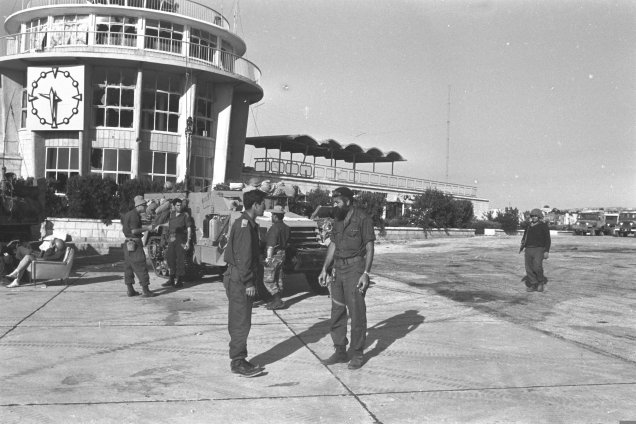
On June 7, 1967, Israeli forces occupied East Jerusalem and entered the Old City.
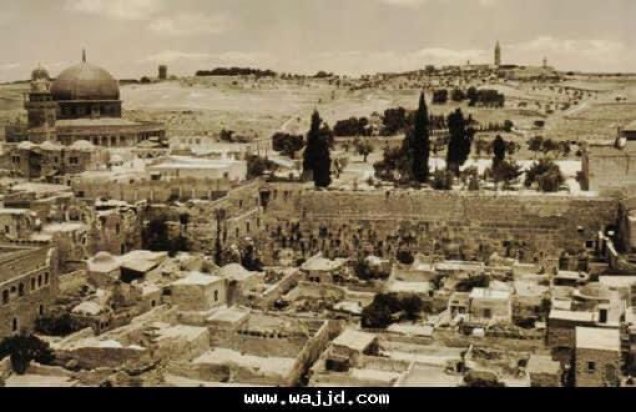
Israeli control now extended over major Muslim, Christian, and Jewish holy sites, including al-Haram al-Sharif, the Church of the Holy Sepulchre, and the Western Wall.
For Palestinians, the occupation of East Jerusalem was one of the most profound consequences of June 1967.
The Destruction of the Moroccan Quarter
Physical transformation of the occupied city began almost immediately.
During the night of June 10–11, 1967, Israeli authorities demolished the historic Maghrebi, or Moroccan, Quarter beside the Western Wall.
Palestinian residents were ordered to leave their homes, and more than one hundred buildings were subsequently demolished.
The demolition created the large Western Wall plaza that exists today.
The destruction of the quarter became one of the earliest examples of the physical restructuring of occupied East Jerusalem.
The Entire West Bank Comes Under Israeli Occupation
Israeli forces continued advancing after the occupation of East Jerusalem.
Ramallah, Bethlehem, Hebron, Nablus, Jericho, Jenin, and other Palestinian cities and towns came under Israeli military control.
Jordanian forces withdrew east of the Jordan River.
Within days, the entire West Bank was occupied.
The Palestinian population that had remained outside Israeli control after 1948 was now subject to Israeli military rule.
The Destruction of Imwas, Yalu, and Beit Nuba
The occupation was accompanied by renewed Palestinian displacement.
Israeli forces expelled the inhabitants of three Palestinian villages in the Latrun area: Imwas, Yalu, and Beit Nuba.
Thousands of residents were displaced.
The villages were subsequently demolished.
United Nations investigations later documented the destruction and confirmed that the displaced residents were not permitted to return.
Their lands were later incorporated into Israeli-controlled areas, and the three Palestinian communities were never reestablished.
Qalqilya and Other Palestinian Communities
Qalqilya also suffered extensive destruction during and immediately after the occupation.
Much of its population fled during the fighting.
United Nations observers documented widespread demolition of houses, including destruction that continued after active fighting had subsided.
Unlike the inhabitants of the three Latrun villages, however, residents of Qalqilya were later permitted to return, and reconstruction began.
The Occupation of the Golan Heights
After Israeli forces had largely completed their operations against Egypt and Jordan, they turned toward Syria.
On June 9, Israeli forces attacked Syrian positions in the Golan Heights.
Syrian defenses collapsed, and Israeli troops advanced across large areas of the plateau.
By June 10, Israel had occupied much of the Syrian Golan Heights.
Most of the Syrian civilian population of the occupied area was displaced during and after the fighting.
The Territories Occupied in June 1967
By the time military operations ended on June 10, Israel had occupied:
- The West Bank, including East Jerusalem, previously under Jordanian rule.
- The Gaza Strip, previously under Egyptian administration.
- The Sinai Peninsula, belonging to Egypt.
- The Golan Heights, belonging to Syria.
For Palestine, this meant that the remaining approximately 22 percent of Mandatory Palestine that had not come under Israeli control in 1948 was now also occupied.
The Second Major Palestinian Displacement
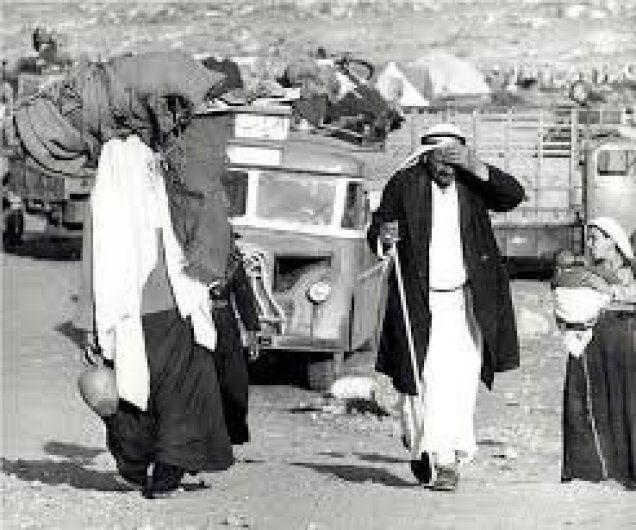
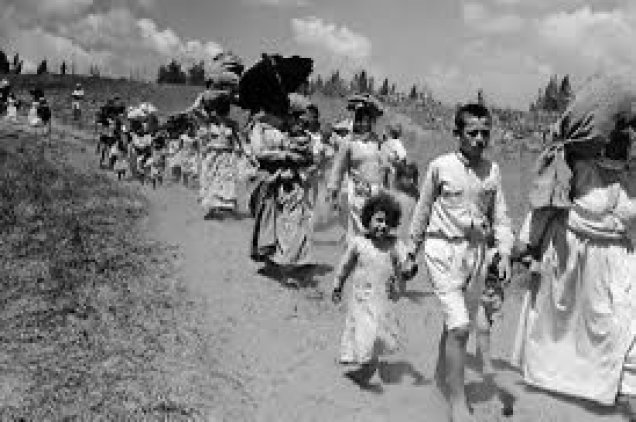
Israeli occupation in 1967 produced a new mass displacement of Palestinians.
Approximately 300,000 Palestinians were displaced during and immediately after the June events, although estimates differ according to the time period and categories counted.
Many crossed the Jordan River into Jordan.
UNRWA reported that approximately 200,000 people crossed from the West Bank to the East Bank during June, July, and August 1967.
Around half of them were Palestinians already registered with UNRWA as refugees from the 1948 Nakba.
These Palestinians therefore experienced displacement twice within less than twenty years.
They had first been driven or had fled from their original towns and villages in 1948, only to be uprooted again from the West Bank in 1967.
The Exodus from Jericho and the Jordan Valley
The Jordan Valley suffered especially extensive displacement.
UNRWA estimated that approximately 65,000 people left the Jericho area during the immediate aftermath of the occupation.
Refugee camps created after the Nakba were dramatically depopulated.
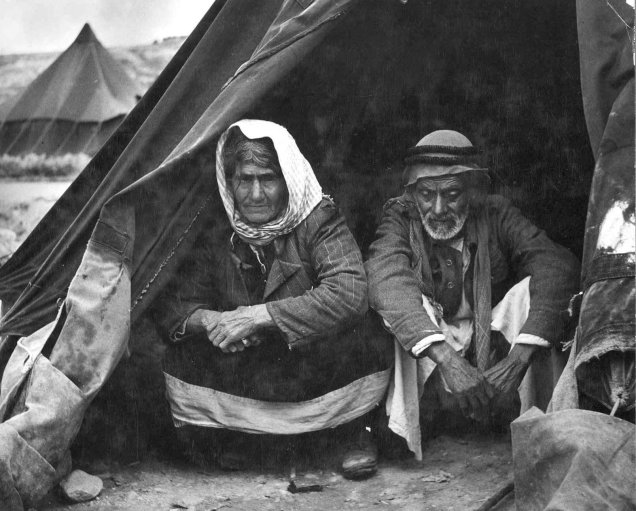
Palestinian families crossed bridges and temporary routes over the Jordan River carrying whatever belongings they could take with them.
Many initially lived in schools, mosques, temporary shelters, tents, or with relatives in Jordan.
UNRWA subsequently established emergency camps for Palestinians displaced in 1967.
Refugees Becoming Refugees Again
One of the most painful characteristics of the 1967 occupation was the repeated displacement of Palestinians already uprooted during the Nakba.
A family expelled from a village near Jaffa, Ramla, Lydda, or Jerusalem in 1948 might have rebuilt its life in a refugee camp near Jericho or elsewhere in the West Bank.
In June 1967, that same family could be forced to flee across the Jordan River.
The Nakba and the 1967 occupation consequently became interconnected experiences rather than separate episodes in Palestinian collective memory.
The Israeli Census and the Question of Residency
Following the occupation, Israeli authorities conducted a census of Palestinians in the West Bank, East Jerusalem, and Gaza Strip.
The census had consequences that lasted for decades.
Palestinians physically present during registration could be recorded in the new Israeli-controlled population registry.
Those who had fled during the fighting or happened to be outside the occupied territories when the census was taken often faced severe obstacles to returning and obtaining recognized residency.
The distinction between those counted and those absent became one of the mechanisms through which the occupation reshaped the Palestinian population.
Security Council Resolution 237
The scale of displacement quickly reached the United Nations.
On June 14, 1967, the Security Council unanimously adopted Resolution 237.
The resolution called upon Israel to ensure the safety and welfare of inhabitants in areas where military operations had taken place.
It also called upon Israel to facilitate the return of those inhabitants who had fled since the outbreak of hostilities.
The Palestinian displacement of 1967 therefore became an international issue alongside the unresolved refugee crisis created by the Nakba.
East Jerusalem: From Military Occupation to De Facto Annexation
Israel treated occupied East Jerusalem differently from most of the West Bank.
On June 27, 1967, the Israeli legislature amended domestic law to permit the government to extend Israeli “law, jurisdiction and administration” to territory designated by government order.
On June 28, Israel applied these measures to occupied East Jerusalem and a much larger surrounding area taken from the West Bank.
Israel also expanded the boundaries of its Jerusalem municipality to include approximately 70 square kilometers of occupied territory.
This included the Old City as well as numerous Palestinian neighborhoods and surrounding lands.
Internationally, these measures have been treated as a de facto annexation of occupied East Jerusalem.
The United Nations Rejects Israel's Measures in Jerusalem
The international response followed rapidly.
On July 4, 1967, the United Nations General Assembly adopted Resolution 2253.
It considered the measures taken by Israel to change the status of Jerusalem invalid and called upon Israel to rescind them.
When Israel failed to comply, the General Assembly adopted Resolution 2254 on July 14, once again demanding that the measures be reversed.
Subsequent United Nations resolutions continued to reject Israeli attempts to alter the legal and demographic status of occupied East Jerusalem.
The Beginning of Israeli Settlement in the Occupied Territories
Israeli settlement began almost immediately after the occupation.
The first Israeli settlement established in territory occupied in June 1967 appeared in the occupied Syrian Golan Heights in July 1967.
In the occupied West Bank, Israeli settlement began at Kfar Etzion in September 1967.
Settlement activity subsequently expanded across the Jordan Valley, East Jerusalem, the Hebron area, the Golan Heights, and later other occupied areas.
From a Palestinian historical perspective, settlement construction marked the beginning of a new stage of colonization in the territories occupied in 1967.
The United Nations and most of the international community have consistently maintained that Israeli civilian settlements in occupied Palestinian territory violate international humanitarian law.
The Allon Plan
Only weeks after the occupation, Israeli minister Yigal Allon developed a proposal for the long-term territorial future of the West Bank.
The plan envisaged permanent Israeli control over strategically important areas—particularly much of the Jordan Valley—while avoiding direct annexation of some densely populated Palestinian areas.
Although the Allon Plan was never formally adopted as the sole official government policy, aspects of its territorial logic influenced early Israeli settlement and security planning.
Security Council Resolution 242
On November 22, 1967, the United Nations Security Council unanimously adopted Resolution 242.
The resolution emphasized the inadmissibility of the acquisition of territory by war.
It called for Israeli withdrawal from territories occupied in the recent conflict and for recognition of the sovereignty, territorial integrity, and political independence of states in the region.
The precise wording of the withdrawal provision later became the subject of extensive diplomatic disagreement.
Nevertheless, Resolution 242 became one of the principal international frameworks for negotiations concerning the territories Israel occupied in 1967.
The Palestinian Question Reduced to a Refugee Issue
From a Palestinian perspective, Resolution 242 contained a fundamental limitation.
Palestinians were not recognized in the resolution as a people with explicit national and political rights.
The only direct reference relevant to them called for a “just settlement of the refugee problem.”
This language reduced the Palestinian national question primarily to a humanitarian refugee issue rather than recognizing Palestinian self-determination.
Palestinian political movements increasingly rejected this framework.
The Rise of Independent Palestinian Resistance
The occupation of 1967 profoundly reshaped Palestinian politics.
Before June 1967, the Palestine question had often been managed through the policies and military strategies of neighboring Arab governments.
The defeat of the Arab armies severely damaged confidence in the idea that Palestinians could recover their rights through conventional Arab military power alone.
Palestinian organizations, particularly Fatah, rapidly increased their political and popular influence.
During the following years, these organizations assumed increasing control of the Palestine Liberation Organization and emphasized independent Palestinian political and military action.
The Khartoum Summit
Arab governments met in Khartoum between August 29 and September 1, 1967, to consider the consequences of the Israeli occupation.
The summit became associated with what were later called the “Three Noes”: no peace with Israel, no recognition of Israel, and no negotiations with Israel at that stage.
Arab governments also began rebuilding their armed forces and developing different approaches to recovering the territories occupied in June.
Occupation Becomes a Permanent System
What initially appeared to many Palestinians and international observers as a temporary military occupation gradually developed into a far-reaching system of control.
Israeli military orders began regulating almost every aspect of Palestinian life in the West Bank and Gaza Strip.
They affected land, property, water, movement, political activity, arrests, publications, economic life, and local administration.
Israeli authorities assumed control over large areas categorized as state land, abandoned property, military zones, or land required for other purposes.
Settlement construction expanded at the same time.
Palestinians who had expected military rule to end after a diplomatic settlement instead found themselves living under an occupation that continued from one generation to another.
The Occupied Arab Territories Follow Different Paths
The territories Israel occupied in June 1967 subsequently experienced different political outcomes.
Egypt recovered the Sinai Peninsula following the Egyptian-Israeli peace treaty and Israel's final withdrawal in 1982.
Israel extended its domestic law to the occupied Golan Heights in 1981, an action that most of the international community did not recognize as transferring sovereignty.
The West Bank, including East Jerusalem, and the Gaza Strip remained at the center of the Palestinian struggle against Israeli occupation.
Israel removed its permanent settlers and military installations from inside the Gaza Strip in 2005, while maintaining extensive control over Gaza's borders, airspace, maritime access, population registry, and other key aspects of life. The United Nations continues to treat Gaza as part of the occupied Palestinian territory.
Why Palestinians Call 1967 the Naksa
Palestinians and Arabs commonly remember June 1967 as al-Naksa—the Setback.
Yet for Palestinians, what occurred went far beyond military defeat.
In 1948, most of Palestine had come under Israeli control and hundreds of thousands of Palestinians had been displaced.
In 1967, Israel occupied what remained of Palestinian territory: the West Bank, including East Jerusalem, and the Gaza Strip.
Another large Palestinian population was displaced.
Palestinian villages were destroyed.
East Jerusalem was subjected to Israeli annexation measures.
Israeli settlements began to appear across the newly occupied territories.
For Palestinians, June 1967 therefore represents not simply a regional military setback but the occupation of the rest of their homeland.
The Remaining 22 Percent of Palestine
After the Nakba, the West Bank and Gaza Strip represented approximately 22 percent of Mandatory Palestine.
These territories were all that remained of Palestine outside Israeli control after 1948.
In June 1967, Israel occupied them as well.
Over subsequent decades, this same 22 percent became the territorial basis of the dominant international proposal for the establishment of an independent Palestinian state alongside Israel.
From a Palestinian historical perspective, this reveals the enormous contraction of Palestinian territorial aspirations after successive stages of dispossession: from the whole of Palestine to a proposed state in less than one-quarter of the homeland.
The Historical Legacy of the 1967 Occupation
The military campaign lasted only six days.
The occupation it created reshaped Palestinian life for generations.
It brought the West Bank, East Jerusalem, and Gaza Strip under Israeli military control.
It displaced approximately 300,000 Palestinians.
It destroyed Palestinian villages and displaced communities.
It initiated Israeli settlement in the territories occupied in 1967.
It transformed Jerusalem.
It created a new system of military rule over millions of Palestinians and contributed to the rise of an increasingly independent Palestinian national movement.
For Palestinians, 1967 therefore stands alongside 1948 as one of the decisive turning points of modern history.
The Nakba brought the loss of most of Palestine.
The 1967 occupation brought Israeli military control over what remained.
The military offensive ended on June 10, 1967.
The occupation of Palestinian territory did not.
Photo gallery
More from the archive


 Download Our Palestine App
The whole archive in the palm of your hand: depopulated villages, the Nakba, the massacres and Al-Aqsa — free, with no ads to erase the story.
Download Our Palestine App
The whole archive in the palm of your hand: depopulated villages, the Nakba, the massacres and Al-Aqsa — free, with no ads to erase the story.

Comments
No comments yet — be the first to write one.
Add your comment
Name and email are optional. Comments appear after review.