The Madrid Peace Conference, 1991
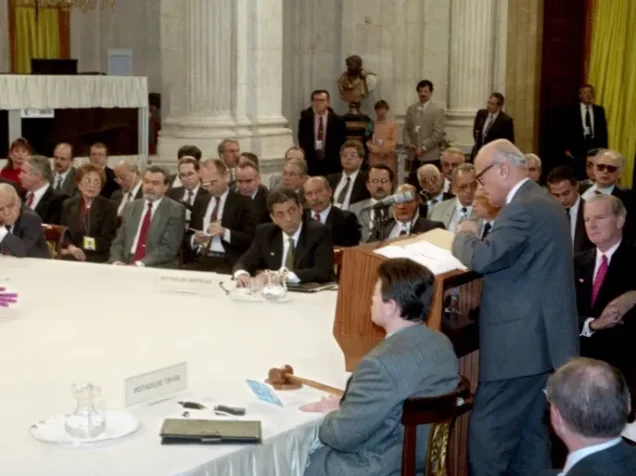
The Madrid Peace Conference, convened in the Spanish capital on October 30, 1991, marked a major turning point in the diplomatic history of the Arab-Israeli conflict and the Palestine question.
Its formal opening sessions took place from October 30 to November 1, 1991 under the joint sponsorship of the United States and the Soviet Union, at a moment of profound international change as the Cold War approached its end and the regional order was being reshaped after the Gulf War.
Madrid was not itself a final peace settlement and had no authority to impose an agreement on the participants. Its purpose was to launch direct negotiations between Israel and Arab parties on one track and between Israel and the Palestinians on another, on the basis of United Nations Security Council Resolutions 242 and 338.
The Political Background
The conference emerged from a rapidly changing regional and international environment.
By 1991, the Cold War was drawing to a close and the Soviet Union was in its final months, while the United States had emerged from the Gulf War with significantly increased diplomatic influence in the Middle East.
At the same time, the First Palestinian Intifada, which began in 1987, had returned the Palestine question to the center of international attention and demonstrated that Israel's continued occupation of the West Bank, including East Jerusalem, and the Gaza Strip could not be treated as a politically stable status quo.
The Palestine Liberation Organization had also proclaimed the State of Palestine in 1988 and adopted a political program accepting Security Council Resolutions 242 and 338 as a basis for an international peace process.
The Gulf crisis of 1990–1991, however, weakened the PLO's regional diplomatic position and gave Washington an opportunity to pursue a negotiating formula in which Palestinians could participate under conditions acceptable to the Israeli government.
James Baker's Shuttle Diplomacy
U.S. Secretary of State James Baker played the central role in preparing the conference.
Between March and October 1991, Baker conducted repeated diplomatic missions throughout the region, meeting Israeli and Arab leaders as well as Palestinian representatives from the occupied territories.
One of the most difficult issues was Palestinian representation.
The Israeli government opposed formal PLO participation and objected to representatives from East Jerusalem or the Palestinian diaspora joining the official Palestinian team.
A compromise was eventually reached under which Palestinians would participate as part of a joint Jordanian-Palestinian delegation, with the formal Palestinian members drawn from the West Bank and Gaza Strip and without official PLO status.
The U.S.–Soviet Invitation
On October 18, 1991, the United States and Soviet Union issued the invitation that established the framework for the conference.
It described the objective as a just, lasting, and comprehensive peace settlement achieved through direct negotiations on two tracks: between Israel and the Arab states, and between Israel and the Palestinians.
Those negotiations were to be based on Security Council Resolutions 242 and 338.
The sponsors made clear that the conference itself could not impose solutions, veto agreements, or decide questions on behalf of the parties.
The substantive negotiations were to take place directly between those involved.
Who Participated?
Israel was represented by a delegation headed by Prime Minister Yitzhak Shamir.
Syria was represented by Foreign Minister Farouk al-Sharaa, Lebanon by Foreign Minister Fares Boueiz, and Jordan by Foreign Minister Kamel Abu Jaber.
The Palestinian component of the joint Jordanian-Palestinian delegation was headed by Gaza physician and political figure Haidar Abd al-Shafi.
Egypt participated through Foreign Minister Amr Moussa. Having already concluded a peace treaty with Israel in 1979, Egypt did not enter a new bilateral territorial negotiating track comparable to those involving Syria, Lebanon, or the Palestinians.
The European Community also participated, while a representative of the United Nations Secretary-General attended as an observer.
The conference was jointly sponsored by U.S. President George H. W. Bush and Soviet President Mikhail Gorbachev.
The Palestinians and the Formal Exclusion of the PLO
The Palestine Liberation Organization did not participate in Madrid under its own name.
This arrangement reflected Israel's refusal to negotiate formally with the PLO and Washington's acceptance of a formula built around Palestinians from the occupied territories within a joint delegation with Jordan.
Palestinians from East Jerusalem and the diaspora were also excluded from formal membership in the initial Palestinian delegation.
Yet this did not mean that the Palestinian team was politically independent of the PLO.
The delegation maintained contact with the PLO leadership in Tunis, and it was widely understood that its members had been selected with the organization's approval and coordinated major political positions with it.
In this sense, the negotiations created a paradox: the PLO was formally absent, but its political influence over the Palestinian negotiating team remained substantial.
East Jerusalem and Palestinian Representation
East Jerusalem was one of the most sensitive issues during the preparations.
Israel opposed the inclusion of East Jerusalem Palestinians as formal delegates, while Palestinians insisted that East Jerusalem was part of the occupied Palestinian territory and that its status could not be excluded from final negotiations.
In a letter of assurances to the Palestinians, the United States stated that acceptance of the temporary delegation formula would not prejudice the Palestinian claim to East Jerusalem or determine the outcome of permanent-status negotiations.
Washington also reiterated that it did not recognize Israel's annexation of East Jerusalem.
Haidar Abd al-Shafi
Haidar Abd al-Shafi emerged as the most prominent Palestinian figure at Madrid.
A respected physician and political leader from Gaza, he headed the Palestinian component of the joint delegation and was accorded a status at the opening session comparable to the heads of the other principal delegations.
In his address, Abd al-Shafi emphasized an end to Israeli occupation, implementation of international resolutions, Palestinian self-determination, and the establishment of an independent Palestinian state with East Jerusalem as its capital.
He also placed Israeli settlement expansion at the center of the Palestinian critique of the peace process, arguing that negotiations could not be credible while facts on the ground continued to change.
George H. W. Bush's Vision
In the opening session, President George H. W. Bush presented the American vision of the process.
He argued that the objective should go beyond ending belligerency and should eventually include peace treaties, security arrangements, diplomatic relations, economic relations, trade, investment, and wider regional interaction.
Bush also emphasized that peace could not simply be imposed by outside powers and that substantive agreements would have to emerge through direct negotiation and compromise.
He described the diplomatic process as proceeding on two tracks: one between Israel and Arab states and another between Israel and the Palestinians, both grounded in Resolutions 242 and 338.
Mikhail Gorbachev and the End of the Cold War
Soviet President Mikhail Gorbachev portrayed Madrid as an opportunity to move beyond decades of confrontation toward a new regional order.
He emphasized that a successful peace process should not be understood as a victory by one side over another, but as a collective departure from the violent political past of the region.
The joint American-Soviet sponsorship itself reflected the transformation of international politics at the end of the Cold War.
Resolutions 242 and 338
The Madrid process was formally based on United Nations Security Council Resolutions 242 and 338.
Resolution 242 had been adopted after Israel's 1967 occupation of the West Bank, including East Jerusalem, the Gaza Strip, Egypt's Sinai Peninsula, and Syria's Golan Heights.
It linked Israeli withdrawal from occupied territory to the establishment of peaceful and secure relations in the region.
Resolution 338, adopted during the October 1973 confrontation, called for implementation of Resolution 242 and negotiations toward a just and durable peace.
The PLO's 1988 acceptance of these resolutions as part of its diplomatic program was one of the developments that helped make Palestinian participation in the Madrid process possible.
The Israeli-Palestinian Track
The Madrid invitation established a phased framework for Israeli-Palestinian negotiations.
The first stage was to address interim Palestinian self-government arrangements.
The sponsors aimed for agreement on those arrangements within one year, followed by a five-year transitional period.
Permanent-status negotiations were expected to begin by the third year of that transitional period.
The invitation did not determine the final political outcome in advance, leaving questions of statehood, sovereignty, Jerusalem, settlements, borders, refugees, and security for later negotiations.
Bilateral and Multilateral Negotiations
Madrid launched two broader forms of negotiation.
The bilateral track included Israeli-Palestinian, Israeli-Jordanian, Israeli-Syrian, and Israeli-Lebanese negotiations.
A separate multilateral track addressed regional issues including water, refugees, arms control and regional security, economic development, and the environment.
The multilateral negotiations formally began in Moscow in January 1992.
The Palestinian Track Becomes Increasingly Independent
Although the Palestinians entered Madrid as part of a joint delegation with Jordan, their role rapidly became more distinct.
After the formal opening, the Israeli and joint Jordanian-Palestinian delegations agreed that negotiations would effectively proceed along separate Israeli-Palestinian and Israeli-Jordanian tracks.
By the third round of talks in January 1992, Palestinian negotiators were in practice conducting separate bilateral negotiations with the Israeli delegation.
The original joint formula therefore increasingly served as an initial diplomatic framework rather than a permanent limitation on Palestinian participation.
The Washington Negotiations
The bilateral talks moved from Madrid to Washington and continued for approximately twenty months.
Palestinian and Israeli delegations held repeated rounds without achieving a decisive breakthrough on the central political questions.
Disagreements persisted over the scope of Palestinian self-government, territorial jurisdiction, Israeli settlement activity, Jerusalem, withdrawal, sovereignty, and the future of the occupied Palestinian territories.
Abd al-Shafi repeatedly argued that continued Israeli settlement construction fundamentally undermined the credibility of negotiations.
Settlements as a Central Dispute
Israeli settlements in the occupied Palestinian territories became one of the most serious points of disagreement during the Madrid-Washington process.
Palestinian negotiators demanded a halt to settlement expansion, arguing that Israel was changing the territorial reality while negotiations over that territory were still under way.
No agreement on a settlement freeze emerged from the Washington rounds.
Abd al-Shafi became particularly associated with the argument that meaningful negotiations could not proceed indefinitely while settlement construction continued.
The Limits of Madrid
Madrid did not produce an Israeli-Palestinian peace treaty or a final agreement on the occupied Palestinian territories.
Nor did the subsequent Washington rounds resolve the core permanent-status issues.
The conference nevertheless created a new framework for direct diplomacy.
Palestinian representatives from the occupied territories sat across from an Israeli delegation in an internationally sponsored negotiating process, and the Palestine question emerged as an identifiable negotiating track in its own right.
From Madrid to Oslo
By early 1993, the public negotiations in Washington had reached an impasse.
At the same time, a secret negotiating channel was developing in Norway between representatives of Israel and the Palestine Liberation Organization.
This channel bypassed one of the central restrictions of Madrid: Israel was now negotiating directly with the PLO that had formally been excluded from the conference.
The Oslo negotiations produced the Declaration of Principles signed in Washington on September 13, 1993.
Oslo was therefore not simply the product of the formal Madrid negotiations, but it emerged from the political and diplomatic environment that the Madrid process had helped create.
Haidar Abd al-Shafi and Oslo
Haidar Abd al-Shafi was not involved in the secret Oslo channel.
Like other members of the official Palestinian negotiating team, he was not initially informed of the secret talks.
He remained critical of continued settlement construction and of aspects of the arrangements that emerged from Oslo, and he declined to attend the Washington ceremony at which the Declaration of Principles was signed.
Madrid from a Palestinian Historical Perspective
Madrid contained a significant contradiction for the Palestinian national movement.
Palestinian representation was restricted, the PLO was formally excluded, and Palestinians from East Jerusalem and the diaspora were prevented from serving as formal delegates during the opening phase.
At the same time, the Palestinian delegation succeeded in presenting a distinct national position before an international audience and placed occupation, settlements, self-determination, and Palestinian statehood at the center of the political debate.
The subsequent negotiations also demonstrated the practical difficulty of excluding the PLO. Palestinian delegates remained politically connected to its leadership, and within less than two years Israel itself entered direct secret negotiations with the organization.
The Political Legacy of Madrid
The Madrid Conference did not end the Israeli occupation, create an independent Palestinian state, or resolve Jerusalem, refugees, settlements, borders, and sovereignty.
It did, however, change the diplomatic form of the conflict.
It brought Palestinian representatives into a direct international negotiating process, placed Resolutions 242 and 338 at the center of the Israeli-Palestinian diplomatic framework, and launched bilateral and multilateral tracks that continued during the following years.
It also gave Palestinian representatives, particularly Haidar Abd al-Shafi, an international platform from which to articulate demands for the end of occupation, Palestinian self-determination, and independent statehood.
From a Palestinian historical perspective, Madrid was neither independence nor a settlement of the Palestine question.
It was an important transitional moment between the political transformation generated by the First Intifada and the 1988 Palestinian diplomatic program, and the era of direct negotiations that would move from Madrid and Washington to the secret Oslo channel.
More from the archive


 Download Our Palestine App
The whole archive in the palm of your hand: depopulated villages, the Nakba, the massacres and Al-Aqsa — free, with no ads to erase the story.
Download Our Palestine App
The whole archive in the palm of your hand: depopulated villages, the Nakba, the massacres and Al-Aqsa — free, with no ads to erase the story.
Comments
No comments yet — be the first to write one.
Add your comment
Name and email are optional. Comments appear after review.