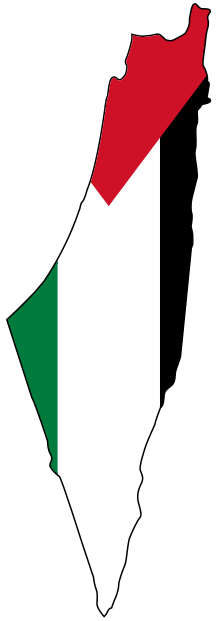
The Declaration of Principles on Interim Self-Government Arrangements – Oslo I, 1993

The First Oslo Accord: From Interim Self-Government to the Obstruction of the Political Process and the Continuation of the Occupation
On September 13, 1993, the Declaration of Principles on Interim Self-Government Arrangements, commonly known as the First Oslo Accord, was signed at the White House in Washington.
The agreement marked a fundamental transformation in Palestinian political history. The official relationship between the Palestine Liberation Organization and the Government of Israel shifted from estrangement and mutual non-recognition to recognition and direct negotiations, opening a new political phase presented as an interim period that was supposed to culminate in a permanent settlement.
Oslo, however, was not a final peace agreement. It did not establish an independent Palestinian state, did not recognize Palestinian sovereignty over the West Bank and Gaza Strip, did not define the borders of a Palestinian state, and did not resolve the issues of Jerusalem, refugees, settlements, or sovereignty.
Instead, it created a five-year interim framework based on the gradual transfer of powers to a Palestinian self-government authority, the redeployment of Israeli occupation forces, the holding of Palestinian elections, and then a transition to permanent-status negotiations that were supposed to address the core issues of the conflict.
The essence of the process was based on a clear sequence: a time-limited interim phase, followed by permanent-status negotiations, and then a final settlement.
But this sequence was never completed.
During the following years, some initial arrangements were implemented, while other redeployments were delayed or suspended. The two sides were repeatedly forced to sign new agreements in order to implement obligations that had already appeared in earlier agreements, while Israel continued building and expanding settlements on land whose future was supposed to be determined through negotiations.
The original interim period ultimately expired on May 4, 1999 without a permanent settlement and without resolving Jerusalem, the refugee question, settlements, borders, or sovereignty, while the occupation remained in place and arrangements that had been intended to be temporary continued.
From the Madrid Conference to Secret Negotiations
The Oslo Accord followed the diplomatic process that began with the Madrid Peace Conference on October 30, 1991.
Palestinians participated in Madrid as part of a joint Jordanian-Palestinian delegation, while the Palestine Liberation Organization did not participate officially as an independent delegation because the Israeli government at the time refused to negotiate directly with it.
After Madrid, bilateral negotiations moved to Washington, but they encountered deep disagreements over self-government, land, settlements, withdrawal, and the nature of the interim period.
As the public negotiating track stalled, informal contacts began during 1992 to explore the possibility of opening a secret channel between PLO representatives and Israeli figures.
Norway and the Birth of the Oslo Channel
Norway provided the venue, cover, and mediation necessary to establish the secret negotiating channel.
Norwegian diplomats Jan Egeland and Mona Juul helped prepare the channel, alongside Terje Rød-Larsen, who was associated with the Norwegian FAFO Institute.
FAFO’s activities and studies of Palestinian social and economic conditions helped provide an appropriate framework for the contacts.
After a series of preparatory contacts, the first actual secret negotiating meeting was held on January 20, 1993.
Not all meetings took place in the city of Oslo itself. Different locations in Norway hosted stages of the talks, but the name “Oslo” later became the name by which both the channel and the agreements it produced became known.
Who Participated in the Negotiations?
In the initial stage, the Israeli negotiators were not official government representatives but academics connected to Israeli Deputy Foreign Minister Yossi Beilin.
The most prominent were Yair Hirschfeld and Ron Pundak.
On the Palestinian side, one of the leading negotiators was Ahmed Qurei “Abu Ala”, a senior official in the Palestine Liberation Organization.
As the negotiations progressed, the channel gradually shifted from informal contacts to a process with direct political authorization.
Officials from the Israeli Foreign Ministry entered the talks, while the PLO leadership in Tunis, headed by Yasser Arafat, followed developments and provided political guidance to its delegation.
Seven Months of Secret Negotiations
The principal negotiations continued from January until August 1993.
Over roughly seven months, a series of drafts was prepared dealing with self-government, withdrawal from Gaza and Jericho, elections, security, economic cooperation, and the issues that would be postponed to permanent-status negotiations.
By late August 1993, the two sides had reached the formulation that became the Declaration of Principles on Interim Self-Government Arrangements.
September 9, 1993: Mutual Recognition
Four days before the signing of the Declaration of Principles, Yasser Arafat and Yitzhak Rabin exchanged letters of mutual recognition on September 9, 1993.
These letters were legally separate from the Declaration of Principles, but they formed the political basis of the new relationship between the two sides.
What Did the Palestine Liberation Organization Commit To?
Yasser Arafat, on behalf of the Palestine Liberation Organization, affirmed:
- The PLO’s recognition of the right of the State of Israel to exist in peace and security.
- Acceptance of United Nations Security Council Resolutions 242 and 338.
- Commitment to the negotiating process to resolve the remaining issues.
- Renunciation of terrorism and acts of violence.
- Recognition that provisions of the Palestinian National Charter inconsistent with these commitments were no longer operative, together with a commitment to formally amend them.
What Did Israel Recognize?
In return, Yitzhak Rabin announced that the Government of Israel had decided to recognize the Palestine Liberation Organization as:
“the representative of the Palestinian people.”
Israel also agreed to begin formal negotiations with the PLO within the framework of the peace process.
September 13, 1993: The White House Signing
On September 13, 1993, the official signing ceremony was held at the White House.
U.S. President Bill Clinton, Israeli Prime Minister Yitzhak Rabin, and PLO Executive Committee Chairman Yasser Arafat attended the ceremony.
The handshake between Arafat and Rabin in front of Clinton became one of the most famous images associated with the Oslo process.
The actual signatories to the Declaration of Principles were:
- Shimon Peres, Israeli Foreign Minister, for the Government of Israel.
- Mahmoud Abbas “Abu Mazen”, for the Palestine Liberation Organization.
The agreement was witnessed by U.S. Secretary of State Warren Christopher and Russian Foreign Minister Andrei Kozyrev.
What Was Oslo Supposed to Achieve?
Article I of the Declaration of Principles defined the objective of the negotiations as the establishment of a Palestinian Interim Self-Government Authority and an elected Palestinian Council for the Palestinians of the West Bank and Gaza Strip.
The interim period was supposed to last no more than five years and lead to a permanent settlement based on United Nations Security Council Resolutions 242 and 338.
When Did the Five-Year Period Begin?
The five-year period did not begin on the day the Declaration of Principles was signed.
Article V stated that the interim period would begin upon the withdrawal from the Gaza Strip and the Jericho area.
The interim period effectively began with the Gaza-Jericho Agreement and its implementation on May 4, 1994.
Accordingly, May 4, 1999 became the original date set for the end of the interim period.
The West Bank and Gaza Strip as a Single Territorial Unit
The Declaration of Principles contained an important provision stating that the West Bank and Gaza Strip should be viewed as a single territorial unit whose integrity was to be preserved during the interim period.
This principle carried political and legal significance because the agreement did not treat Gaza and the West Bank as two separate entities within the interim arrangement.
Gaza and Jericho First
The Declaration of Principles stipulated that implementation would begin with the withdrawal of Israeli occupation forces from the Gaza Strip and the Jericho area.
On May 4, 1994, the PLO and the Government of Israel signed the Gaza-Jericho Agreement in Cairo.
Israel subsequently began withdrawing from designated areas, and some civil and security powers were transferred to the Palestinian side.
These were the first practical steps in the interim system designed by Oslo.
The Establishment of the Palestinian Authority
The agreement of September 13, 1993 did not immediately create the Palestinian Authority in its operational form; rather, it established the legal and political basis for it.
Following the Gaza-Jericho Agreement, the Palestinian Authority began exercising powers in the areas transferred to it.
The PLO leadership and a number of its cadres returned to Palestine during 1994.
The new development was the establishment of a Palestinian self-government authority with national institutions exercising civil and security powers over parts of the occupied Palestinian territory.
But this authority was not an independent state and did not possess full sovereignty over land, borders, resources, or the external sphere.
Powers of Self-Government
The Declaration of Principles provided for the gradual transfer of powers to the Palestinian side in fields including:
- Education and culture.
- Health.
- Social welfare.
- Direct taxation.
- Tourism.
- Other areas agreed upon by the two sides.
It also provided for the election of a Palestinian Council that would exercise legislative and executive powers within the scope of the authorities transferred to it.
Security and the Palestinian Police
The agreement allowed for the establishment of a Palestinian police force responsible for public order and internal security for Palestinians in the areas under self-government.
In return, Israel retained broad security powers, particularly with regard to external security and the security of Israelis.
These arrangements were further detailed in the Gaza-Jericho Agreement and later in Oslo II.
The Paris Protocol and Economic Dependence
The Declaration of Principles also provided for economic cooperation between the two sides.
On April 29, 1994, the Paris Protocol on Economic Relations was signed.
The protocol regulated broad aspects of the economic relationship, including trade, taxation, customs, labor, currency, imports, and exports.
It became one of the most important economic structures that remained in place even after the original interim period had expired.
Issues Postponed to Permanent Status
Oslo did not resolve the fundamental issues concerning the future of the Palestinian question.
Article V provided that permanent-status negotiations would address:
- Jerusalem.
- Refugees.
- Settlements.
- Security arrangements.
- Borders.
- Relations and cooperation with neighboring states.
- Other issues of common interest.
The most sensitive issues were therefore postponed to a later stage without the agreement determining in advance how they would be resolved.
When Were Permanent-Status Negotiations Supposed to Begin?
The parties were not supposed to wait until the end of the five-year period.
The Declaration of Principles stipulated that permanent-status negotiations should begin as soon as possible, but not later than the beginning of the third year of the interim period.
The first session of permanent-status negotiations was indeed held in Taba on May 5 and 6, 1996.
However, the opening session did not develop into a continuous negotiating process capable of addressing Jerusalem, refugees, settlements, borders, and sovereignty.
Following the Israeli elections and Benjamin Netanyahu’s rise to the premiership in 1996, the implementation of the agreements and the negotiating process entered a new phase of stagnation and Israeli obstruction of the agreement.
Oslo II and the Division of the West Bank
On September 28, 1995, the PLO and the Government of Israel signed the Interim Agreement on the West Bank and Gaza Strip, commonly known as Oslo II.
For the purposes of the interim period, the agreement divided the West Bank into the areas known as A, B, and C.
- Area A: The Palestinian Authority was granted broad civil and internal security powers.
- Area B: The Palestinian Authority was granted civil powers, with restricted security arrangements and continuing broad Israeli security powers.
- Area C: This area remained under extensive Israeli control and included settlements, military bases, and large areas of West Bank land.
This division was not designed to become permanent borders.
It was supposed to be a temporary arrangement within a time-limited interim period.
Hebron: A New Agreement to Implement an Earlier Commitment
Oslo II had already provided for the redeployment of Israeli forces in the city of Hebron. The redeployment was delayed. After further negotiations, the two sides signed the Hebron Protocol on January 17, 1997.
The protocol explicitly provided for the implementation of redeployment in the city in accordance with the Interim Agreement.
Powers were transferred to the Palestinian Authority in the area known as H1, while Israel retained security control over the area known as H2.
The Hebron Protocol reveals a pattern that increasingly characterized the Oslo process: a new agreement became necessary in order to implement an obligation that had already existed in an earlier agreement.
Permanent-Status Negotiations Come to a Halt
Permanent-status negotiations opened in May 1996 within the prescribed timetable.
But they did not continue in a substantive manner after the opening session.
The issues at the core of a final settlement—above all Jerusalem, refugees, settlements, borders, and sovereignty—remained outside any sustained negotiating process.
The Oslo political timetable thus began to lose one of its most important components: the transition from administering self-government to negotiating an end to the interim period itself.
Settlement Expansion During the Oslo Years
The settlement project in the West Bank and East Jerusalem did not stop. Israeli governments continued constructing settlement units, expanding existing settlements, and confiscating land for purposes connected to settlements and their infrastructure.
According to figures cited by the United Nations, the number of settlers in the West Bank and Gaza Strip, excluding East Jerusalem, rose from approximately 116,400 settlers in 1993 to approximately 175,000 in 1998. A substantial additional settler population lived in East Jerusalem and was not included in these figures.
This represented a fundamental contradiction in the process: the fate of settlements, land, and borders had been postponed to final negotiations, while the realities surrounding those very issues were being changed on the ground during the period of postponement.
Settlements and the Transformation of the Land Under Negotiation
The impact of settlement expansion was not limited to increasing the number of Israeli settlers in the occupied territory.
Settlement expansion was also linked to roads, infrastructure, military areas, land confiscation, and the fragmentation of geographical continuity between Palestinian communities.
Palestinians therefore viewed continued settlement activity not as an issue separate from Oslo, but as a direct factor undermining a process that was supposed to leave the future of the land, borders, and settlements open until permanent-status negotiations.
Wye River: Returning to Negotiations Over the Implementation of Earlier Agreements
By 1998, additional stages of redeployment had become the subject of dispute and delay.
On October 23, 1998, Yasser Arafat and Benjamin Netanyahu, under the sponsorship of U.S. President Bill Clinton, signed the Wye River Memorandum.
The objective stated in the memorandum itself was to facilitate implementation of Oslo II and the earlier agreements.
Thus, nearly five years after Oslo, the peace process had returned to negotiating the implementation of interim arrangements instead of advancing steadily toward their completion.
The Wye River Memorandum provided for additional stages of Israeli redeployment, the transfer of areas from Area C, the reclassification of other areas, and Palestinian security and political commitments.
Implementation Begins and Then Stops
Israel began implementing the first stage of the redeployment arrangements provided for in the Wye River Memorandum. However, implementation did not continue according to the agreed timetable, and Israel obstructed the process once again.
December 20, 1998: Suspension of the Wye River Memorandum
On December 20, 1998, the Israeli government took a decision that effectively suspended further implementation of the Wye River Memorandum.
This halted the completion of additional stages of Israeli military redeployment.
Once again, a process originally intended to address delayed implementation of earlier agreements was itself brought to a halt.
Obstruction Becomes a Repeated Pattern
The issue was no longer confined to a single dispute over one city or area.
During the Oslo years, a recurring pattern emerged:
- An agreement established a timetable for implementation.
- A stage of redeployment was delayed.
- New negotiations began to implement the delayed obligation.
- A new agreement was signed.
- Partial implementation began.
- Implementation then stopped or became subject to additional conditions and negotiations.
As a result, a process that had been intended to move gradually toward permanent status increasingly revolved around implementing the interim stages themselves.
May 4, 1999: The Deadline Expires Without a Settlement
May 4, 1999 was the original deadline for the end of the five-year interim period.
But the date passed without a final agreement.
The status of Jerusalem remained unresolved.
The refugee issue remained unresolved.
No final borders were agreed upon.
The settlement issue remained unresolved.
Palestinian sovereignty was not achieved.
The Israeli occupation did not end.
Instead of the interim arrangements being replaced by a permanent settlement, the institutions, territorial divisions, and mechanisms created for the temporary period remained in place.
How Far Did Control Over the West Bank Shift?
Following redeployments implemented up to the beginning of 2000, the majority of the West Bank, excluding East Jerusalem, remained within Area C under extensive Israeli control.
The approximate territorial division at the time was:
- Approximately 18.2% Area A.
- Approximately 21.8% Area B.
- Approximately 60% Area C.
East Jerusalem was never included in the A, B, and C classification, and Israel continued to impose its control over it.
The interim process therefore did not result in the transfer of control over the entire West Bank to the Palestinians before the end of the five-year period.
From Temporary Arrangements to a Long-Term Reality
Areas A, B, and C, the self-government arrangements, and the structures of security and economic coordination were supposed to form part of a limited interim phase.
But the absence of a permanent settlement caused these structures to remain in place beyond the date on which they were supposed to expire.
The divisions of the West Bank, originally created to administer a temporary period, became part of a political and geographical reality that lasted for decades.
The Palestinian Authority continued to exercise limited powers in parts of the West Bank, while Area C and East Jerusalem remained under Israeli control.
Oslo More Than Three Decades Later
By 2026, the Zionist occupation had continued to renege on what had been agreed upon, while the United Nations continued to use the term Occupied Palestinian Territory in reference to the West Bank, including East Jerusalem, and the Gaza Strip.
More from the archive


 Download Our Palestine App
The whole archive in the palm of your hand: depopulated villages, the Nakba, the massacres and Al-Aqsa — free, with no ads to erase the story.
Download Our Palestine App
The whole archive in the palm of your hand: depopulated villages, the Nakba, the massacres and Al-Aqsa — free, with no ads to erase the story.
Comments
No comments yet — be the first to write one.
Add your comment
Name and email are optional. Comments appear after review.