
Yasser Arafat: From Revolution to the Muqataa Siege and His Death
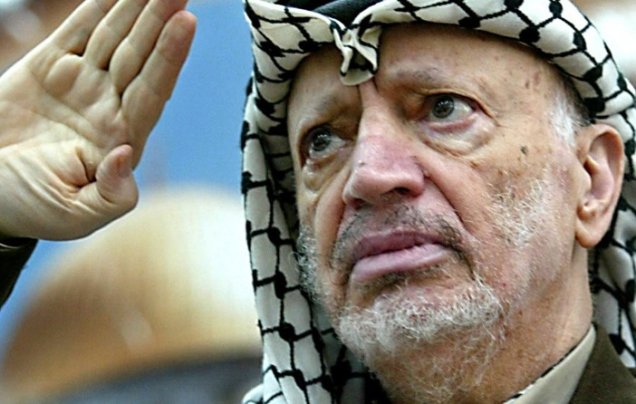
“I have come bearing an olive branch in one hand and a freedom fighter’s gun in the other. Do not let the green branch fall from my hand.”
(Yasser Arafat at the UN General Assembly, 13 November 1974) [1]
Yasser Arafat, “Abu Ammar” (1929–2004), was the leader of the modern Palestinian national movement: a founder of Fatah, chairman of the Palestine Liberation Organisation from 1969, President of the State of Palestine from 1989 and the first elected president of the Palestinian Authority. He led the revolution from Jordan, Lebanon and Tunis and survived several Israeli assassination attempts, before the occupation besieged him in his Ramallah headquarters for more than two years. His health collapsed suddenly, and he died at Percy hospital near Paris on 11 November 2004, in circumstances that still raise suspicions of poisoning. [2] [3] [4] [5]
This article is part of the series “Leaders of the Palestinian Revolution Who Were Assassinated,” alongside the articles on Khalil al-Wazir “Abu Jihad”, Salah Khalaf “Abu Iyad”, Kamal Adwan and Sheikh Ahmed Yassin.
Who was Yasser Arafat?
For more than four decades Yasser Arafat’s name was bound up with the rise of an independent Palestinian national movement: from founding Fatah and armed struggle, to winning international recognition of the PLO as the representative of the Palestinian people, to the declaration of independence, then the Oslo Accords and the Palestinian Authority, and finally his siege in the Muqataa during the al-Aqsa Intifada [2] [3]. His keffiyeh became a worldwide symbol of the Palestinian cause.
Yasser Arafat at a glance
| Item | Details |
|---|---|
| Name | Muhammad Abdel Raouf al-Qudwa al-Husseini, “Yasser Arafat,” “Abu Ammar” [2] |
| Born | 24 August 1929, most likely in Cairo [2] |
| Education | Civil engineering, Fuad I University (Cairo) [2] |
| Founding | A founder of Fatah (Kuwait meeting, 1957) [3] |
| Offices | Chairman of the PLO Executive Committee (1969), President of the State of Palestine (1989), President of the Palestinian Authority (1996) [2] |
| Siege | Confined in Ramallah from December 2001 until his illness [4] [2] |
| Died | 11 November 2004, Percy hospital near Paris [2] [4] |
| Grave | The Muqataa compound in Ramallah, after the occupation refused burial in Jerusalem [6] [1] |
Timeline
| Date | Event |
|---|---|
| 24 August 1929 | Born [2] |
| 1952–1956 | Heads the Palestinian Students’ League in Cairo [3] |
| 1956 | Serves with the Egyptian army against the Tripartite Aggression [2] |
| 1957 | Founding meeting of Fatah in Kuwait [3] |
| 1 January 1965 | Fatah’s official launch [3] |
| 21 March 1968 | Battle of Karameh [3] |
| February 1969 | Chairman of the PLO Executive Committee [2] |
| 13 November 1974 | UN General Assembly speech [2] [1] |
| 22 November 1974 | PLO granted observer status (Resolution 3237) [7] |
| Summer 1982 | Siege of Beirut and departure to Tunis [2] [1] |
| 1 October 1985 | Hammam al-Shatt massacre; survives assassination [8] |
| November 1988 | Declaration of the independence of the State of Palestine [2] |
| April 1989 | Elected President of the State of Palestine [2] |
| 1993 | The Oslo Accords [2] |
| July 1994 | Returns to Gaza after 27 years [2] [1] |
| 20 January 1996 | Elected President of the Palestinian Authority [2] |
| July 2000 | Camp David summit [2] |
| December 2001 | Siege in Ramallah begins [4] |
| 11 September 2003 | Occupation government decides in principle to expel him [9] |
| 11 November 2004 | Dies at Percy hospital [2] [4] |
| July 2012 | Al Jazeera polonium investigation [4] [2] |
| 27 November 2012 | Tomb opened and samples taken [4] |
| November 2013 | Swiss report supports the poisoning hypothesis [5] [10] |
| 1 September 2015 | French judges dismiss the case [4] |
From Cairo and Jerusalem to the cause
Muhammad Abdel Raouf al-Qudwa al-Husseini, known as Yasser Arafat and “Abu Ammar,” was born on 24 August 1929, most likely in Cairo, the sixth son of a Palestinian merchant from Gaza who had moved to Cairo in 1927; some accounts say he was born in Jerusalem [2] [1]. When his mother died when he was about four, his father sent him to Jerusalem, where he spent years of his childhood and became aware of the events of the 1936 revolt, before returning to Cairo in 1937 [2].
During the 1948 war he helped move weapons and ammunition from Egypt to Palestinian fighters confronting the Zionist militias [1]. He studied civil engineering at Fuad I University (later Cairo University) and headed the Palestinian Students’ League from 1952 to 1956 [2] [3]. In 1956 he served alongside the Egyptian army in repelling the Tripartite Aggression [2].
Founding Fatah
In 1958 Arafat moved to Kuwait to work as an engineer [2]. There he joined comrades including Khalil al-Wazir “Abu Jihad”, Salah Khalaf “Abu Iyad” and Kamal Adwan in an independent national framework that would return the initiative to Palestinians, free of official Arab tutelage [3]. Al Jazeera’s encyclopedia regards the secret meeting Arafat organised in Kuwait in 1957 as the movement’s first building block, at which its name, statement and structure were adopted [3].
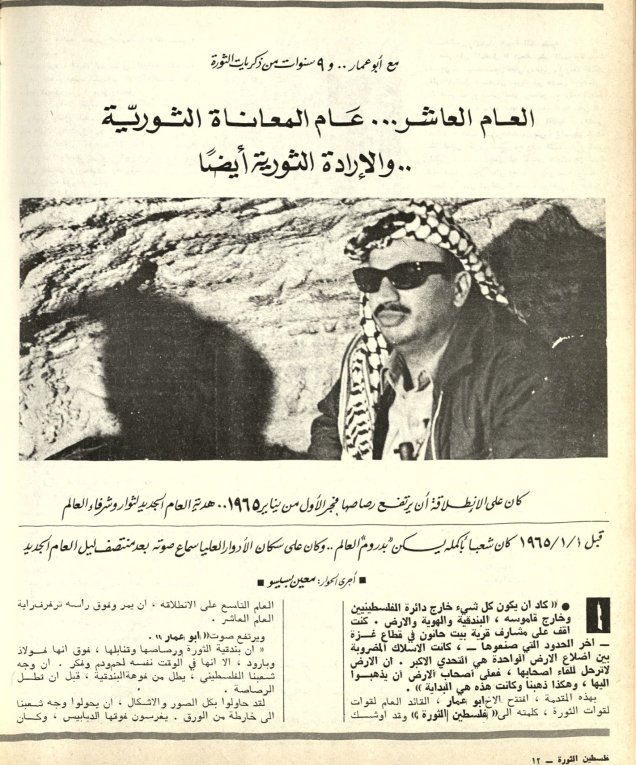
The Palestinian National Liberation Movement, Fatah, held that liberating Palestine was a Palestinian project led by Palestinians, with armed struggle as its main path. Its first operation was the sabotage of the Eilabun tunnel on the night of 31 December 1964, and its launch was officially announced on 1 January 1965, remembered as the start of the modern Palestinian revolution [3].
Karameh and the PLO chairmanship
After Israel occupied the rest of Palestine in June 1967, Arafat led fedayeen operations from Jordan and built new military cells in the West Bank [2] [3]. The great turning point came at the Battle of Karameh on 21 March 1968, when Palestinian fedayeen and the Jordanian army repelled a large Israeli attack in the Jordan Valley, sending the popularity of Fatah and Arafat soaring across the Arab world [3].
In February 1969 the Palestinian National Council elected him chairman of the PLO Executive Committee, succeeding Yahya Hammouda; he held the post until his death [2]. After the clashes of September 1970 in Jordan, the resistance moved to Lebanon in 1971, which became the PLO’s main political and military centre [2].
The PLO as representative of the Palestinian people
On 13 November 1974 Arafat addressed the UN General Assembly in New York, affirming that the Palestinian cause was among the just causes of peoples suffering colonialism and oppression [2], and delivering his famous words about the olive branch and the freedom fighter’s gun [1]. Days later, on 22 November 1974, the General Assembly in Resolution 3237 invited the PLO to take part in its sessions and work as an observer [7]. The Palestinian cause thus entered the international system with independent Palestinian representation.
The siege of Beirut, Tunis and Hammam al-Shatt
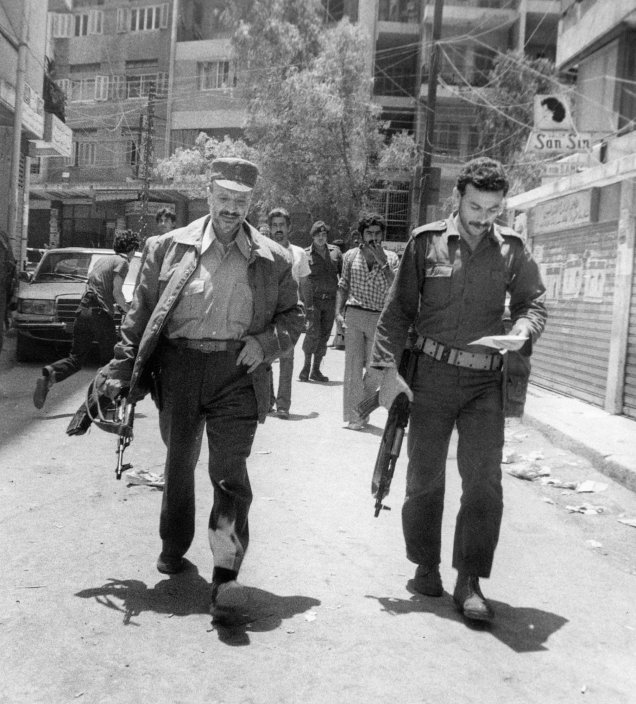
Between 1978 and 1982 the Israeli occupation repeatedly attacked resistance bases in Lebanon, then invaded in the summer of 1982 and besieged Beirut for some ten weeks under heavy bombardment. Arafat and the PLO leadership stayed inside until he agreed to leave Lebanon under international protection [2], and the PLO leadership moved to Tunis [1].
The occupation’s attempts on his life did not stop. On 1 October 1985 Israeli aircraft flew more than 2,000 kilometres to bomb the PLO headquarters at Hammam al-Shatt near Tunis, aiming to kill its leadership, above all Arafat. Fifty Palestinians and 18 Tunisians were killed and about a hundred wounded. Arafat survived because he was not in the targeted buildings, and the UN Security Council condemned the aggression in Resolution 573 [8].
Declaring the State of Palestine
The First Intifada, which erupted in December 1987, was a major turning point. In November 1988 the Palestinian National Council, meeting in Algiers, declared the State of Palestine with Jerusalem as its capital [2]. In December that year Arafat announced at the UN General Assembly a peace initiative based on international resolutions [2]. In April 1989 the PLO Central Council elected him President of the State of Palestine [2] [1].
Oslo and the return home
After the Madrid conference and the Washington talks, a secret negotiating channel opened in Norway in 1993, leading to the Oslo Accords, signed at the White House on 13 September 1993, which created the Palestinian Authority [2]. But the agreement postponed the core issues – Jerusalem, refugees, settlements, borders and sovereignty – to final-status negotiations.
In July 1994, after 27 years in exile, Arafat returned to Gaza as head of the Palestinian Authority, welcomed by hundreds of thousands [2] [1]. That year he shared the Nobel Peace Prize with Yitzhak Rabin and Shimon Peres [2]. On 20 January 1996 he was elected president of the Palestinian Authority in the first Palestinian general elections, held in the West Bank, the Gaza Strip and East Jerusalem [2] [1].
Yet the interim period, meant to end with an independent state within five years, expired in 1999 without a state, while the occupation pressed on with settlement, the Judaisation of Jerusalem and control over crossings and borders.
Camp David and the al-Aqsa Intifada
In July 2000 Arafat attended the Camp David summit with Israeli Prime Minister Ehud Barak and US President Bill Clinton; it collapsed after about two weeks over Jerusalem and other issues [2]. Israel and the United States blamed Arafat, while Palestinians held that the proposals offered neither full sovereignty nor a just solution for Jerusalem and the refugees. On 8 January 2001 Arafat rejected the US proposals, which according to Al Jazeera involved giving up the right of return [2].
In September 2000 the al-Aqsa Intifada erupted after Ariel Sharon stormed al-Aqsa Mosque [6]. With Sharon as prime minister, incursions, assassinations and closures escalated, and his government set about dismantling the Authority’s institutions and gains [6].
The Muqataa siege and the expulsion decision
From December 2001 the occupation army barred Arafat from leaving Ramallah, then besieged his Muqataa headquarters and destroyed large parts of it, confining him there with some 480 aides and police officers [4] [6]. He remained trapped there for the last two and a half years of his life [2].
On 11 September 2003 the occupation government’s security cabinet, chaired by Sharon, decided “in principle” to expel the Palestinian president from the Palestinian territories and tasked the army with drawing up a plan, with 9 of 11 ministers in favour and War Minister Shaul Mofaz leading the push [9]. Palestinian Foreign Minister Nabil Shaath called the decision a declaration of war on the Palestinian people and their leadership, and demonstrations broke out in Palestinian cities [9].
Illness and death
In October 2004, still besieged in the Muqataa, Arafat’s health suddenly deteriorated, and doctors spoke of a digestive ailment [6]. At the end of the month he was flown to Percy Military Hospital near Paris, showing no fever [4]. There he fell into a deep coma, and he died on 11 November 2004 at the age of 75 [2] [4].
No autopsy was performed [4]. The hospital report, not disclosed until 2012, attributed death to a major haemorrhagic stroke preceded by intestinal inflammation and blood-clotting disorders, without identifying an underlying cause [4]. His personal physician, Ashraf al-Kurdi, insisted he had been poisoned and called for an autopsy [6].
The poisoning hypothesis and the investigations
On 3 July 2012 Al Jazeera aired a nine-month investigation revealing abnormal levels of radioactive polonium-210 on Arafat’s personal belongings, analysed in a Swiss laboratory [4] [2]. On 27 November 2012 his tomb in Ramallah was opened and about 60 samples of bone and tissue were taken and divided among Swiss, French and Russian teams [4].
In November 2013 the Swiss report, from the University Centre of Legal Medicine in Lausanne, concluded that its results moderately support the hypothesis of death by polonium poisoning, having found levels more than 18 times the normal average [5] [10]. The Russian experts found polonium but judged the evidence insufficient to show it caused death, while the French experts attributed it to the environment of the tomb – to which François Bochud, director of Lausanne’s Institute of Radiation Physics, replied that the Swiss findings were “unassailable” [5] [10] [4]. On 1 September 2015 the French judges dismissed the “murder” complaint filed by his widow Suha Arafat, citing insufficient evidence [4].
The Palestinian investigation committee, formed in 2009 and headed by Maj. Gen. Tawfiq Tirawi, stated that Arafat did not die of old age, illness or natural causes, and directly accused Israel of being the “first, main and only suspect” in what it called “the crime of the twenty-first century” [5] [4]. In November 2015 Tirawi announced that the committee had identified who carried out the assassination [2]. More than two decades on, the file remains open in Palestinian consciousness.
The funeral and the Jerusalem he was denied
An official funeral was held for Arafat in Cairo, after which his body was flown on an Egyptian military aircraft to Ramallah, where tens of thousands gathered to receive him, and he was buried in the Muqataa [1] [6]. His wish had been to be buried in Jerusalem, but Sharon refused, so soil from al-Aqsa Mosque was placed in his grave [6].
And so the President of the State of Palestine, who spent part of his childhood in Jerusalem and whose people declared it their capital, was buried in Ramallah, while the capital remained under occupation.
Legacy
Yasser Arafat’s life encapsulated the great transformations of the Palestinian national movement in the second half of the twentieth century: from secret founding and armed struggle, to international recognition and the declaration of statehood, to the return home, and finally the years of siege in the Muqataa. His image in the keffiyeh, the olive branch and the freedom fighter’s gun, the ruined Muqataa and the Jerusalem where he was denied burial all remain alive in Palestinian national memory.
Images and video
Frequently asked questions about Yasser Arafat
Who was Yasser Arafat?
A Palestinian leader, a founder of Fatah, chairman of the PLO from 1969, President of the State of Palestine from 1989 and the first elected president of the Palestinian Authority.
What was Yasser Arafat’s real name?
Muhammad Abdel Raouf al-Qudwa al-Husseini; his nom de guerre was “Abu Ammar.”
When was Fatah founded?
Its founding meeting was held in Kuwait in 1957, and its launch was officially announced on 1 January 1965.
When did Yasser Arafat die?
On 11 November 2004 at Percy Military Hospital near Paris.
Was Yasser Arafat poisoned?
The Swiss report found moderate support for polonium-210 poisoning and the Palestinian investigation committee accuses Israel of killing him, while the Russian and French teams did not confirm poisoning.
Where is Yasser Arafat buried?
In the Muqataa compound in Ramallah, after the occupation refused his burial in Jerusalem.
How long was Arafat besieged in the Muqataa?
From December 2001 until he was flown out for treatment at the end of October 2004.
Sources and references
Arabic-language sources are listed with translated titles.
- “Yasser Arafat on the Anniversary of His Passing: Abu Ammar Between the Gun and the Olive Branch,” Al-Ahram Gate, 14 November 2024.
- “Yasser Arafat,” Al Jazeera Encyclopedia (updated 13 September 2023).
- Inam al-Nunu, “Fatah: The First Palestinian National Movement Formed After the 1948 Nakba,” Al Jazeera Encyclopedia.
- “Timeline: Arafat’s Death Between Expert Investigations and Court Decisions,” Al-Jarida (Kuwait), via AFP, 3 September 2015.
- “Tirawi: The Reports Bring Us Closer to Arafat’s Killer,” Al Jazeera Net, 8 November 2013.
- Ali Saadeh, “21 Years Since the Mysterious Death of the Man of the Gun and the Olive Branch,” Al Jazeera Net, 13 November 2025.
- “Observer Status for the PLO” (General Assembly Resolution 3237), Interactive Encyclopedia of the Palestine Question, Institute for Palestine Studies.
- “The Hammam al-Shatt Massacre 1985: Israeli Aggression on Tunisia to Assassinate Palestinian Revolution Leaders,” Al Jazeera Encyclopedia, 27 September 2025.
- “Israeli Government Decides in Principle to Expel Arafat,” Al Jazeera Net, 11 September 2003.
- “Swiss Experts Renew the Arafat Poisoning Hypothesis,” Al Jazeera Net, 6 December 2013.
Photo gallery
More from the archive


 Download Our Palestine App
The whole archive in the palm of your hand: depopulated villages, the Nakba, the massacres and Al-Aqsa — free, with no ads to erase the story.



Comments
No comments yet — be the first to write one.
Add your comment
Name and email are optional. Comments appear after review.