
Lydda and Ramla Before the Nakba: From Orange Groves to the Death March
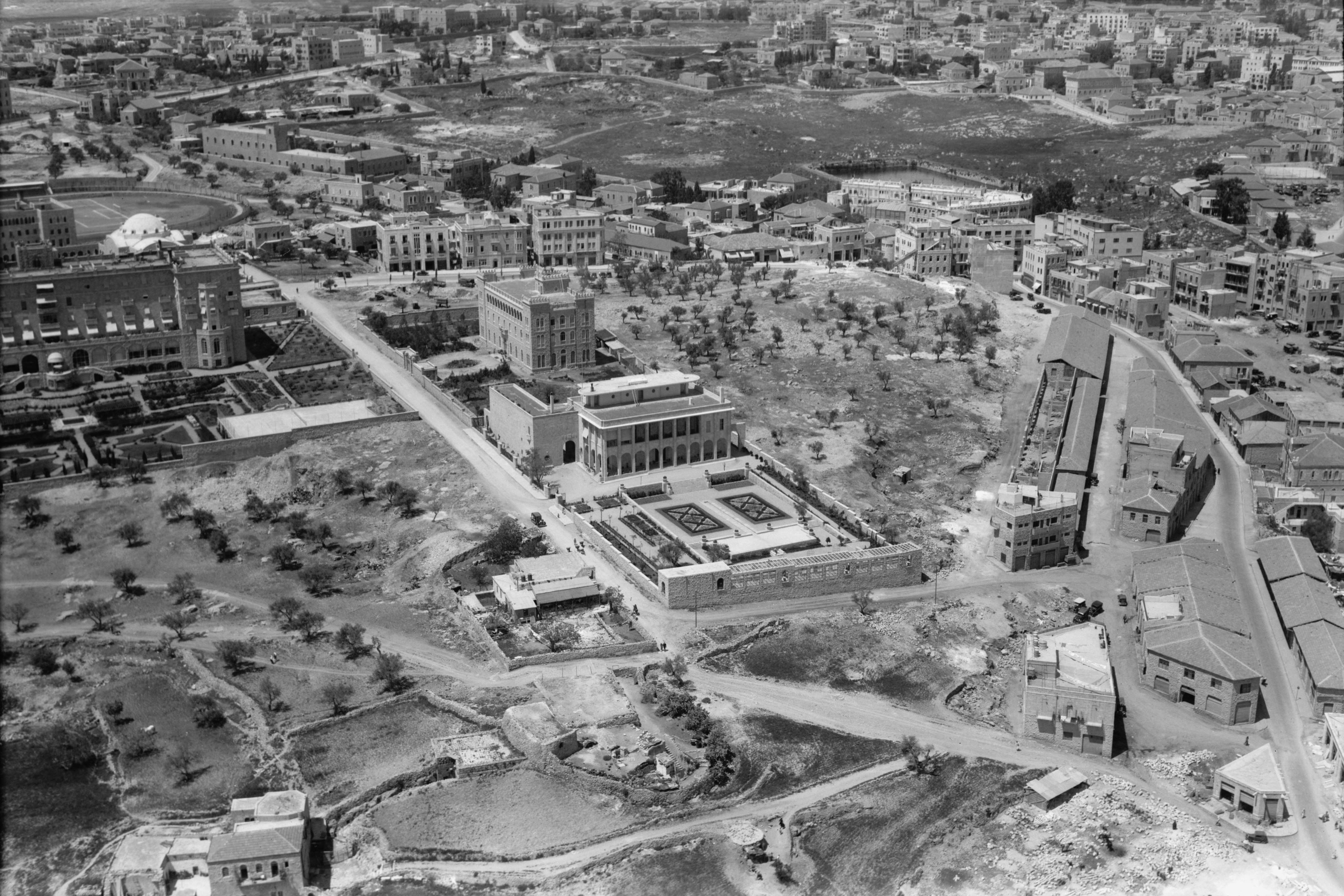
Lydda and Ramla are twin cities on the Palestinian plain, only a few kilometers apart: Ramla was the capital of Palestine in the Umayyad era, and Lydda was the city of St. George, a railway junction and the site of Palestine's international airport. On July 11 and 12, 1948, both cities fell; about 426 Palestinians were killed in Lydda alone, and about 60,000 people were driven out of the two cities on foot under gunfire. [1] [2] [3]
This article tells the story of the two cities before the Nakba: their history, landmarks, markets and schools, and Lydda's role in transport, then the days of July 1948, from the Dahmash Mosque massacre to the long road that Palestinians came to call the "death march." Find more on our Ramla and Lydda pages.
Lydda and Ramla Before the Nakba at a Glance
| Item | Details |
|---|---|
| Founding of Ramla | 715 CE, by Sulayman ibn Abd al-Malik, as capital of Jund Filastin [4] |
| Population of Lydda | About 8,100 in 1922 and about 18,250 in 1946 [2] |
| Railway | Stations on the Jaffa–Jerusalem line from 1892; Lydda became the rail junction under the Mandate [2] [5] |
| Lydda airport | Opened in 1937 [2] [6] |
| Fall of the cities | July 11–12, 1948, in Operation Dani [1] [4] |
| Killed in Lydda | About 426, including about 176 in the Dahmash Mosque [2] [3] |
| Expelled from the two cities | About 60,000 [1] |
| Who remained | About 1,000 Palestinians in both cities [7] |
Ramla: Palestine's Umayyad Capital
The Umayyad caliph Sulayman ibn Abd al-Malik founded Ramla in 715 CE and made it the capital of Jund Filastin in place of Lydda. He built a palace, a mosque and a water-supply system there, and laid it out so that people built within a set plan. [4] [8] It then passed to the Abbasids, Tulunids, Ikhshidids and Fatimids, was occupied by the Crusaders, retaken by the Ayyubids and Mamluks, and then came under Ottoman rule. [4]
Under the Mandate, Ramla grew in population and trade and became one of the largest cities in central Palestine. [4] Lying midway on the road between Jaffa and Jerusalem, it had commercial weight in peacetime and strategic weight in war. [9]
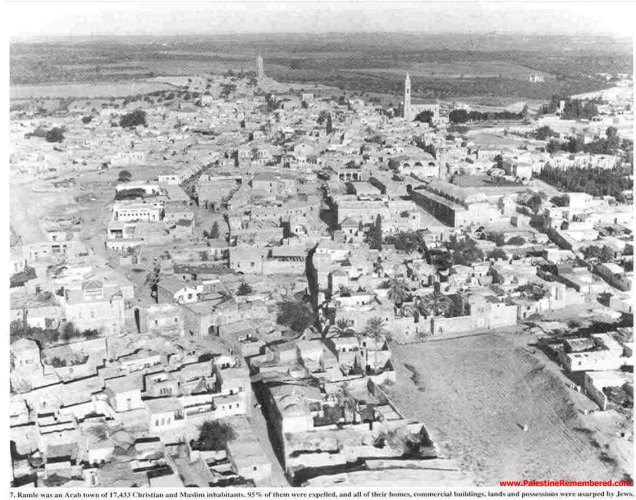
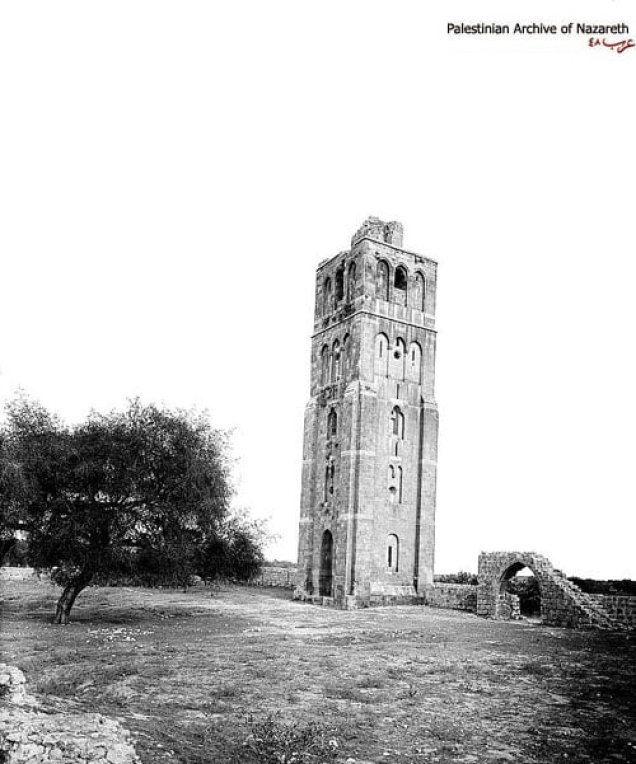
Ramla's Landmarks
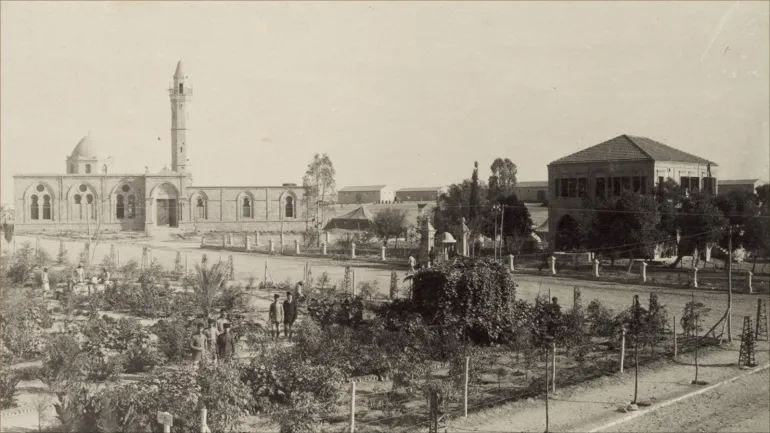
- The White Mosque and its minaret: built in the Umayyad era; its minaret is one of the city's best-known landmarks. [4] [9]
- The Umari (Great) Mosque: one of the city's largest mosques. [4]
- Birkat al-Anaziya (the Pool of the Arches): about a kilometer northwest of the city, one of its most famous landmarks. [9]
- The Nabi Salih cemetery and shrine: where the Nabi Salih festival was held every year. [4]
- The Franciscan monastery and church. [4]
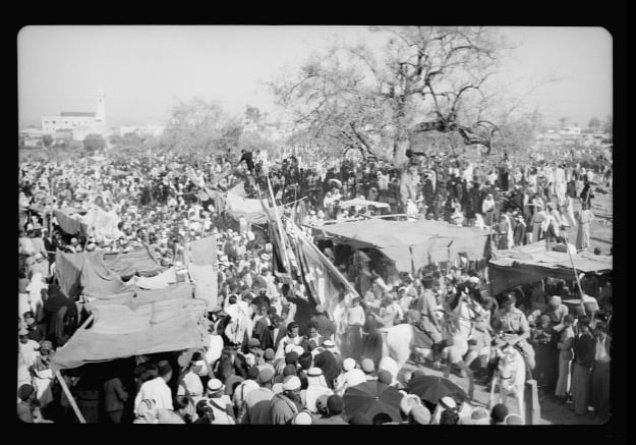
Read about the Nabi Salih festival and others in Folk Festivals in Palestine Before the Nakba.
Lydda: The City of St. George
Lydda is one of the oldest cities in Palestine. Its standing declined after the Umayyads founded Ramla and made it the capital. [10] But it remained an important city, revered by Muslims and Christians alike as the city of al-Khadr (St. George), whose feast drew pilgrims every year. [2] [10]
Lydda had about 8,100 residents in 1922, about 920 of them Christian, rising to about 18,250 in 1946, on lands of about 19,870 dunams. [2]
Lydda's Landmarks and Markets
- The Church of St. George: built over the tomb of St. George, venerated by Muslims and Christians, and rebuilt in 1870. [2]
- The Great Umari Mosque: built in the Mamluk period under Sultan al-Zahir Baybars. [2]
- The Dahmash Mosque: built by Khalil Dahmash, with room for about 800 worshippers. [2]
- Khan al-Hilu: an inn for travelers. [2]
- The weekly livestock market: a famous market that drew traders from Palestine, Transjordan, Syria and Egypt. [2]
Railway Junction and Airport
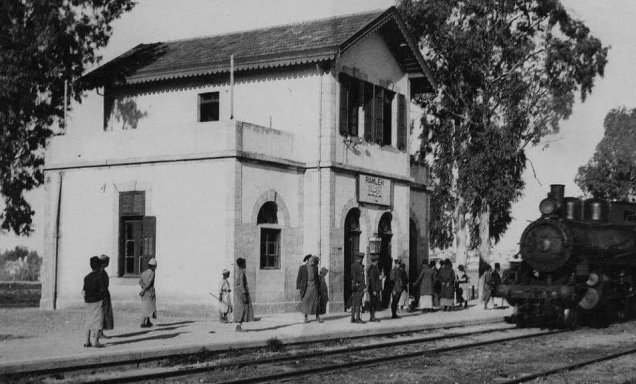
From 1892, Lydda and Ramla had stations on the Jaffa–Jerusalem railway, the first railway in Palestine. [11] In 1918 the British line from Qantara in Egypt reached Lydda and then Haifa [5], making Lydda the railway junction where the Jaffa–Jerusalem line met the coastal line from Egypt to Haifa. [2]
In 1937 the Mandate government opened the Wilhelma airport near Lydda, which became Lydda airport and then Palestine's international airport. [6] Read: Trains and Ports in Palestine Before the Nakba.
Olives, Pottery and Orange Groves
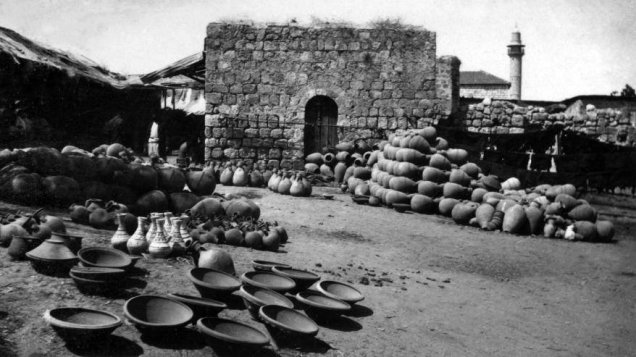
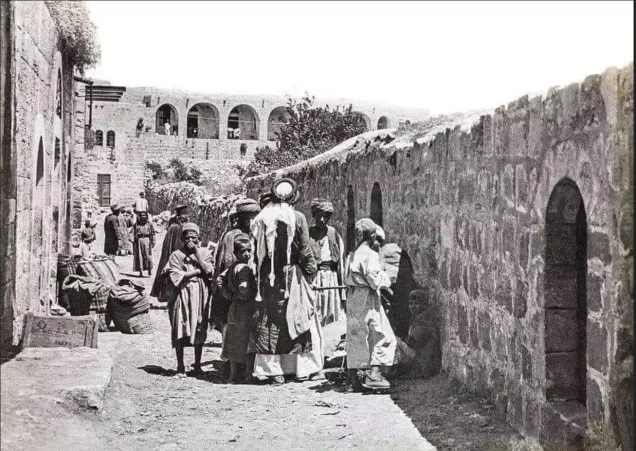
The economy of both cities rested on agriculture: olives, grains and vegetables, and later the orange groves that spread across the plain. [9] Lydda had olive presses and tahini workshops dating from Ottoman times [2], while Ramla was known for its pottery, sold in its markets.
Schools
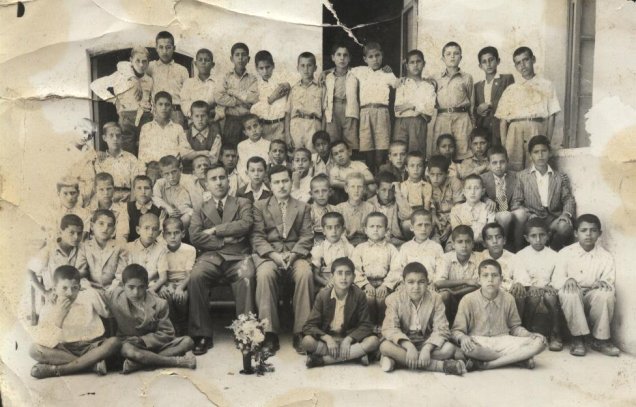
The schools of the two cities were among the largest in central Palestine. On January 1, 1948, Lydda's school had 1,046 students in 19 classes taught by 24 teachers, with a library of 818 books, a boarding section for village students and about 14 dunams for agricultural teaching. In early 1948, Ramla's secondary school had about 895 students, and its girls' school 473. [12]
Read: Education in Palestine Before the Nakba.
Notable People
- George Habash: born in Lydda in 1925, he studied medicine at the American University of Beirut, returned to Lydda in June 1948 to work as a surgeon's assistant treating the wounded, and was then expelled with his family. He later founded the Popular Front for the Liberation of Palestine. [1]
- The poet Abu al-Iqbal al-Ya'qubi (1880–1941): from Lydda, known as "the Hassan of Palestine." [10]
- Abd al-Hamid Yasin (1906–1975): from Lydda; he worked in Palestinian radio and education and later became the first secretary-general of the University of Jordan. [10]
Lydda's families included the Abu Shrayha, Abu Hamad, Hassouna, Salameh and Dahmash families. [2]
Spring 1948: Two Cities on the Front Line
Lydda and Ramla lay on the border between the Arab and Jewish states in the partition plan, on the Arab side. As Jaffa fell in May 1948, refugees flooded into them and their populations swelled. [2] In the days before their fall, the surrounding villages fell one after another, among them al-Abbasiyya on July 10. [13]
July 1948: Operation Dani
On July 10, 1948, David Ben-Gurion appointed Yigal Allon to command the attack on Lydda and Ramla, as part of an operation called "Dani" that ran from July 8 to 17. [3] [13] On July 11 the forces stormed Lydda, and both cities fell on July 11 and 12. [1] [3]
The Defense of the Two Cities
Lydda and Ramla were defended by local fighters and volunteers with few weapons, facing an organized army hardened by many battles. The few Jordanian Arab Legion forces in the area were short of ammunition, because the Arab side had observed the UN arms embargo during the June 1948 truce. [14]
In Ramla, the city's notables, including Mayor Sheikh Mustafa al-Khairi, signed a surrender document stating that residents could leave "if they want," meaning that staying was also their right. But the people were driven out by force of arms. [14] Among those expelled were many Christian families, driven directly out of Lydda and Ramla. [15]
The Dahmash Mosque Massacre
A number of fighters and residents took refuge in the Dahmash Mosque in the center of Lydda. After hours of fighting they ran out of ammunition and surrendered, but the attacking forces killed them inside the mosque. [3] Sources estimate that about 176 were killed in the mosque and about 426 in Lydda as a whole [2], including about 250 killed in house-to-house shooting after the assault. [3]
The day after the cities fell, Arab men of fighting age were arrested and taken to special detention camps. [3] Read about Zionist massacres on our site.
The Death March
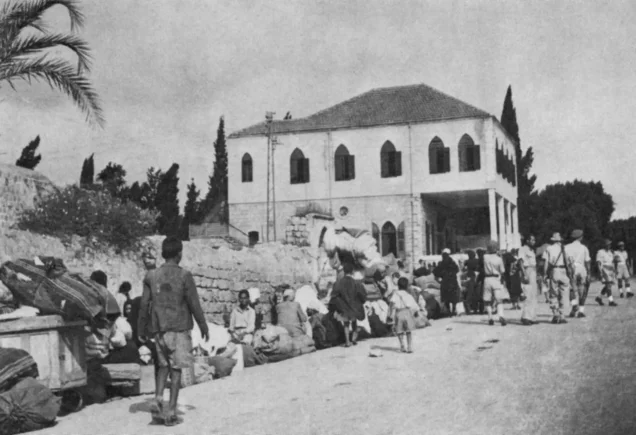
On July 13, 1948, loudspeakers announced the order to leave and set out the exit routes. [3] About 60,000 people from Lydda and Ramla, and the refugees sheltering there, were forced to walk inland under gunfire [1], in the July heat, without water or food, and many elderly people, women and children collapsed along the way. George Habash, then a medical student, treated those who fell. [1]
The expelled walked east toward the Ramallah area, through villages that were themselves falling in those days, such as Barfiliya, depopulated on July 14. [4] Women carried dough and whatever light belongings they could, and the thirsty drank from stagnant pools. [16]
This harsh journey became known in Palestinian memory as the "death march," one of the largest mass expulsions of the Nakba. Among those who walked it were two young men who later became prominent leaders of the national movement: George Habash of Lydda and Khalil al-Wazir (Abu Jihad) of Ramla; the Journal of Palestine Studies published their testimonies of those days. [1] [17]
The Depopulated Villages of Ramla District
Lydda and Ramla did not fall alone: 59 villages in Ramla district were depopulated in 1948, most of them in the same days of July. Among them: [4]
| Date of depopulation | Villages |
|---|---|
| April–May 1948 | Wadi Hunayn, Sarafand al-Kharab, Bir Salim, Sarafand al-Amar |
| June 1948 | al-Nabi Rubin, al-Bariyya |
| July 10, 1948 | Qula, al-Tira, Jimzu, Daniyal, Khirbat al-Duhayriyya, Kharruba, Innaba |
| July 12–13, 1948 | al-Muzayri'a, Bayt Nabala, al-Haditha, Abu al-Fadl, Majdal Yaba, Dayr Tarif, Dayr Abu Salama, Khirbat Zakariyya |
| July 14–18, 1948 | Barfiliya, al-Burj, Shilta |
Other villages of the district include Yibna, Zarnuqa, Abu Shusha, al-Qubab, Salbit and Latrun. The full list, with a page for each village, is on the Ramla district page in our depopulated villages section.
After the Nakba
- Who remained: only about 1,000 Palestinians remained in Lydda and Ramla together [7]; other sources estimate that about 1,050 remained in Lydda alone, out of about 19,000. [2]
- Resettlement: by May 1949, about 2,450 Jewish immigrant families, some 7,878 people from 22 countries, had been settled in Ramla in the homes of the expelled. [7]
- Today: Arabs make up about 30% of Lydda's population and about 25% of Ramla's [7], most of them living in the old city's neighborhoods. [9]
Testimonies of Those Who Lived the Nakba
The story of Lydda and Ramla lives on in the testimonies of those who lived it. George Habash and Khalil al-Wazir gave their testimonies to the Journal of Palestine Studies [17], and the journalist Sandy Tolan told the story of the al-Khairi family home in Ramla, later occupied by a Jewish immigrant family, in his book The Lemon Tree. [14]
Read more on our site: Ramla and its depopulated villages, Jaffa Before the Nakba and Jaffa Oranges Before the Nakba.
Conclusion
Lydda and Ramla were the heart of the Palestinian plain: an Umayyad capital and the city of St. George, a railway junction and the first international airport, markets that drew traders from across the Arab world. In three days of July 1948 hundreds were killed, and tens of thousands walked under the sun into exile. But the White Mosque and the Church of St. George still stand, and Palestinians still live in both cities, guarding the memory of those who were driven out.
Frequently Asked Questions About Lydda and Ramla Before the Nakba
When did Lydda and Ramla fall in 1948?
Both cities fell on July 11 and 12, 1948, during Operation Dani, even though they were allotted to the Arab state under the partition plan.
What was the Dahmash Mosque massacre?
A massacre in Lydda in July 1948, when the attacking forces killed those who had taken refuge in the Dahmash Mosque after they surrendered. Sources estimate about 176 were killed there, out of about 426 killed in Lydda as a whole.
What was the death march?
The forced expulsion of about 60,000 people from Lydda and Ramla, including refugees sheltering there, in July 1948, when they were made to walk under gunfire in the heat without water, and many died along the way.
Who founded Ramla?
The Umayyad caliph Sulayman ibn Abd al-Malik founded it in 715 CE and made it the capital of Jund Filastin in place of Lydda.
Why is Lydda known as the city of St. George?
Because it is home to the Church of St. George, built over the tomb of the saint, who is venerated by Muslims and Christians alike and whose feast is held there every year.
Which villages were depopulated in Ramla district?
Fifty-nine villages in Ramla district were depopulated in 1948, among them Jimzu, Innaba, Bayt Nabala, al-Haditha, Dayr Tarif, Barfiliya, Yibna and Zarnuqa; most fell in July 1948 along with Lydda and Ramla.
How many Palestinians remained in Lydda and Ramla after 1948?
Only about 1,000 Palestinians remained in the two cities together, and thousands of Jewish immigrants were settled in the homes of the expelled.
Sources and References
Arabic-language sources are listed with translated titles.
- "George Habash," Interactive Encyclopedia of the Palestine Question, Institute for Palestine Studies.
- "History of the Palestinian City of Lydda," PDF on the Internet Archive (Arabic).
- Mohamed Abdel Rahman, "The Lydda Massacre," Youm7, July 11, 2022 (Arabic).
- "Ramla," Depopulated Palestinian Villages section, Palestinina (Arabic).
- Mansour Jween, "The Role of the Hejaz Railway in the Development of Haifa," Journal of Palestine Studies (Arabic edition), no. 65, 2006.
- "Lydda," Encyclopedia, Al Jazeera Net, 2014 (Arabic).
- "'Mixed Cities' in Israel: The Product of Plunder, Looting and the Expulsion of Palestine's Coastal Cities," Al-Quds Al-Arabi, June 6, 2021 (Arabic).
- Ahmed Seif al-Nasr, "Umayyad Architecture: From the Dome of the Rock to the Desert Castles," Noon Post, March 12, 2026 (Arabic).
- "Ramla," Encyclopedia, Al Jazeera Net, 2014 (Arabic).
- Farouk Mawasi, "Notable Figures From Lydda," Diwan al-Arab, February 10, 2012 (Arabic).
- Aseel al-Jundi, "132 Years Old: What You Don't Know About the Jaffa–Jerusalem Railway," Al Jazeera Net, October 30, 2020 (Arabic).
- "Education in Palestine Before the Nakba," Palestinina, citing Mandate Education Department statistics (Arabic).
- "Al-Abbasiyya," Interactive Encyclopedia of the Palestine Question, Institute for Palestine Studies.
- Sandy Tolan, "The Fall of an Arab Town in 1948," Al Jazeera English, July 19, 2008.
- Sujod Aways, "Layers of the Nakba and Its Masks," Noon Post, May 15, 2025 (Arabic).
- Rania Marjia, "Three Cities Walking Toward Oblivion," Diwan al-Arab, October 18, 2025 (Arabic).
- "First Testimony: Khalil al-Wazir (Abu Jihad)" and "Second Testimony: George Habash," Journal of Palestine Studies (Arabic edition), no. 34, Spring 1998.
More from the archive
 Download Our Palestine App
The whole archive in the palm of your hand: depopulated villages, the Nakba, the massacres and Al-Aqsa — free, with no ads to erase the story.



Comments
No comments yet — be the first to write one.
Add your comment
Name and email are optional. Comments appear after review.