
Al-Majdal and Asqalan Before the Nakba: City of Looms and Oranges
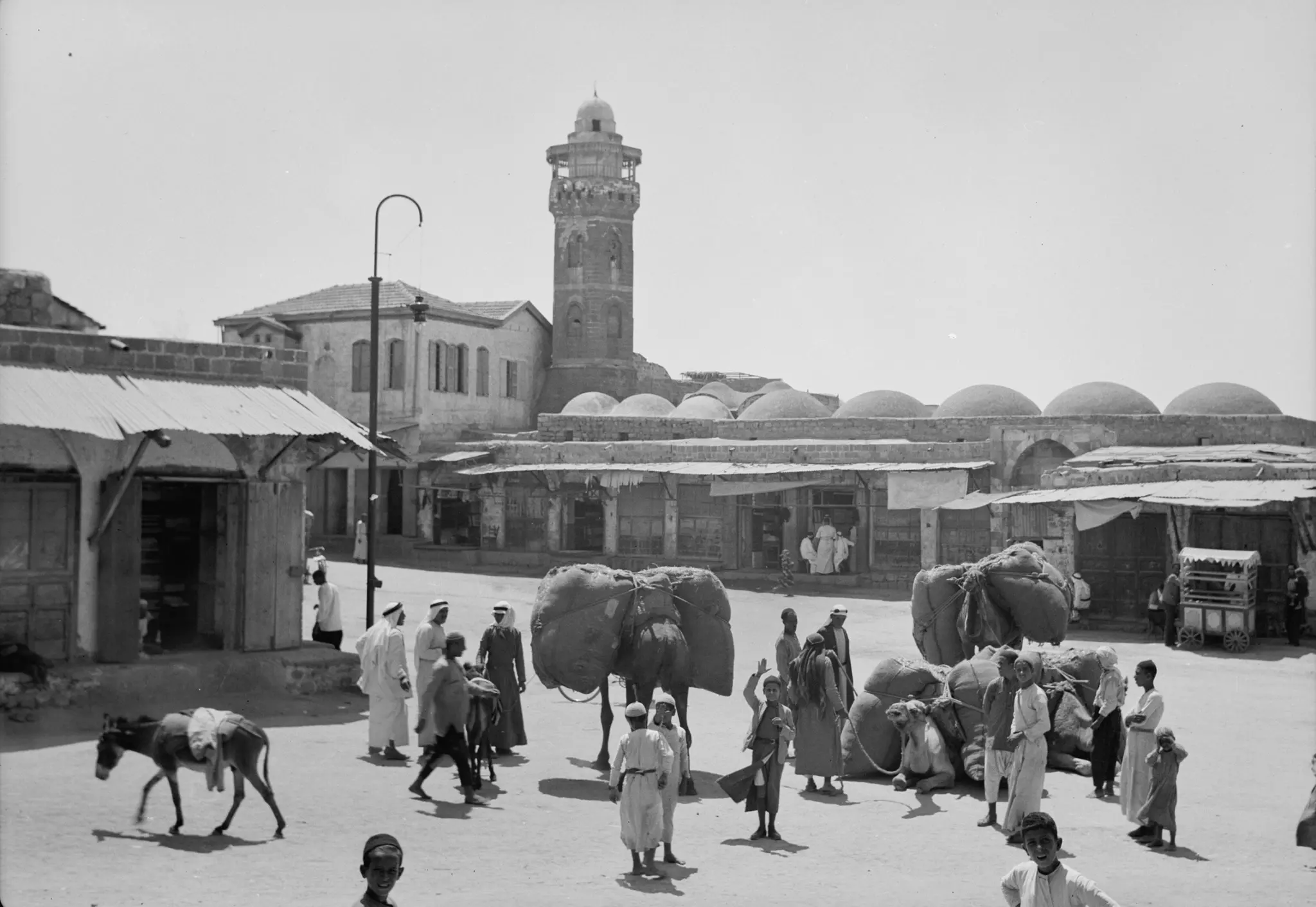
Al-Majdal, or Majdal Asqalan, is a Palestinian city on the southern coast near the ruins of ancient Asqalan (Ascalon). Before the Nakba it was Palestine's best-known center of hand weaving: some 800 looms in its houses, "Majdalawi" cloth sold in markets across Palestine, and citrus groves and vineyards all around. It fell on November 4–5, 1948, and those of its people who remained were expelled to Gaza in 1950, after the war had ended. [3] [5] [7]
This article tells the story of al-Majdal before the Nakba: its history and ancient Asqalan, its quarters and market, its looms and cloth, its groves and schools, its role in Palestine's revolts, then 1948, when it became the headquarters of the Egyptian army, its fall and the expulsion of its people and the villages around it. The depopulated villages of the area are on our Gaza district page.
Al-Majdal Before the Nakba at a Glance
| Item | Details |
|---|---|
| Location | Palestine's southern coast, northeast of Gaza, near the ruins of Asqalan [2] [3] |
| Population | 9,910 in 1945 [8], and about 11,000–13,000 in 1948 [2] [3] |
| Land | 1,346 built-up dunams, and 42,334 cultivated dunams, none of them Jewish-owned [3] [4] |
| Hand looms | About 800 in 1945 [3] [5] |
| Fall of the city | November 4–5, 1948 [5] [8] |
| Expulsion of those who remained | About 2,700 expelled to Gaza in 1950 [7] |
| Majdal refugees | About 70,000 in 1996 [2] |
From Asqalan to al-Majdal
Asqalan is one of the oldest cities in the world. The Canaanites founded it around 3000 BCE, and it was a port and a stop for caravans and armies on the coastal plain. [2] The Babylonians destroyed it in 604 BCE; it was rebuilt, Muslims entered it under Amr ibn al-As, and it passed between the Crusaders, Ayyubids and Mamluks until al-Zahir Baybars demolished it in 1270 so that the Crusaders could not return to it. [2]
The people of al-Majdal say their town is "a story of return": after Asqalan was ruined in Saladin's wars with the Crusaders, its people came back only after the Crusader presence ended in the Mamluk era, and al-Majdal grew up as Asqalan's daughter near its ruins, with camel caravans bringing building stone and beach sand. [10] Under the Ottomans it was a modest town, then became the center of a nahiya overseeing the surrounding villages. [11]
Al-Majdal, close by, inherited Asqalan's place as the town and market of the area. It grew from the second half of the 19th century thanks to weaving, and again under the Mandate, its population doubling between 1930 and 1945. [2] [3] [10] It became a municipality under the 1922 municipalities law and had six mayors up to 1948 [10], among them al-Hajj Ahmad Abd al-Razzaq al-Madhoun until 1934. [13] Its historic landmarks included its great mosque, built by the Mamluk emir Sayf al-Din Salar around 1300. [2] [3] The ruins of Asqalan remained by the sea west of the town, where a Roman tomb and a decorated Hellenistic cave were found in 1937. [2]
The Town, Its Quarters and the Friday Market
Al-Majdal was laid out on a grid around two main perpendicular streets, with the main market at its center. [3] It lay about 25 km north of Gaza, separated from the sea by a strip of dunes, with al-Jura to the southwest and Hamama to the northwest. [10] [11] It had four main quarters named after its families: al-Madhuna in the south, al-Zaqaqita after the Zaqout family, al-Ubaydiyya in the west, and al-Shaqaqira in the north after the Shaqura family; other sources mention six quarters. [9] [10]
On the eve of the Nakba the town had a water network, electricity arrived around 1946, and it had two small hotels. [10] Some of its merchants imported goods from outside Palestine and sold them in the town and nearby villages, while others took their goods to the markets of neighboring towns and villages. [11]
Its best-known market was the "Friday market," a weekly market in the southwest of the town organized by the municipality, where people from the surrounding villages came to sell their produce and buy what they needed, including Majdal cloth. [4] The people of al-Majdal worked in trade, especially in cloth and farm produce, and were bound to the surrounding villages by marriage and kinship. [3] [4]
City of Looms: Majdalawi Cloth
Al-Majdal was "the best-known center of hand weaving in southern Palestine," and its fame for dyeing and weaving dates back to the Crusader period. [3] [6] Accounts say almost every house had a loom. [5]
- Number of looms: more than 500 in 1909, at the end of the Ottoman era; about 800 in the 1940s; and, according to other sources, nearly 3,000 during the Second World War and up to 1948, when demand for local cloth rose. [3] [5] [10] A few powered looms arrived late in the Mandate. [3]
- Products: cotton and silk fabrics, keffiyehs, thobe fabrics, men's clothing fabrics, rugs and towels, sold in markets across Palestine. [2] [5]
- Fabric names: among the best known were "Jaljali," "Talhami" and "Jannah wa Nar" (Heaven and Fire). [5]
- A family craft: the father wove, the mother wound the threads and prepared the spools, and the children trimmed the rugs, arranged the colors and prepared the yarn. [5]
- Weaving families: among the best known were Zaqout, Maleiha, al-Madhoun, Saalha, al-Hennawi and Abu Sharkh. [5]
- The 1934 prize: al-Majdal won first prize for textile manufacturing at the Arab National Exhibition in Jerusalem in 1934. [5]
Majdalawi weaving requires skill in tensioning the threads, matching colors and judging the density of the weave: the warp threads are stretched lengthwise and the weft threads passed crosswise between them. [6] Read also: Palestinian Industries Before the Nakba.
Oranges, Vineyards and Orchards
Al-Majdal was also a farming town, its cultivated land stretching over 42,334 dunams of grain, vegetables and fruit trees. [4] Citrus groves were its largest crop, followed by vineyards, then figs, peaches, plums, mulberries and bananas. [3] [9] Its people sold none of their land to Zionist institutions. [4]
Schools and Services
- "The Big School": al-Majdal's main boys' school, teaching from primary to secondary level, attended by hundreds of students from the town and nearby villages. [10] [11]
- The girls' school: in the al-Madhuna quarter, one of the first girls' schools in Palestine, which the British used as a base for their forces during the Great Revolt. [4] [10]
- The kuttab: a traditional Quran school run by Sheikh Taha al-Bardawil. [10]
- Vocational training: the school had a weaving section and a plot of land for teaching farming and beekeeping. [9]
- Health: the town had a health center staffed by doctors from Ramla, Jaffa and Gaza and nurses from Beit Jala, an eye clinic founded in the 1930s, and two pharmacies in the late 1940s. [3] [9] [10]
Read: Education in Palestine Before the Nakba.
Seasons and Social Life
Every year the people of al-Majdal held a folk season in "Wadi al-Naml," southwest of the town beneath the eastern wall of Asqalan, in late April, known as the season of "Arba'at Ayyub," which brought together the people of the town and the surrounding villages. [3] [10] The town's cafés were where its people, its merchants and visitors to its market met. [9] In the 1940s youth associations flourished, including a branch of the "Futuwwa" organization in 1941 and the "al-Mithl al-A'la" society in 1943. [13] Read about Folk Festivals in Palestine Before the Nakba.
Al-Majdal in Palestine's Revolts
Most people in al-Majdal supported the Supreme Muslim Council and Hajj Amin al-Husseini, and many joined the Palestine Arab Party led by Jamal al-Husseini. They boycotted the nearby Jewish settlements and attacked the nearby settlement of "Be'er Tuvia" during the events of 1929. [10]
In the Great Revolt (1936–1939), a revolutionary committee led by Abd al-Aziz Abu Sharkh organized strikes and recruited fighters [10]:
- The fighters: more than 80 fighters from al-Majdal sabotaged the Gaza–Beersheba railway and attacked the police station, taking its horses and sending them to the rebels in Jenin and Tulkarm. [10]
- The revolutionary court: the rebels set up a revolutionary court headed by Sheikh Mahmoud al-Qudra. [10]
- British punishment: the British blew up at least 40 houses in al-Majdal. [10]
- Ramadan 1938: a cell of 18 men led by Umran Shushar was preparing a bomb in the house of Khalil al-Awwar to target the British forces' base in the girls' school, when it exploded prematurely, killing all eighteen. [10]
1948: Headquarters of the Egyptian Army
The Egyptian army entered al-Majdal on May 21, 1948, then advanced to Isdud on May 29 and east to Iraq Suwaydan and al-Faluja, bringing the whole area under its control. [4] The Egyptian commander, Major General Ahmad Ali al-Mawawi, made al-Majdal his headquarters from May until late October 1948. [4] [12] At the first truce the al-Majdal sector was held by the 4th Infantry Brigade, with a company of the 8th Reserve Battalion and Sudanese and Saudi volunteers. [12] Al-Mawawi was later dismissed after the Negev battles, and Major General Ahmad Fuad Sadiq took command. [12]
From the area the Egyptian army fought several battles, including the battle of Dayr Sunayd, the attempt to take the settlement of Negba on June 2, the battle of Isdud on June 2–3, and the capture of the settlement of Nitzanim on June 7. [4] The first truce ran from June 11 to July 8, and the second from July 18. [4]
The Fall of al-Majdal
On October 15, 1948, Zionist forces launched Operation "Yoav" in the south, and al-Majdal and the villages around it, such as Hirbiya, Dayr Sunayd and al-Jura, were bombed from the air. [1] [4] Then Isdud fell on October 28, and the Egyptian army withdrew south toward the Gaza Strip. [1] [4] Al-Majdal fell on November 4–5, 1948, after a long period of clashes, and most of its people fled to the Gaza Strip. [5] [8] [10]
1950: Expulsion After the War
Al-Majdal's tragedy did not end with its fall: about 2,700 of its people, roughly a quarter of its population, remained. In 1950, after the war had ended and the armistice agreements were signed, they received expulsion orders and within a few weeks were moved by force to the border of the Gaza Strip, because the occupation's leaders wanted the town and its lands to settle newly arrived Jewish immigrants. [7]
Al-Majdal thus became an example of how expulsion was not limited to the days of war but continued afterward. [7] Its people settled in the Jabalia, al-Shati and Khan Younis camps in the Gaza Strip, and the number of Majdal refugees reached about 70,000 in 1996. [2] [5]
The Majdalawis carried the loom with them into exile, and it was they who brought weaving to Gaza [11]: in Jabalia camp, the father of the weaver Hossam Zaqout rebuilt his loom and resumed weaving, and Majdal's refugees lived from it for a time. [5]
The Depopulated Villages Around al-Majdal
Al-Majdal was the market of the coastal and farming villages of northern Gaza district, and these villages were depopulated in stages: some in May 1948, most in Operation "Yoav" in October, and the last with the fall of al-Majdal in November. Here are brief profiles; each village has a detailed page in the depopulated villages section of our site: [1]
May 1948: Operation "Barak" northeast of al-Majdal
- Bayt Daras: about 32 km northeast of Gaza, with 2,750 inhabitants; under the Mamluks it was a postal station on the Gaza–Damascus road. The "Givati" Brigade seized it on May 10, 1948 and its houses were demolished.
- Burayr: about 18 km northeast of Gaza, with 2,740 inhabitants. Palmach forces attacked it on the night of May 12–13, 1948 and expelled its people, and its destruction drove the neighboring villages to flee.
- al-Sawafir al-Sharqiyya: one of three villages named al-Sawafir, about 32 km northeast of Gaza, with 970 inhabitants. It was occupied in May or June 1948, and all its houses were destroyed.
October 1948: Operation "Yoav" and the raids on the south
- Isdud: about 35 km northeast of Gaza, with 4,620 Arab inhabitants. It was a forward position of the Egyptian army from May 1948, was bombed from the air and sea from mid-October, and was occupied on October 28; about 300 who stayed were expelled south.
- Bayt Tima: about 21 km northeast of Gaza, with 1,060 inhabitants. It was occupied on October 18–19, 1948 after heavy shelling, and the ruins of its houses remain.
- Hulayqat: about 20 km northeast of Gaza, with 420 inhabitants, and an important Egyptian defensive position. It was finally occupied on the night of October 19–20, 1948.
- Kawkaba: about 25 km northeast of Gaza, with 680 inhabitants. The Egyptians retook it on July 8, and it was finally occupied on October 20, 1948 and completely destroyed.
- Hamama: about 24 km northeast of Gaza near the coast, and one of the largest villages in the area, with 5,070 inhabitants, two schools and a local council. It was occupied in late October or early November 1948.
- Bayt Jirja: about 15.5 km northeast of Gaza, with 940 inhabitants and a school opened in 1932. It was occupied in late October 1948.
- Dayr Sunayd: about 12 km northeast of Gaza, with 730 inhabitants and a station on the coastal railway. It was bombed from the air from mid-October and occupied in late October or early November 1948.
- Hirbiya: about 14 km northeast of Gaza, with 2,240 Arab inhabitants, an oasis among the dunes known for citrus, grapes and bananas. It was bombed from the air on October 15–16, 1948 and occupied in early November.
November 4–5, 1948: with the fall of al-Majdal
- al-Jura: on the seashore about 2 km west of al-Majdal, with 2,420 inhabitants, a fishing harbor and a school founded in 1919. It was bombed from the air in October and occupied with al-Majdal on November 4–5, 1948; only one house remains.
- Ni'ilya: about 3 km southwest of al-Majdal, with 1,310 inhabitants; a school was built there in the winter of 1948 but never opened. It was occupied on November 4–5, 1948.
- al-Khisas: on al-Majdal's northern edge, with 150 inhabitants, who planted trees to hold back the dunes from their orchards. It was occupied on November 4–5, 1948.
- al-Jiyya: about 19 km northeast of Gaza, southeast of al-Majdal, with 1,230 inhabitants, known for its cheese. It was occupied on November 4–5, 1948 and destroyed.
- Barbara: about 17 km northeast of Gaza, with 2,410 inhabitants, famous for grapes considered among Palestine's finest and for the "mazawid" rugs woven by its women. It was occupied on the night of November 4–5, 1948.
The full list of the district's villages, with a page for each, is on our Gaza district page.
Al-Majdal After the Nakba
- A city under another name: Jewish families were settled in the homes of al-Majdal's people, and the town was then merged with Asqalan into one city named "Ashkelon," erasing al-Majdal's name from the maps. [2] [3]
- The landmarks: many of the town's historic landmarks were destroyed, and new buildings went up in place of some of them. [2]
- The land: settlements were built on al-Majdal's land, including "Kfar Silver" and "Nir Israel." [9]
- The loom in exile: Majdalawi weaving survived in Gaza for decades, until the last looms in Jabalia were destroyed in the 2023 war on Gaza, and Hossam Zaqout moved his loom to Cairo in 2024. [5]
Read more on our site: Gaza and its depopulated villages, Jaffa Before the Nakba and Jaffa Oranges Before the Nakba.
Conclusion
Al-Majdal was the city of looms and oranges: looms in its houses weaving "Jaljali" and "Jannah wa Nar," a Friday market for the people of the villages, and citrus groves and vineyards around the ruins of Asqalan. It fell in November 1948, and its last people were expelled in 1950, after the guns had fallen silent. But the Majdalawis carried their looms to Jabalia and al-Shati, and their cloth still recalls a city by the sea that waits for its people.
Frequently Asked Questions About al-Majdal Before the Nakba
What was al-Majdal known for before the Nakba?
It was known for hand weaving, with about 800 looms in 1945 and its "Majdalawi" cloth sold in markets across Palestine, as well as for its citrus groves, vineyards and Friday market.
When did al-Majdal fall in 1948?
Al-Majdal fell on November 4–5, 1948, at the end of Operation "Yoav," after the withdrawal of the Egyptian army, which had made it its headquarters since May 1948.
What happened to the people of al-Majdal who stayed after 1948?
About 2,700 of its people remained; in 1950, after the war had ended, they received expulsion orders and were moved by force to the border of the Gaza Strip so that Jewish immigrants could be settled in their place.
What is the difference between al-Majdal and Asqalan?
Asqalan is an ancient Canaanite city on the sea that al-Zahir Baybars demolished in 1270; al-Majdal is the nearby town that inherited its place and was the town of the area until the Nakba, which is why it is known as Majdal Asqalan.
What were al-Majdal's best-known fabrics?
Among the best known were "Jaljali," "Talhami" and "Jannah wa Nar," alongside keffiyehs, thobe fabrics, rugs and towels.
What were the quarters of al-Majdal?
It had four main quarters named after its families: al-Madhuna in the south, al-Zaqaqita, al-Ubaydiyya in the west and al-Shaqaqira in the north; other sources mention six quarters.
What was al-Majdal's role in the 1936 revolt?
A revolutionary committee led by Abd al-Aziz Abu Sharkh organized strikes, and more than 80 fighters from al-Majdal sabotaged the Gaza–Beersheba railway and attacked the police station, after which the British blew up more than 40 houses in the town.
Where do the people of al-Majdal live today?
Most live as refugees in the Gaza Strip, in the Jabalia, al-Shati and Khan Younis camps; the number of Majdal refugees reached about 70,000 in 1996.
Sources and References
Arabic-language sources are listed with translated titles.
- "Gaza," Depopulated Palestinian Villages section, Palestinina (Arabic).
- Ali Saada, "Asqalan: One of the World's Oldest Cities, Inhabited by Arabs 5,000 Years Ago," Arabi21, June 7, 2021 (Arabic).
- "The City of al-Majdal," The Palestinian Encyclopedia, via Palestine Remembered (Arabic).
- "The Palestinian City of al-Majdal / Asqalan," Palestine Remembered (Arabic).
- "From al-Majdal to Exile: The Survival of Majdalawi Weaving" (interview with weaver Hossam Zaqout), The Jerusalem Fund – Palestine Center, March 24, 2026.
- "Palestinian Industries Before the Nakba: From Nablus Soap to Hebron Glass," Palestinina (Arabic).
- "Internally Displaced Palestinians Within the Green Line," Haq al-Awda, BADIL Resource Center (Arabic).
- "Al-Majdal," Palestine Open Maps (Arabic).
- "Al-Majdal / Majdal Asqalan," Palestinian Villages Encyclopedia (Arabic).
- Ali Habib Allah, "Majdal Asqalan: Originally a Story of Return," Arab48, May 13, 2024 (based on Sharif Kanaana and Rashad al-Madani, Majdal Asqalan, Birzeit University) (Arabic).
- "Al-Majdal," The Palestinian Encyclopedia, October 28, 2015 (Arabic).
- Mohamed Shaaban Ayoub, "Reading the Nakba Papers: Who Failed the Egyptian Army in the 1948 War?", Al Jazeera Net, December 15, 2023 (Arabic).
- "History of the al-Madhoun Family of al-Majdal," Palestine Remembered, March 24, 2011 (Arabic).
More from the archive
 Download Our Palestine App
The whole archive in the palm of your hand: depopulated villages, the Nakba, the massacres and Al-Aqsa — free, with no ads to erase the story.



Comments
No comments yet — be the first to write one.
Add your comment
Name and email are optional. Comments appear after review.