
Battle of Jurat Bahlas 1938: Hebron Rebels Destroy a British Convoy

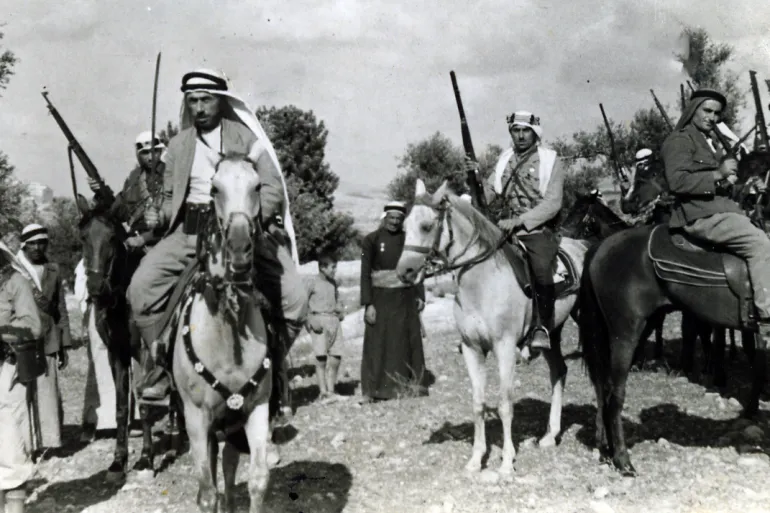
The Battle of Jurat Bahlas, also called the Battle of Ras al-Jura after the site’s present name at the northern entrance of Hebron, was one of the largest and most successful battles of the Great Palestinian Revolt (1936–1939) in southern Palestine. Hebron’s rebels, led by Abd al-Halim al-Jilani, known as “al-Shalaf,” ambushed a convoy of the British occupation army on the road between Halhul and Hebron, wiped out its soldiers and shot down two of the aircraft sent to rescue it. [1]
The most detailed account dates the battle to 11 October 1938, at the height of the revolt, when the rebels controlled wide areas of the Hebron hills and the town of Beersheba. [1][2]
Contents
- The battle at a glance
- Background: the revolt at its height
- The commander: Abd al-Halim al-Jilani, “al-Shalaf”
- The course of the battle
- Results and significance
- Differences between the accounts
- Timeline
- Frequently asked questions about the Battle of Jurat Bahlas
The battle at a glance
| Item | Details |
|---|---|
| Date | 11 October 1938 (another account says September 1938) |
| Place | Jurat Bahlas (Ras al-Jura), between Halhul and Hebron |
| Palestinian commander | Abd al-Halim al-Jilani, “al-Shalaf” (also spelled al-Jawlani) |
| Palestinian force | More than 200 village volunteers and 50 full-time rebels |
| Enemy | A British military convoy of about 70 soldiers, then five warplanes |
| Outcome | Convoy destroyed, two aircraft downed, rebels withdrew |
| Context | The Great Palestinian Revolt, 1936–1939 |
Background: the revolt at its height
The Great Palestinian Revolt broke out in 1936 against the British occupation, which had opened Palestine to Zionist immigration and paved the way for a “Jewish national home” on Palestinian land. It peaked in 1938, when control of many towns and rural areas passed into the rebels’ hands. [3]
In the south, rebels led by al-Jilani stormed Beersheba on 9 September 1938 and seized its government facilities; the town stayed liberated for more than two months. From the barracks stores they took about 250 rifles, 50 pistols, 200 hand grenades, a hundred old rifles and boxes of ammunition, which strengthened their ability to fight bigger battles in the Hebron hills. [4][2]
Read also: The 1936 Revolt.
The commander: Abd al-Halim al-Jilani, “al-Shalaf”
Abd al-Halim al-Jilani was a son of Hebron, known by the nickname “al-Shalaf.” He was jailed for six months in 1931 for trying to seize a British soldier’s weapon, led a band of Hebron rebels from the start of the Great Revolt, and in 1937 was chosen as supreme commander of the rebels in the Hebron area. [2][5]
Under his command the rebels set up a base in the Shi’b al-Milh area, which their supporters called “the Shi’b al-Milh government.” Al-Jilani kept up the struggle after the revolt and was a commander in southern Palestine in the Holy Jihad forces during the 1948 war. [2][5]
The course of the battle
The rebels and volunteers deployed along the road between Halhul and Hebron, concentrated at Jurat Bahlas and blocked the road with stones, while other bands stayed in position to stop British reinforcements from getting through. [1]
When the British convoy, carrying about 70 soldiers, arrived, it was forced to stop at the barricades, and the rebels opened fire. The fighters battled the convoy’s troops until they had killed them and took their weapons. [1]
Five British warplanes then arrived, bombing the rebels’ positions and raking them with machine-gun fire. Although the rebels had only light rifles, they shot down two aircraft: the first fell on the main road at Jurat Bahlas and its crew burned, and the second came down south of Hebron. [1]
A testimony handed down in one local family tells how a rebel hit a British plane with a Bren gun until it “reeled, burning, and fell,” and how shepherds later made flutes from its pipes. [6]
The rebels then withdrew in good order and dispersed into the surrounding hills. [1]
Results and significance
The battle ended with the destruction of the British convoy; the same account says all seventy of its soldiers were killed, and that the rebels downed two aircraft and seized the convoy’s weapons. [1]
Jurat Bahlas came to be counted among the revolt’s best-known battles: it came at the peak of rebel control in southern Palestine and showed that village volunteers, with light weapons and knowledge of the land, could inflict heavy losses on an imperial army armed with aircraft and armour. [2][1]
Read also about the battles of Hebron’s rebels: The Battle of al-Khader, 1936; The Battle of Bani Na’im.
Differences between the accounts
The available sources differ on some details. The al-Masareb account, drawn from Abd al-Hakim Samara and al-Dustour, dates the battle to 11 October 1938, while the Badil account places it in September 1938. The first account’s main text also credits al-Jilani with downing three aircraft but describes only two in detail, so we have used the better-documented figure. [1][2]
The sources also differ on al-Jilani’s years of birth and death. We found no documentation in the available Arab sources of the number of rebels martyred in this battle or where they were buried, so we have left it out until a reliable source is available. [5][2]
Timeline
| Date | Event |
|---|---|
| 1931 | Al-Jilani jailed for six months for trying to seize a British soldier’s weapon [2] |
| April 1936 | The Great Palestinian Revolt breaks out [3] |
| 1937 | Al-Jilani chosen as supreme commander of the Hebron-area rebels [5] |
| 9 September 1938 | Rebels storm Beersheba and seize its barracks’ weapons [4] |
| 11 October 1938 | Battle of Jurat Bahlas: British convoy destroyed and two aircraft downed [1] |
| 1939 | The Great Revolt winds down [3] |
Frequently asked questions about the Battle of Jurat Bahlas
When was the Battle of Jurat Bahlas?
On 11 October 1938 according to the most detailed account, during the Great Palestinian Revolt. [1]
Where is Jurat Bahlas?
On the road between Halhul and Hebron, in the area now known as Ras al-Jura at Hebron’s northern entrance. [1]
Who led the rebels at Jurat Bahlas?
Abd al-Halim al-Jilani, known as “al-Shalaf,” supreme commander of the Hebron-area rebels. [1][5]
How many rebels fought?
More than 200 village volunteers and 50 full-time rebels. [1]
What were the British losses?
The Palestinian account says all seventy soldiers of the convoy were killed and two warplanes were shot down. [1]
How is the Beersheba raid linked to Jurat Bahlas?
The rebels stormed Beersheba on 9 September 1938 and seized hundreds of weapons, which strengthened their ability to fight big battles in the Hebron hills. [4]
Read also on Palestinuna
Sources and references
- Ziad Zakaria, “Abd al-Halim al-Jilani,” al-Masareb blog, 4 May 2016, citing Abd al-Hakim Samara and al-Dustour newspaper, 24 August 2002 (in Arabic).
- “A Palestinian Story: al-Jilani and the Shi’b al-Milh Revolt,” al-Awda News Network, citing Badil (in Arabic).
- WAFA, “Battles and Revolts in Palestine” (in Arabic).
- “The Beersheba Battle, in Which Palestinians Defeated the British Army,” Arabi Post, 9 September 2024 (in Arabic).
- Abd al-Hakim Samara, “The Fighter against the British, Abd al-Halim al-Jilani,” al-Ittihad, 13 June 2020 (in Arabic).
- “The Palestinian on the Cross,” al-Manar newspaper (in Arabic).
More from the archive
 Download Our Palestine App
The whole archive in the palm of your hand: depopulated villages, the Nakba, the massacres and Al-Aqsa — free, with no ads to erase the story.



Comments
No comments yet — be the first to write one.
Add your comment
Name and email are optional. Comments appear after review.