
Battle of al-Dheisheh 1948: The Holy Jihad Traps the Kfar Etzion Convoy at al-Nabi Daniel

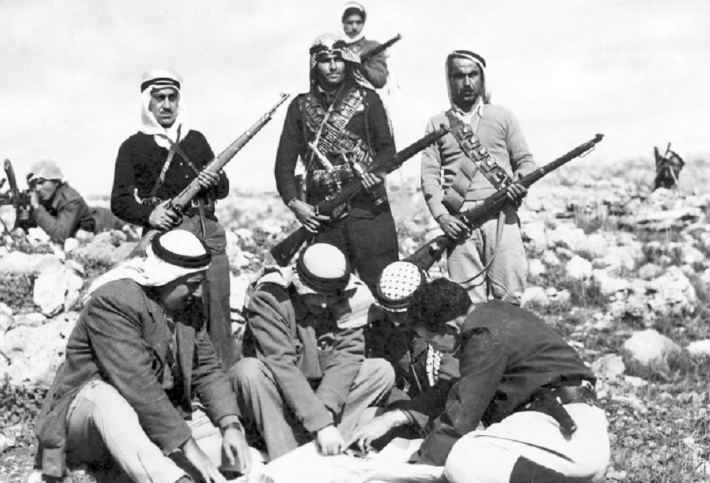
The battle of al-Dheisheh, also known as the battle of al-Nabi Daniel, was an ambush laid between 29 and 30 March 1948 by Holy Jihad fighters and reinforcements from Bethlehem, Beit Jala, Beit Sahour, Hebron and the Ta’amra for a huge Zionist convoy of some 100 trucks and 19 armoured cars returning from the Kfar Etzion settlements to Jerusalem along the Hebron road. The fighters besieged the convoy for two days at al-Dheisheh, until those of its men who had dug into the al-Nabi Daniel building were forced to lay down all their arms. [1][2]
It was led by Kamel Erekat, deputy commander of the Holy Jihad, while Abd al-Qadir al-Husseini was away in Damascus, and it ended with three armoured cars and the convoy’s weapons captured and the settlement project north of Hebron stalled; three fighters were martyred, among them Yusuf al-Rashmawi. [1][2]
Contents
- At a glance
- The Kfar Etzion convoy
- The ambush
- The siege of the al-Nabi Daniel building
- Results
- Differences between the accounts
- Timeline
- Frequently asked questions about the Battle of al-Dheisheh
At a glance
| Item | Details |
|---|---|
| Date | 29–30 March 1948 (the convoy set out on the evening of 27 March) |
| Place | Between Solomon’s Pools and al-Dheisheh on the Jerusalem–Hebron road, and the al-Nabi Daniel building |
| Arab forces | The Holy Jihad, with reinforcements from Bethlehem, Beit Jala, Beit Sahour, Hebron and the Ta’amra |
| Commander | Kamel Erekat, deputy commander of the Holy Jihad |
| Convoy | Some 100 trucks, 19 armoured cars, a bulldozer and five buses, guarded by the Haganah |
| Martyrs | Three, among them Yusuf al-Rashmawi |
| Spoils | Three armoured cars, eight tow vehicles, a truck and a bus, and all the convoy’s weapons |
| Outcome | The besieged surrendered and handed over their weapons and were taken to Jerusalem under Red Cross supervision |
The Kfar Etzion convoy
The Kfar Etzion settlements between Bethlehem and Hebron were isolated among Arab villages and depended on convoys from Jerusalem. On the evening of 27 March 1948 a huge Zionist convoy set out for them, some 100 trucks, 19 armoured cars, a bulldozer and five buses, guarded by a Haganah force armed with machine guns, rifles, mortars and grenades, and reached the settlements on 28 March. [1]
The ambush
Abd al-Qadir al-Husseini had gone to Damascus at the end of March to coordinate with the Military Committee, so command passed to his deputy, Kamel Erekat, who massed a large body of fighters and deployed them on both sides of the road between Solomon’s Pools and al-Dheisheh, laying mines and setting up roadblocks. [1]
On the morning of 29 March, as the convoy headed back towards Jerusalem, the fighters fell on it from every side and cut off its way back. The armoured cars tried to force a way forward, but the fighter Yusuf al-Rashmawi threw a bomb at the leading armoured car, disabling it and halting the column, and was martyred. Aircraft dropped some supplies and ammunition to the besieged, but most of it fell into the fighters’ hands. [1]
The siege of the al-Nabi Daniel building
On the evening of 29 March Arab reinforcements arrived from Beit Sahour, Beit Jala, Bethlehem, Hebron and the Ta’amra, and the convoy’s men took refuge in the al-Nabi Daniel building. On the morning of 30 March the fighters called on them to surrender, and the Zionist command asked the British and the Red Cross to intervene. [1][2]
At first the British refused to intervene directly and sent Aref al-Aref and Issa al-Bandak to persuade the fighters to let the besieged men go; Kamel Erekat refused and insisted on surrender. A British force under Colonel Harper tried to reach the scene, but the fighters blew up mines in its path and it turned back to Jerusalem; another British detachment also failed, and then Harper arrived with a representative of the Red Cross. [1]
In the end the Mufti, Hajj Amin al-Husseini, proposed by radio that the Zionists hand over their weapons and then be taken to Jerusalem by the Red Cross. Erekat accepted; the besieged men laid down all their arms, the armoured cars that had not burned were handed to the fighters, and the Zionists were driven to Jerusalem under British and Red Cross supervision. [1]
Results
The battle ended with the convoy captured and much of it destroyed; the fighters took three armoured cars, eight tow vehicles, a truck and a bus, and the convoy’s weapons and ammunition, while three of the fighters were martyred, among them Yusuf al-Rashmawi. The settlement project north of Hebron was stalled, and the Etzion settlements were left more isolated. [1][2]
It came days after the Shu’fat ambush north of Jerusalem, as part of the Holy Jihad’s campaign to cut the supply routes to the settlements around the city, and days before the battle of al-Qastal in which Abd al-Qadir al-Husseini was martyred. [1]
Differences between the accounts
Metras dates the battle to 27 March, the day the convoy set out, while WAFA’s file says the ambush took place on the morning of 29 March and lasted until 30 March. The number of the convoy’s dead is garbled in WAFA’s scanned text and appears to be about 15, while Metras says only that “a large number” of Zionists were killed. [2][1]
Timeline
| Date | Event |
|---|---|
| Evening, 27 March 1948 | The convoy sets out from Jerusalem for Kfar Etzion [1] |
| 28 March | The convoy reaches the settlements [1] |
| Morning, 29 March | The ambush between Solomon’s Pools and al-Dheisheh; Yusuf al-Rashmawi martyred [1] |
| Evening, 29 March | Reinforcements arrive; the Zionists take refuge in the al-Nabi Daniel building [1] |
| 30 March | The British relief fails; the besieged surrender and hand over their weapons [1] |
Frequently asked questions about the Battle of al-Dheisheh
When was the Battle of al-Dheisheh?
On 29–30 March 1948, after the convoy set out on the evening of 27 March. [1]
Why is it also called the battle of al-Nabi Daniel?
Because the convoy’s men took refuge in the al-Nabi Daniel building, where the fighters besieged them until they surrendered. [1][2]
Who led the fighters?
Kamel Erekat, deputy commander of the Holy Jihad, since Abd al-Qadir al-Husseini was in Damascus. [1]
Who was Yusuf al-Rashmawi?
A fighter who threw a bomb at the leading armoured car, disabling it and halting the convoy, and was martyred. [1]
What were the results?
The besieged surrendered their weapons; three armoured cars and the convoy’s arms were captured; the settlement project north of Hebron was stalled. [1][2]
Read also on Palestinuna
Sources and references
More from the archive
 Download Our Palestine App
The whole archive in the palm of your hand: depopulated villages, the Nakba, the massacres and Al-Aqsa — free, with no ads to erase the story.



Comments
No comments yet — be the first to write one.
Add your comment
Name and email are optional. Comments appear after review.