
Palestinian Press Before 1948: Al-Karmil, Filastin & Al-Difa
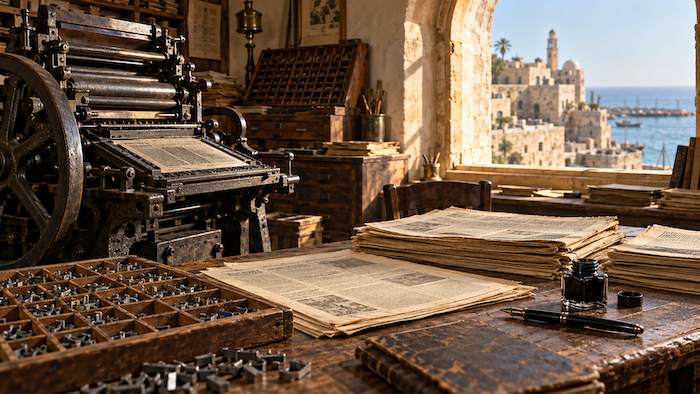
The Press in Palestine Before the Nakba: From Al-Karmil and Filastin to Al-Difa
Before 1948, Palestine had a vibrant Arabic-language press: daily newspapers in Jaffa and Jerusalem, weekly publications in Haifa, literary magazines, and printing houses producing books and newspapers. Following the restoration of the Ottoman constitution in 1908, Palestinian journalists warned against the Zionist project and land sales, facing closures, imprisonment, and exile under Ottoman rule and later the British Mandate. The Nakba shattered the newspaper industries of Jaffa and Haifa and turned many journalists into refugees who continued publishing elsewhere.
The Beginnings: From Al-Quds al-Sharif to the Constitution of 1908
Printing arrived in Jerusalem decades before newspapers, but the earliest presses were largely religious or governmental institutions producing scriptures and schoolbooks. In 1876, Al-Quds al-Sharif appeared in Arabic and Turkish as an official Ottoman publication. Some historians, including Abd al-Qadir Yasin, therefore date the beginnings of the independent Palestinian press to Al-Taraqqi in 1907.
The major turning point came with the restoration of the Ottoman constitution in 1908. Restrictions eased, allowing an urban middle class to establish political newspapers. In Jerusalem, Jurji Habib Hanania had operated a printing house near New Gate since around 1894. Officially licensed in 1908 and described as the city’s first privately owned Arab printing house, it produced approximately 281 books.
Hanania’s newspaper Al-Quds first appeared on 5 September 1908. Often described as a pioneering privately owned Arabic newspaper in Palestine, it consisted of four pages, appeared twice weekly, and had a print run of approximately 1,500 copies. Its contributors included Khalil al-Sakakini and Ali al-Rimawi.
Other publications followed that year: Al-Asma‘i, which criticized Zionist settlement; Al-Insaf, published by Bandali Ilyas Mashhur; Al-Najah, launched by Ali al-Rimawi in December 1908; and Al-Nafa’is al-‘Asriyya, Khalil Baydas’s literary magazine, which began in Haifa before moving to Jerusalem. Sa‘id Jarallah’s Al-Munadi followed in 1912.
Most of these publications ceased appearing when the First World War began in 1914. Hanania left the country after Ottoman authorities discovered his membership in the Young Palestine association. He died in Alexandria in 1920.
Al-Karmil and the Press in Haifa
In Haifa, Najib Nassar founded Al-Karmil in 1908 as a twice-weekly newspaper. Known as a leading elder of Palestinian journalism, Nassar was among the earliest journalists to warn against the Zionist project. Ottoman authorities closed the newspaper for two months in 1909. British Mandate authorities later suspended it repeatedly before its final closure under emergency regulations. Most accounts place this closure in 1944, although another gives 1942.
Sadhij Nassar began contributing to Al-Karmil in 1923 and introduced a section devoted to women. British authorities detained her in late 1938.
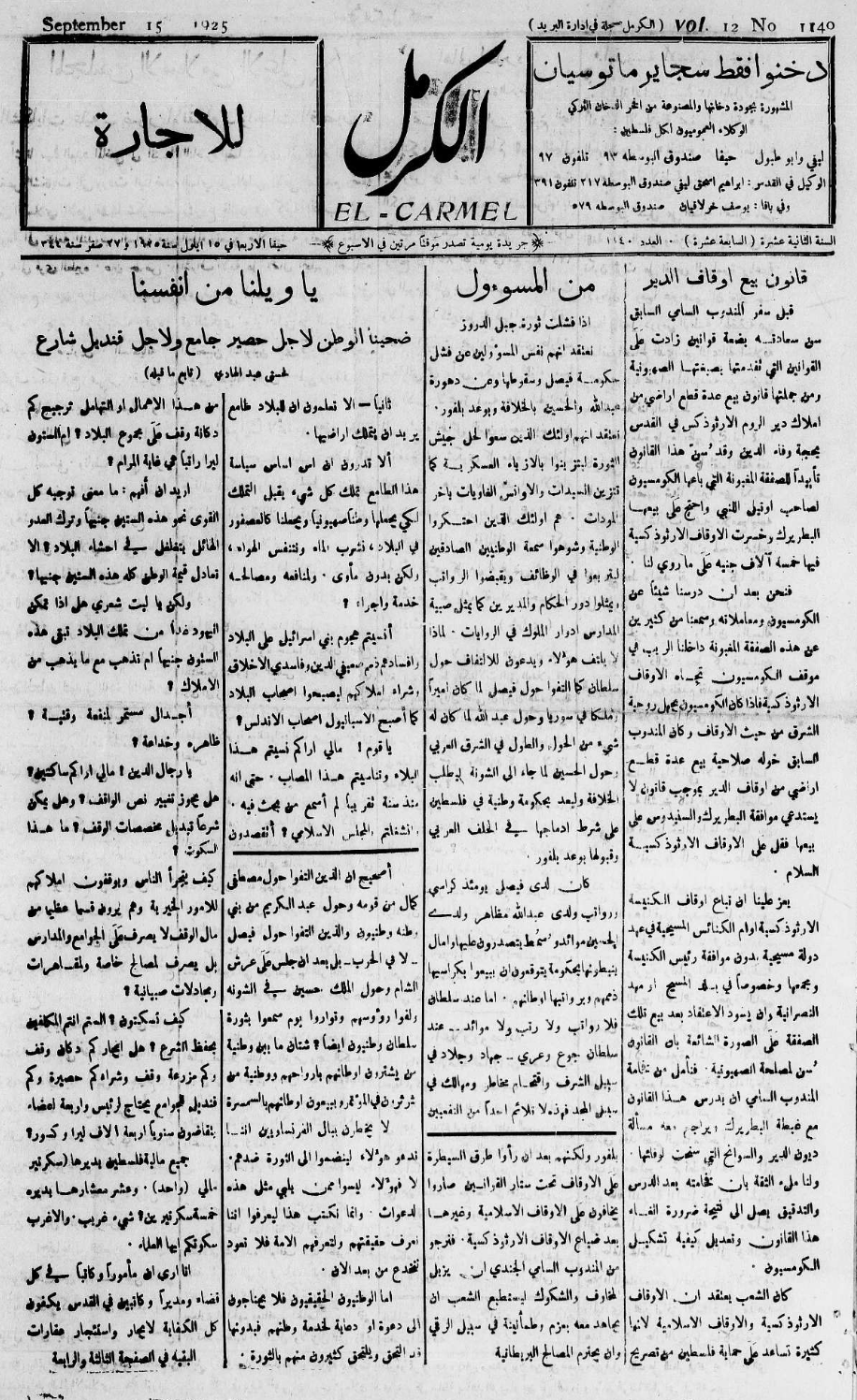
Al-Karmil was not Haifa’s only newspaper. The city also hosted Al-Nafir, which moved there from Jerusalem; the satirical Al-‘Asa li-man ‘Asa, established in 1912; Al-Zuhur, published by Jamil al-Bahri in 1927; and Al-Iqdam, founded in 1926, which moved to Jaffa in 1931 and continued until the Nakba. The daily Akhir Sa‘a appeared in 1938.
Filastin Newspaper in Jaffa
Its Founding and Ottoman Suppression
In January 1911, Issa Daoud al-Issa launched Filastin in Jaffa. His cousin Yusuf al-Issa served as editor-in-chief until the newspaper’s suspension during the First World War. Born in Jaffa in 1878, Issa studied at the institution now known as the American University of Beirut and worked in Jerusalem and Egypt before returning to his hometown.
Filastin began as a small twice-weekly publication and increasingly warned against Zionism and its expanding economic influence. In October 1913, Ottoman authorities closed it on charges of stirring communal tensions. It was suspended again during the war after advocating Ottoman neutrality. Its publisher was tried in Damascus and exiled to Anatolia, in late 1916 or 1917 according to differing accounts.
From a Periodical to a Daily Newspaper
Filastin resumed publication in March 1921, appearing three times a week, and became a daily in 1930. It also published an English-language edition between 1929 and approximately 1932. Known for its professionalism, extensive correspondent network, and accuracy, it became an influential newspaper in the Levant, reaching readers in both towns and villages.
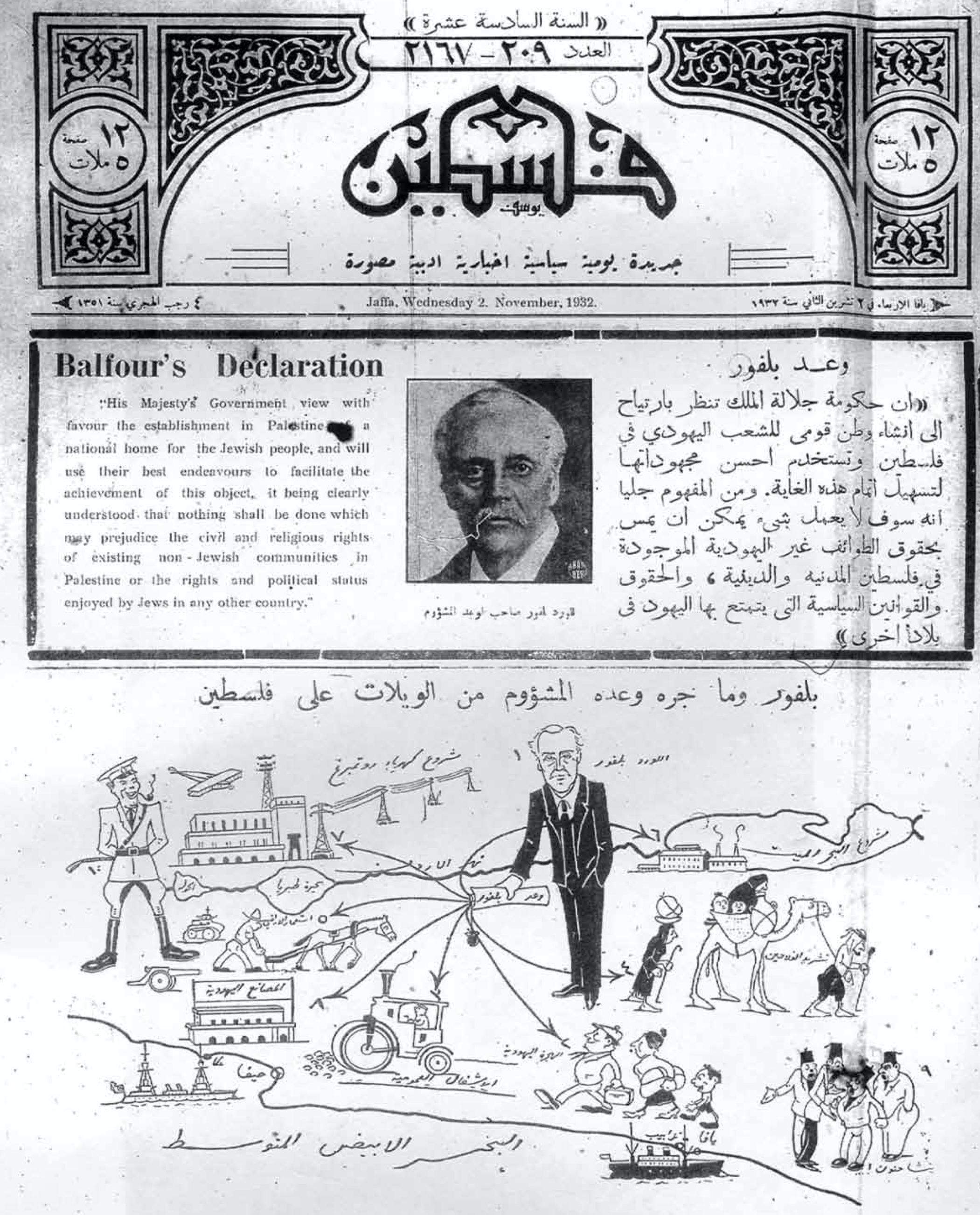
It was among the early Arab newspapers to feature political cartoons on its front page. Its coverage addressed the Balfour Declaration, Zionist immigration, British Mandate policies, the revolt that began in 1936, and the Second World War.
Its Fate in 1948
Filastin’s final Jaffa edition appeared on 7 April 1948, weeks before the city fell to Zionist forces. Issa al-Issa died as a refugee in Beirut in 1950. That same year, his son Raja resumed publication in East Jerusalem.
In 1967, Filastin merged with Al-Manar to form Al-Dustour, ending its existence as a separate newspaper. In 2025, Jordan’s Ward publishing house republished its archive in 75 volumes, following six years of collecting editions from libraries around the world.
Newspapers in Jerusalem and Jaffa Under the British Mandate
Following the British occupation, the press expanded alongside the Palestinian national movement. It flourished further during the 1930s as political parties emerged, publications multiplied, and major newspapers subscribed to international news agencies. Prominent titles included:
- Mir’at al-Sharq: Founded by Boulos Shehadeh in Jerusalem on 17 September 1919. By 1925, it was a twelve-page weekly. Ahmad al-Shuqayri became its editor in 1928, followed by Akram Zu‘aytir. British authorities suspended it repeatedly before closing it permanently in 1938 or 1939, according to differing accounts, after it published a poem calling for resistance to their policies.
- Al-Jami‘a al-‘Arabiyya: Founded by Munif al-Husayni in Jerusalem in either 1925 or 1927. It expressed the views of the Supreme Muslim Council. The Al-Aqsa Mosque Library preserves issues extending to 1936.
- Al-Sirat al-Mustaqim: Established by Abdullah al-Qalqili in Jaffa in September 1925 as a twice-weekly newspaper.
- Al-Jami‘a al-Islamiyya: Launched by Shaykh Sulayman al-Taji al-Faruqi in Jaffa on 16 July 1932 to expose Zionist ambitions. British authorities suspended it repeatedly before revoking its license on 24 June 1938.
- Al-Liwa: Established by Jamal al-Husayni in Jerusalem in late 1935 or 1936 and edited by Uthman Qasim. Its publication was short-lived.
- Al-Hayat: Published in Jerusalem from 1930 and edited by Akram Zu‘aytir. British authorities closed it in 1931.
Magazines and Printing Houses
Literary magazines such as Khalil Baydas’s Al-Nafa’is al-‘Asriyya complemented the newspapers. Newspapers themselves devoted space to poetry, short stories, and essays, making the press a platform for Palestinian literature as well as politics.
Some publications operated their own printing houses. Al-Karmil’s press in Haifa printed Najib Nassar’s books and a satirical newspaper, while Hanania’s Jerusalem printing house produced both books and newspapers.
Al-Difa and Ibrahim al-Shanti
Ibrahim al-Shanti was born in Jaffa in 1910 and graduated in political science from the American University of Beirut in 1933. He subsequently wrote for Al-Jami‘a al-Islamiyya and joined the Istiqlal Party.
In 1934, he founded Al-Difa in Jaffa with Sami al-Sarraj and Khayr al-Din al-Zirikli. Sources differ over whether its launch took place in February or April. The newspaper became associated with the Istiqlal Party, arguing that British colonialism lay at the root of Palestine’s crisis and that Zionism operated within that colonial framework. It criticized settlement and policies facilitating immigration.
Contributors included Abd al-Karim al-Karmi, known as Abu Salma, and Ibrahim Tuqan. Al-Difa became a widely read daily, reportedly selling between 6,000 and 10,000 copies a day in 1946. In 1943, al-Shanti purchased Al-Sirat al-Mustaqim and published it as an evening newspaper until 1946.
Challenging the Balfour Declaration and Land Sales
From its early years, the Palestinian press played an important role in political mobilization and opposition to land transfers:
- Explaining Zionism: Najib Nassar collected his writings in Zionism: Its History, Objectives, and Significance, published by Al-Karmil’s printing house in 1911. It was among the earliest Arabic books on the subject.
- Warning against land sales: In 1914, Nassar urged Arab landowners not to transfer their land to settlers, repeating his warnings in 1920. Al-Munadi was closed in July 1913 following its criticism of Zionist objectives.
- Opposing the Balfour Declaration: Issa al-Issa helped establish Jaffa’s Muslim-Christian Association to resist the declaration. On 12 December 1918, he signed a statement addressed to the peace conference rejecting the proposed Jewish national home.
- Boycotting pro-Zionist publications: Newspapers such as Barid al-Yawm and Lisan al-‘Arab struggled in the early 1920s as Arab readers boycotted publications they regarded as promoting Zionist interests.
British Censorship, Suspensions, and Imprisonment
Over three decades, British Mandate authorities closed newspapers, restricted access to information, imposed censorship, and imprisoned or banished journalists. The Press Ordinance No. 3 of 1933 regulated newspaper publication and printing-house ownership. Subsequent amendments strengthened the British High Commissioner’s power to suspend newspapers and prohibit their circulation.
Examples of repression included:
- The imprisonment of Khalil Baydas for his involvement in the unrest of 1920.
- The suspension of Al-Jami‘a al-Islamiyya in July 1934 on accusations of incitement, alongside the closure of Al-Shabab and Al-Wahda and the confiscation of their printing press that year.
- The detention of Akram Zu‘aytir several months after he began working at Mir’at al-Sharq, in 1929 or 1930, followed by his banishment to Nablus. He was banished again in 1931 after Al-Hayat was closed.
- The repeated detention of ‘Ajaj Nuwayhid because of his writings.
According to the historical account summarized here, wartime restrictions left only three Arabic newspapers authorized to appear during the Second World War: Al-Difa, Filastin, and Al-Sirat al-Mustaqim.
The Press During the 1936 General Strike and Revolt
On 19 April 1936, the National Committee in Nablus, whose secretary was journalist Akram Zu‘aytir, called for the general strike that lasted approximately six months. That year, the Mandate government introduced emergency regulations that included press censorship.
A study published in the Journal of Palestine Studies records 34 suspensions of Arabic daily newspapers during the first phase of the revolt. At times, all four daily newspapers were suspended simultaneously. Following the Peel Commission’s visit in 1937, three were suspended for more than a month.
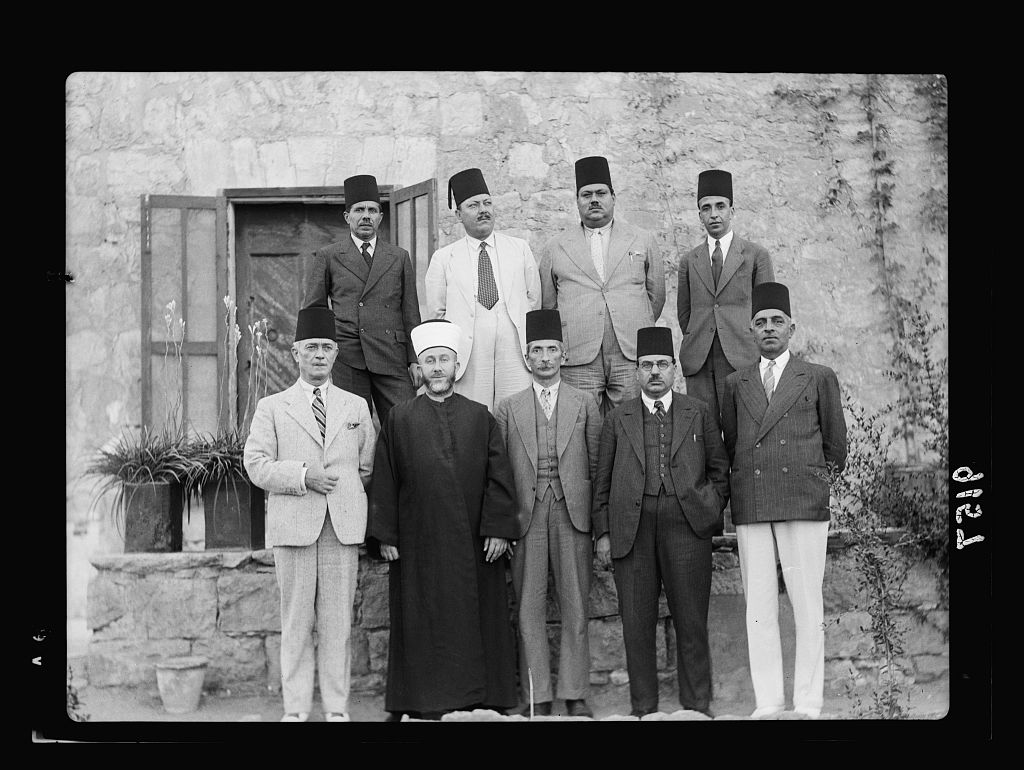
Repression extended beyond publication bans. British authorities detained Ibrahim al-Shanti after he organized a National Guard during the strike and imprisoned him at ‘Awja al-Hafir in the Naqab. Akram Zu‘aytir was held at the same detention camp.
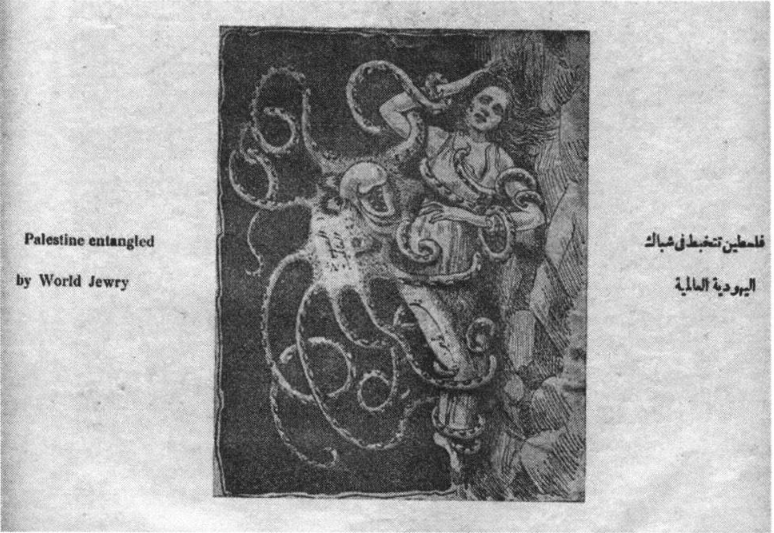
Meanwhile, Filastin intensified its use of front-page political cartoons, including images depicting Zionist expansion as consuming farmers’ citrus groves and fields.
What the Nakba Did to the Palestinian Press
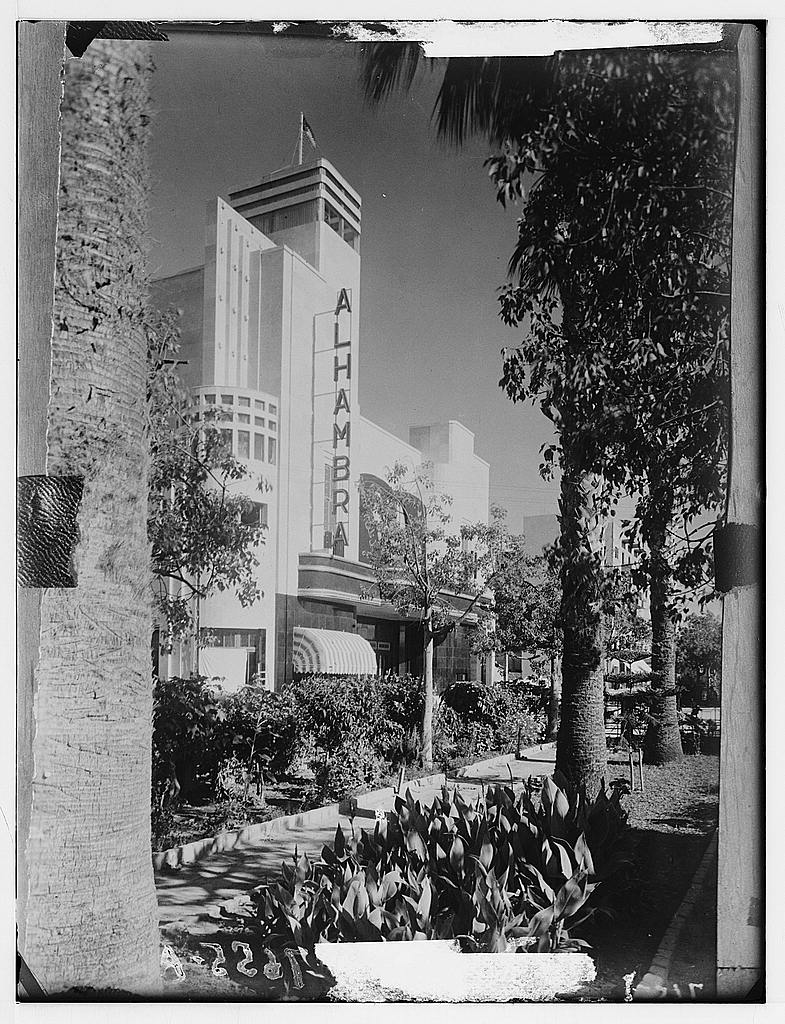
Before 1948, Jaffa was a major center of Palestinian journalism, with five newspapers alongside cinemas, printing houses, and cultural clubs. Its fall in May 1948 and the displacement of most of its Palestinian population devastated the institutions that sustained this public life.
The newspaper industries of Jaffa and Haifa were shattered. Printing equipment, paper stocks, and archives were looted or dispersed, and publications from Jaffa, Haifa, and Acre sought to continue elsewhere, including Jerusalem.
Many journalists became refugees. Najib Nassar died in Nazareth on 3 March 1948, weeks before Haifa fell. Issa al-Issa died in Beirut in 1950. Ibrahim al-Shanti settled in Cairo, where he published Al-Qahira between 1953 and 1957.
Al-Difa resumed publication in Jerusalem in 1950 and moved to Amman after the occupation of East Jerusalem in 1967. Sources differ over its final publication date, placing it between 1967 and 1970. Al-Shanti died in Amman in 1979.
The Nakba uprooted a newspaper culture that had developed over decades of political struggle. Publications born in Jaffa and Haifa continued, when possible, in displacement and exile. Surviving issues in the Al-Aqsa Mosque Library and libraries around the world remain evidence of a modern Palestinian society that read, wrote, and debated long before 1948.
Frequently Asked Questions About the Palestinian Press Before the Nakba
What was the first Arabic newspaper in Palestine?
The official Ottoman newspaper Al-Quds al-Sharif appeared in 1876. Accounts of the first privately owned Arabic newspaper differ: some historians identify Al-Taraqqi in 1907, while others emphasize Jurji Habib Hanania’s Al-Quds, launched on 5 September 1908.
Who founded Filastin newspaper?
Issa Daoud al-Issa founded Filastin in Jaffa in 1911, with Yusuf al-Issa as its first editor-in-chief. It became a daily in 1930, and its final Jaffa edition appeared on 7 April 1948.
Who founded Al-Difa newspaper?
Ibrahim al-Shanti founded Al-Difa in Jaffa in 1934 with Sami al-Sarraj and Khayr al-Din al-Zirikli. Associated with the Istiqlal Party, it became one of the most widely circulated Palestinian newspapers of the 1940s.
How did British Mandate authorities suppress the Palestinian press?
They used the 1933 Press Ordinance and subsequent amendments, emergency regulations introduced in 1936, repeated newspaper suspensions, censorship, and the imprisonment or banishment of journalists.
What happened to Palestinian newspapers after the Nakba?
The newspaper industries of Jaffa and Haifa were devastated, and printing houses and archives were looted or dispersed. Filastin and Al-Difa resumed publication in Jerusalem in 1950 and continued into the late 1960s, with accounts placing Al-Difa’s final closure between 1967 and 1970.
More from the archive
 Download Our Palestine App
The whole archive in the palm of your hand: depopulated villages, the Nakba, the massacres and Al-Aqsa — free, with no ads to erase the story.





Comments
No comments yet — be the first to write one.
Add your comment
Name and email are optional. Comments appear after review.