
Yarmouk Martyrs Cemetery: Guardian of Palestinian Memory
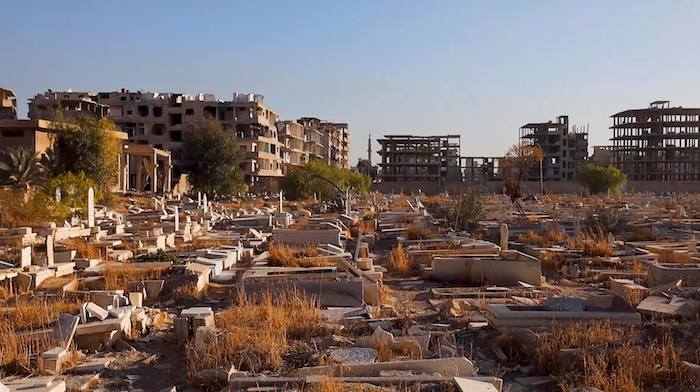
On the edge of Yarmouk camp south of Damascus lie two martyrs’ cemeteries, whose gravestones bear the names of fedayeen, leaders and refugees from Palestine’s towns and villages. Since its first funeral in 1964, the “Martyrs’ Cemetery” has been the resting place of those the occupation would not let return home, and a living memory for the largest community of Palestinian refugees in Syria. [1][2]
Khalil al-Wazir “Abu Jihad,” Fathi al-Shiqaqi and others are buried there, but the war in Syria left the cemeteries in ruins, and many families still search the rubble for their loved ones’ graves. [3][2][4]
Contents
- The two cemeteries at a glance
- Yarmouk camp
- The first cemetery: the first martyrs’ resting place outside Palestine
- Abu Jihad in the Martyrs’ Cemetery
- The new cemetery
- Guardian of memory
- The cemeteries in the war
- Frequently asked questions
The two cemeteries at a glance
| Item | First (old) cemetery | New cemetery |
|---|---|---|
| Founded | Mid-1960s; first burial on 7 November 1964 | 1980 |
| Location | Near Harat al-Maghariba on the edge of Yalda | End of Yarmouk Street, on 50 dunams |
| First burial | The martyrs Mufleh al-Salem and Ali al-Kharboush | Lutfi Hijazi “Abu Fahd” |
| Among those buried | Munhal Shadid, Zuhair Mohsen | Fathi al-Shiqaqi, Jihad Jibril, Izz al-Din al-Sheikh Khalil |
Yarmouk camp
Yarmouk camp was established between 1954 and 1957, about eight kilometres south of central Damascus, on roughly two square kilometres, to house refugees driven out of Palestine by Zionist forces in 1948. It became one of the largest Palestinian camps in the diaspora: registered refugees exceeded 112,000 in 2002, while Palestinian sources put its real population at over 220,000. [7]
Read also: Palestinian refugee camps; The Palestinian Nakba.
The first cemetery: the first martyrs’ resting place outside Palestine
Until the mid-1960s, Palestinians in Damascus buried their dead in the city’s cemeteries, among them al-Dahdah. Then the first Martyrs’ Cemetery was established near Harat al-Maghariba on the edge of Yalda, the first resting place for Palestine’s martyrs outside their homeland; it was followed by one in Wahdat camp in Amman and a third in Beirut. [1]
On 7 November 1964 the first two martyrs were buried there: Mufleh Muhammad al-Salem of Saffuriyya and Ali al-Kharboush of Arraba al-Battuf, fighters of the Palestinian Fedayeen Battalion 68 in the Syrian army, who were killed in a fedayeen operation in Galilee and whom the occupation refused to allow to be buried in their villages. [5]
The third burial was Lieutenant Muhammad Hishma, killed in an accident at a Fatah position in al-Shaalan. Large fedayeen funerals followed, among them those of Munhal Shadid of Allar in the Tulkarm district in February 1967, attended by Yasser Arafat, and of Zuhair Mohsen, commander of al-Sa‘iqa. [1]
Abu Jihad in the Martyrs’ Cemetery
On 16 April 1988 an Israeli unit assassinated Khalil al-Wazir “Abu Jihad,” architect of the Stone Intifada, at his home in Sidi Bou Said near Tunis. On 21 April 1988 he was buried in the Martyrs’ Cemetery in Yarmouk camp, and his grave became one of its best-known landmarks. [3]
The new cemetery
As the first cemetery filled up, the new Martyrs’ Cemetery opened in 1980 on 50 dunams at the end of Yarmouk Street. By coincidence, Lutfi Hijazi “Abu Fahd” died on the day it opened and became its first burial. [2][6]
Palestinian leaders buried there include Fathi al-Shiqaqi, secretary-general of Islamic Jihad (1995), Jihad Jibril (2002) and Izz al-Din al-Sheikh Khalil (2004). [2]
Guardian of memory
The two cemeteries were never just burial grounds: they became part of the camp’s identity, where families and factions commemorate their dead on national occasions, and their gravestones carry the names of Palestine’s towns and villages, keeping the map of the homeland alive in the land of exile. [2]
The cemeteries in the war
During the war in Syria Yarmouk camp was besieged and shelled, and in early April 2015 the Islamic State group stormed it and took most of it. The 2018 military campaigns brought the heaviest bombardment on the two cemeteries, damaging the new cemetery and breaking its gravestones. [7][4]
In June 2019 Russian forces dug up the old cemetery, and in 2020 they pitched tents among the graves to search for the remains of two Israeli soldiers missing since 1982, barring civilians from visiting. [8][4]
As of February 2025 the old cemetery had not been entered or cleared of mine remnants and there was no plan to restore it, while families search on their own for their relatives’ graves, comparing old photographs with what remains because the cemetery’s landmarks are no longer clear. [4]
Yet Yarmouk’s two martyrs’ cemeteries remain witnesses to a generation of refugees who carried Palestine into exile, and to martyrs who could return to their villages only as names carved on their gravestones.
Frequently asked questions
When was the Martyrs’ Cemetery in Yarmouk founded?
The first cemetery was set up in the mid-1960s, with its first burial on 7 November 1964; the new cemetery opened in 1980. [5][2]
Who was buried there first?
The martyrs Mufleh Muhammad al-Salem of Saffuriyya and Ali al-Kharboush of Arraba al-Battuf. [5]
Is Abu Jihad buried in the Yarmouk Martyrs’ Cemetery?
Yes; he was buried there on 21 April 1988 after his assassination in Tunis. [3]
Which leaders are buried in the new cemetery?
Among them Fathi al-Shiqaqi, Jihad Jibril and Izz al-Din al-Sheikh Khalil. [2]
How large is the new cemetery?
About 50 dunams at the end of Yarmouk Street. [2]
What happened to the cemeteries during the war in Syria?
They were shelled and gravestones were broken, and Russian forces dug up the old cemetery in 2019. [4][8]
Has the old cemetery been restored?
No; as of February 2025 it had not been cleared of mine remnants and there was no restoration plan. [4]
Read also on Palestinuna
Sources and references
- Ali Badwan, “The Palestine Martyrs’ Cemetery in Yarmouk,” Diwan al-Arab, 2 May 2019 (in Arabic).
- Hussam Zeidan, “The Martyrs’ Cemetery in Yarmouk: Guardian of Palestinian Memory,” al-Manar, 19 December 2019 (in Arabic).
- “Khalil al-Wazir (Abu Jihad), Architect of the Stone Intifada,” Al Jazeera Encyclopedia, 10 June 2025 (in Arabic).
- Bisan Khalaf, “The Cemeteries of Yarmouk and Jobar: Searching among the Rubble,” Enab Baladi, 24 February 2025 (in Arabic).
- Ali Badwan, “The First Two Martyrs in the Palestine Martyrs’ Cemetery in Yarmouk,” Diwan al-Arab, 4 July 2018 (in Arabic).
- Khalil al-Samadi, “Landmarks of the Camp,” from Memories of Yarmouk Camp, Romman Magazine (in Arabic).
- “Yarmouk Camp,” Al Jazeera Encyclopedia (in Arabic).
- “Yarmouk Camp: The Russians Dig Up the Old Martyrs’ Cemetery,” al-Modon, 11 June 2019 (in Arabic).
More from the archive
 Download Our Palestine App
The whole archive in the palm of your hand: depopulated villages, the Nakba, the massacres and Al-Aqsa — free, with no ads to erase the story.



Comments
No comments yet — be the first to write one.
Add your comment
Name and email are optional. Comments appear after review.