
Far'a Refugee Camp
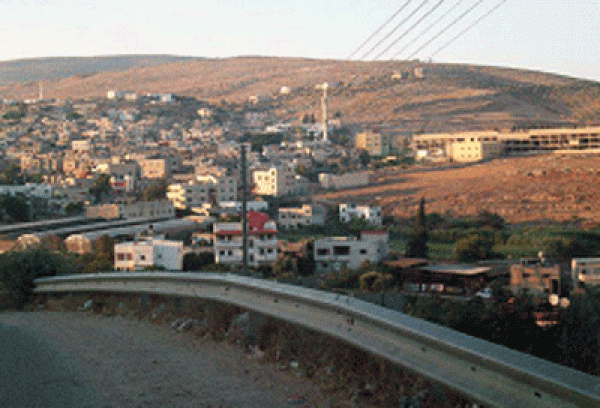
Far'a Refugee Camp
Far'a Refugee Camp in Tubas: History, Villages of Origin, the Far'a Prison and the Current Situation
Far'a Camp lies in the foothills of the Jordan Valley, south of Tubas and 17 km north-east of Nablus, beside the Far'a spring that gives it its name. It was established in for refugees from villages of the Haifa and Jaffa districts, among them al-Kafrayn, Sabbarin, Umm al-Zinat, Qannir and Biyar Adas. Next to the camp stood the notorious al-Far'a detention centre, used by Israel for interrogation from 1982. Since 2024, the camp has faced repeated military operations, and in November 2025 a 15-year-old pupil was killed during a raid. This guide covers its history, origins, population and current situation.
Quick Facts About Far'a Camp
| Arabic name | مخيم الفارعة |
|---|---|
| Country / Region | Palestine, northern West Bank |
| Governorate | Tubas, south of the city of Tubas |
| Year established | |
| Area | About 0.26 km² (about 255 dunums) |
| Registered refugees | About 8,761 (UNRWA) |
| Residents | 5,625 (Palestinian census, 2017) |
| Origin of residents | Villages of the Haifa and Jaffa districts, and some from the Tulkarm district |
| Known for | Its water spring, its rural setting, and the former al-Far'a detention centre |
The Nakba: Why Far'a Camp Exists
Far'a Camp was born from the Nakba (Arabic for "catastrophe"): the mass expulsion of Palestinians during the occupation of Palestine in . Roughly 750,000 Palestinians were driven from their homes. The villages of Mount Carmel and the Bilad al-Ruha area in the Haifa district, and of the coastal plain north-east of Jaffa, were emptied in the spring and summer of 1948. Their people fled east into the hills of Jenin and Nablus, and some settled near the Far'a spring.
The Right of Return
The right of return is the central demand of Far'a's refugees. It rests on several foundations in international law:
- UN General Assembly Resolution 194 (), paragraph 11, resolved that refugees wishing to return to their homes and live at peace with their neighbours should be permitted to do so at the earliest practicable date, and that compensation should be paid to those choosing not to return and for loss of or damage to property.
- The Universal Declaration of Human Rights (Article 13) affirms everyone's right to leave any country, including their own, and to return to it.
- UN General Assembly Resolution 3236 () reaffirmed the "inalienable right" of Palestinians to return to their homes and property.
History of the Camp
Founding (1949)
The camp was established in 1949 on about 255 dunums of land in Wadi al-Far'a. It is one of the few camps in the West Bank supplied with water by a nearby spring.
Under occupation (1967–1998)
The camp came under Israeli military rule with the occupation of the West Bank in , and its people took part in both Intifadas. It remained under Jordanian and then Israeli control for almost fifty years, until November 1998, when it came under full Palestinian Authority control following the Wye River Memorandum.
The Second Intifada and after
Like other camps of the northern West Bank, Far'a was frequently raided during the Second Intifada and in the years that followed, with raids intensifying sharply from 2023 onward.
The Far'a Prison
Beside the camp stands a compound originally built by the British as an army camp, and later used for the same purpose under Jordanian rule. From 1982, the Israeli army used it as a detention and interrogation centre, which became notorious among Palestinians. A report by the human rights organisation Al-Haq, based on detainees' affidavits, concluded that its main purpose was to facilitate torture. After the Oslo Accords, the former prison was turned into a youth centre.
The Current Situation (2024–2026)
Since 2024, Far'a has been among the camps most targeted in the northern West Bank:
- June 2024: A large force with bulldozers carried out a wide operation in the camp, raiding homes, cutting electricity and killing a 15-year-old boy.
- August–September 2024: Far'a was among the camps targeted in Israel's largest West Bank operation in two decades.
- Early 2025: The Israeli operation launched in the northern West Bank in January 2025 extended to the Tubas area, including Tammun and Far'a.
- 8 November 2025: A 26-year-old man was killed by live fire during confrontations in the camp.
- 16 November 2025: A 15-year-old ninth-grade pupil at the camp's UNRWA boys' school was shot dead during a raid. Ambulance crews were prevented from reaching him and his body was withheld; two others were wounded and a third was arrested.
- May 2026: A five-hour raid in which forces detained and interrogated 12 residents, including a woman.
- August–September 2026: Repeated raids, including one on 29 August in which six people were treated for tear gas suffocation, and others on 27 and 29 September.
These operations come as the camps of Jenin, Tulkarm and Nur Shams have been emptied of their residents since January 2025, raising fears that Far'a could face the same fate.
Origin of the Name
The camp takes its name from the Far'a spring (عين الفارعة) and Wadi al-Far'a, the valley in which it lies and from which it draws its water. The name is also spelled Fara'a, Faraa or al-Fari'ah.
Location and Geography
Far'a Camp lies in the Tubas Governorate, in the foothills of the Jordan Valley, about 17 km north-east of Nablus, a few kilometres south of Tubas and about 3 km north-west of Tammun. Unlike most camps, it lies in a rural area surrounded by farmland. Nearby is the archaeological site of Tirzah.
Area
The camp covers about 0.26 km² (about 255 dunums). Because land around the camp is relatively cheap, some families have been able to build outside it, so Far'a suffers less from overcrowding than most other camps.
Villages of Origin
Far'a's refugees come mainly from villages in the north of Palestine, most of them in the Haifa district and north-east of Jaffa:
- Haifa district: Al-Kafrayn, Sabbarin, Umm al-Zinat, Qannir and Al-Rihaniyya
- Jaffa district: Biyar Adas and Al-Sawalima
- Tulkarm district: Umm Khalid and Bassat al-Faliq (Birkat Ramadan)
Population and Demographics
Population of Far'a Camp
- 20057,244 registered refugeesUNRWA
- 20065,750 residentsPalestinian Central Bureau of Statistics
- 20158,761 registered refugeesUNRWA
- 20175,625 residentsPalestinian Central Bureau of Statistics
Note: Registered refugees are not the same as residents. Many refugees registered in Far'a have moved to land around the camp, so the census, which counts only those living inside it, records fewer people.
Living and Economic Conditions
Far'a's isolation makes many services accessible only in Jenin and Nablus. Most of the workforce is employed in agriculture, and some in construction, including in Jordan Valley settlements. The surrounding farmland offers some economic relief, but residents consistently name unemployment and poverty as their most pressing problems. In 2005, nearly 900 families depended on UN food rations.
Education and Health
In 1996, UNRWA built two schools in the camp with funding from the European Union, one for boys and one for girls, serving about 1,800 to 2,000 pupils. Secondary students attend schools in Tubas and nearby towns. UNRWA also provides primary health care to the camp's refugees, while residents rely on hospitals in Tubas, Jenin and Nablus for more advanced care.
Frequently Asked Questions About Far'a Camp
Where is Far'a refugee camp located?
It lies in the Tubas Governorate, in the foothills of the Jordan Valley, about 17 km north-east of Nablus and south of the city of Tubas.
Why is it called Far'a?
The camp is named after the Far'a spring and Wadi al-Far'a, the valley in which it lies and from which it draws its water.
What was the Far'a prison?
A British-built army compound beside the camp that Israel used from 1982 as a detention and interrogation centre, notorious for torture according to human rights reports. After the Oslo Accords it became a youth centre.
Where do Far'a's refugees come from?
Mainly from villages in the Haifa district, such as al-Kafrayn, Sabbarin, Umm al-Zinat, Qannir and al-Rihaniyya, and from Biyar Adas and al-Sawalima in the Jaffa district.
What is happening in Far'a Camp now?
The camp has faced repeated Israeli raids since 2024. In November 2025, a 15-year-old pupil was killed during a raid, and raids continued throughout 2026.
Conclusion
Far'a is a rural camp beside a spring in the foothills of the Jordan Valley, founded by refugees from the villages of Mount Carmel and the coastal plain. It lived for decades beside one of the occupation's most notorious detention centres, and today faces repeated raids that have claimed the lives of its children. Its people continue to hold onto the right to return.
More from the archive



 Download Our Palestine App
The whole archive in the palm of your hand: depopulated villages, the Nakba, the massacres and Al-Aqsa — free, with no ads to erase the story.
Download Our Palestine App
The whole archive in the palm of your hand: depopulated villages, the Nakba, the massacres and Al-Aqsa — free, with no ads to erase the story.



Comments
No comments yet — be the first to write one.
Add your comment
Name and email are optional. Comments appear after review.