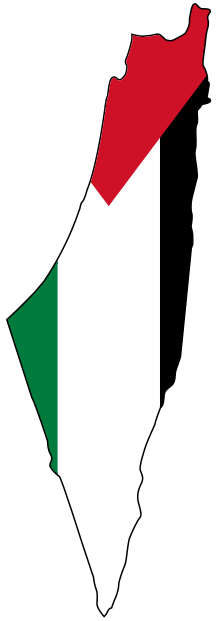
The depopulated village of Al-Tantura / District of Haifa

Al-Tantura
About the depopulated village of Al-Tantura
- District
- Haifa
- Date Al-Tantura was occupied
- 22 May 1948
- Population in 1948
- 1,728
- Brigade that carried it out
- Alexandroni Brigade
- Distance from the governorate centre
- 24 km south of Haifa
- Elevation above sea level
- 25 m
- Cause of displacement
- Direct military assault by Israeli occupation forces, followed by a massacre and the expulsion of the inhabitants
- Extent of destruction
- The village has been mostly destroyed with the exception of few houses remain.
- Ethnic cleansing
- al-Tantura inhabitants were completely ethnically cleansed.
- Settlements built on the built-up area of Al-Tantura after 1948
- Kibbutz Nachsholim, established in June 1948 on village lands northeast of the village site; and the settlement of Dor, established in 1949 east of the village site
- Refugees' migration routes
- Some of the refugees went to the Triangle, while as many as 1,200 were expelled to nearby al-Furaydis.
Hover a dot to read the village name, or click to open its card.
Borders of the depopulated village of Al-Tantura
al-Tantura: A Depopulated Palestinian Village in the Haifa District
al-Tantura was a Palestinian coastal village in the Haifa District, located approximately 24 kilometres south of the city of Haifa on a small hill rising slightly above the sandy Mediterranean shore, at an average elevation of about 25 metres above sea level. The village was occupied by the 33rd Battalion of the Alexandroni Brigade on the night of 22–23 May 1948, and its inhabitants were displaced during the Nakba and the occupation of Palestine in 1948. Palestinian sources and survivor testimonies also document a massacre following the capture of the village, although estimates of the precise number of victims vary.
- Subdistrict
- Haifa
- Distance from district center
- 24 km south of Haifa
- Average Elevation
- 25 m above sea level
- Population in 1931
- 953
- Number of Houses in 1931
- 202
- Population in 1944/1945
- 1,490
- Estimated Population in 1948
- About 1,728 – a later demographic estimate, not an official census
- Total Land Area in 1945
- 14,520 dunams
- Attack and Depopulation
- The 33rd Battalion (the Third Battalion of the Alexandroni Brigade) attacked the village on the night of 22–23 May 1948 and it fell after a brief battle; Israeli occupation forces then committed a massacre in the village, whose death toll differs between sources. As many as 1,200 of its inhabitants were then expelled to the neighbouring village of al-Furaydis, while others went to the Triangle region.
- Final Israeli Control
- 22–23 May 1948 (at night), according to the History of the War of Independence as cited by Khalidi, and according to studies published by the Institute for Palestine Studies
- Military Unit
- The Haganah's 33rd Battalion (the Third Battalion of the Alexandroni Brigade), according to the History of the War of Independence as cited by Khalidi
- Cause of Depopulation
- Direct military assault by Israeli occupation forces, followed by a massacre and the expulsion of the inhabitants
- Settlements Documented on Village Lands
- Kibbutz Nachsholim, established in June 1948 on village lands northeast of the village site; and the settlement of Dor, established in 1949 east of the village site
Location
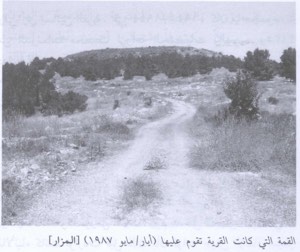
al-Tantura stood on a small hill rising slightly above the sandy Mediterranean shore south of Haifa.
A secondary road linked the village with the main coastal highway leading to Haifa and other urban centres. The village also had a railway station serving the coastal railway line.
Its small harbour lay immediately north of the village, on the edge of a peninsula extending into the sea. Its coastal position contributed significantly to fishing and local trade.
al-Tantura was bordered by Kafr Lam to the north, the Mediterranean Sea to the west, Qisarya to the south, al-Furaydis to the east, and Ayn Ghazal to the northeast.
```al-Tantura and Ancient Dor
al-Tantura stood near the remains of ancient Canaanite Dor, one of the important historical coastal cities of Palestine.
```The name Dor appears in an inscription dating to the thirteenth century BCE and in the Egyptian account of Wen-Amun from around 1100 BCE.
Ancient sources associate Dor with the Tjekker, who settled there during the twelfth century BCE. By the fourth century BCE, the town was associated with Sidon, and in later periods it was also known as Dora.
During the Crusader period, a fortress known as Merle was constructed at the site. In 1799, retreating troops from Napoleon's campaign burned the village.
The story that the Arabic name “al-Tantura” resulted from combining “Dora” with the Egyptian town of Tanta following the settlement of Egyptian soldiers is not supported by the principal Palestinian sources reviewed and is therefore not presented here as established history.
```Architecture and Public Facilities
The stone houses of al-Tantura were built close to the sandy shore, and the village generally extended along a north–south axis.
```The village contained a khan or guesthouse, a small harbour, and a railway station.
The built-up area amounted to approximately 123 dunams in the 1944/1945 statistics: 119 dunams of Arab-owned land, 3 dunams of Jewish-owned land, and 1 dunam of public land.
```Education
al-Tantura had two elementary schools. The boys' school was built around 1889, while the girls' school was established in 1937/1938.
```Traditional kuttab education also existed in the village, teaching reading, writing, basic arithmetic, and the Qur'an.
Local accounts state that the boys' school reached the seventh grade and the girls' school the fourth grade. Since these details do not appear in the principal account used by Walid Khalidi, they are not treated here as fixed official statistics.
```Population
In the late nineteenth century, al-Tantura's population was estimated at approximately 1,200.
```The 1922 Census of Palestine recorded approximately 750 inhabitants.
In the 1931 census, the total population reached 953, including 952 Arabs, living in 202 houses.
According to the 1944/1945 Village Statistics, al-Tantura had 1,490 Arab inhabitants.
The estimate of approximately 1,728 inhabitants in 1948 and 10,614 refugees and descendants in 1998, published by Palestine Remembered, are later estimates rather than official censuses of the Government of Palestine.
Population of al-Tantura
- Late nineteenth centuryAbout 1,200Historical estimate
- 1922750Official census
- 1931953Official census
- 1944/19451,490Government of Palestine statistics
- 1948About 1,728Later estimate
- 199810,614Estimate of refugees and their descendants
Number of Houses
The official 1931 census recorded 202 houses in al-Tantura.
```Land of al-Tantura
The total land area of al-Tantura amounted to approximately 14,520 dunams according to the 1944/1945 statistics.
```Arab ownership amounted to 11,758 dunams, Jewish ownership to 2,051 dunams, while 711 dunams were classified as public land.
Land Ownership in al-Tantura in 1944/1945
- Arab ownership11,758 dunums81%
- Jewish ownership2,051 dunums14%
- Public land711 dunums5%
Agriculture and Economic Life
al-Tantura's economy depended on agriculture, fishing, and livestock raising. Its coastal location and small harbour made fishing a particularly important activity.
```During the British Mandate period, the quantity of fish caught increased dramatically, from approximately 6 tons in 1928 to more than 1,600 tons in 1944 according to the material used by Walid Khalidi.
The villagers cultivated wheat, barley, sesame, pulses, vegetables, citrus fruit, olives, figs, and other crops.
According to the 1944/1945 statistics, 8,325 dunams were cultivated or suitable for cultivation, representing approximately 57 percent of the village's total land area.
Cereal cultivation covered 7,439 dunams: 6,593 Arab-owned dunams, 662 Jewish-owned dunams, and 184 dunams of public land.
Irrigated and plantation land covered 860 dunams, including 287 Arab-owned and 573 Jewish-owned dunams. Citrus and bananas occupied a further 26 Arab-owned dunams.
Walid Khalidi reports approximately 270 dunams planted with olive trees, while the statistical table published by Palestine Remembered gives a figure of 20 dunams. Because of this discrepancy, Khalidi's figure is noted separately and is not added to the land-use totals.
Land Use in al-Tantura in 1944/1945, in Dunams
- Arab
- Jewish
- Public
- Cereals7,439 dunums
- Irrigated and plantation land860 dunums
- Citrus and bananas26 dunums
- Built-up area123 dunums
- Uncultivable land6,072 dunums
Archaeology
The al-Tantura–Dor area is one of the important archaeological zones on the Palestinian coast.
```Underwater excavations near the shore uncovered ship anchors dating to several historical periods, while a Byzantine basilica was excavated on the northern slopes of Tall al-Burj.
At Khirbat al-Mazra'a to the south are the remains of the Crusader castle known as Casal de Châtillon, including a square vaulted tower.
Further archaeological remains were also reported at Khirbat Dirayhima northeast of the village.
The statement that all neighbouring archaeological sites or inscriptions date to the thirteenth century BCE is inaccurate. That date relates specifically to one of the earliest known written references to ancient Dor.
```The Nakba and the Occupation of al-Tantura
```The Situation Before the Assault
By the beginning of May 1948, al-Tantura was one of the last Palestinian villages remaining along the coastal strip between the Zikhron Ya'aqov area and Tel Aviv.
On 9 May, local Haganah intelligence officers and experts on Arab affairs met to determine the fate of al-Tantura and several other villages. PalQuest, through Walid Khalidi, reproduces Benny Morris's account that the decision was to subdue or expel the inhabitants.
This information is included here only as transmitted through the Palestinian source and not through direct reliance on the original Israeli source.
The Assault of 22–23 May
The 33rd Battalion, the Third Battalion of the Alexandroni Brigade, attacked al-Tantura on the night of 22–23 May 1948.
Fighting took place between the attacking force and the village defenders before the Alexandroni forces gained control of al-Tantura by the morning of 23 May.
The most precise formulation is therefore that the assault occurred during the night of 22–23 May and that the occupation was completed on 23 May 1948.
A source discrepancy should be noted: some statistical listings published by Palestine Remembered, as well as an intelligence document reproduced by PalQuest, give 21 May. The detailed chronology in Walid Khalidi's account and studies published by the Institute for Palestine Studies, however, consistently places the battle and capture on the night of 22–23 May.
```Occupation and Depopulation Chronology
- 9 May 1948
Decision to expel or subdue the inhabitants
A meeting of local Haganah intelligence officers and Arab affairs experts was held to decide the fate of al-Tantura and a handful of other villages, and the decision taken was to 'expel or subdue' them, according to Benny Morris as cited by Khalidi. Al-Tantura was then one of the last remaining Arab villages on the coastal plain stretching from the Zikhron Ya'aqov area south of Haifa to Tel Aviv.
- 22–23 May 1948
Final occupation
The Haganah's 33rd Battalion (the Third Battalion of the Alexandroni Brigade) attacked the village at night and it fell after a brief battle, according to the History of the War of Independence as cited by Khalidi; according to Morris, the village had refused the Haganah's surrender terms. An Israeli military communiqué issued on 23 May 1948 and quoted by the New York Times stated that 'hundreds of Arabs' had fallen into the attacking forces' hands.
- 22–23 May 1948
Massacre
Israeli occupation forces committed a massacre in the village, which PalQuest dates to 22 May and studies published by the Institute for Palestine Studies date to 22–23 May 1948. The death toll differs between sources: 230 people according to some estimates cited by PalQuest, and 'more than 200' villagers, mostly unarmed young men, shot after the village surrendered, according to Teddy Katz's 1998 research as presented in the Journal of Palestine Studies.
- Late May 1948
Expulsion of the inhabitants
After the fall of the village, as many as 1,200 of its inhabitants were expelled to the neighbouring village of al-Furaydis, which had been captured earlier, while some went to the Triangle region. At the end of May, Israeli minister Bechor Shitrit asked Prime Minister David Ben-Gurion whether the al-Tantura refugees should be expelled from al-Furaydis as well.
- June 1948
Settlement on village lands
Zionist immigrants from the United States and Poland established Kibbutz Nachsholim on village lands, northeast of the village site.
- Summer 1948
Expulsion of the remaining inhabitants
According to Morris as cited by Khalidi, by the summer most of the al-Tantura refugees had been expelled from Israeli-held territory, and some 200 remained in al-Furaydis, mostly women and children whose male relatives were in Israeli detention.
- 1949
Settlement on village lands
Zionist immigrants from Greece established the settlement of Dor east of the village site.
The Tantura Massacre
Studies and Palestinian testimonies published by the Institute for Palestine Studies document a massacre in al-Tantura after the battle ended and Alexandroni forces took control of the village.
```Written Palestinian references to the massacre appeared soon after the Nakba. Around 1950, Muhammad Nimr al-Khatib published accounts from al-Tantura residents, including testimonies associated with Iqab al-Yahya and his son Marwan.
Palestinian researcher Mustafa al-Wali later collected dozens of oral testimonies from former villagers, more than twenty of which were published by the Institute for Palestine Studies. These testimonies describe killings and executions following the capture of the village.
In 1998, researcher Teddy Katz conducted a university study based on recorded testimony from Palestinians and members of the Alexandroni Brigade. His research concluded that more than 200 villagers, most of them unarmed men, were killed after the village surrendered. A study published in the Journal of Palestine Studies discusses evidence indicating approximately 200 post-battle deaths, including testimony from a person involved in burials who estimated that 230 bodies were counted.
The exact death toll nevertheless varies between accounts and studies. Some early Palestinian testimony specifically documented the execution and communal burial of around forty young men in one episode, while later oral-history research placed the overall number of victims above 200.
This article therefore concludes that a large-scale massacre took place at al-Tantura after its capture, while avoiding the presentation of 220 or 230 as an undisputed final death toll.
Testimonies describe the separation of men from women and children, the detention of male villagers, executions, and burial in a mass grave or graves. Highly specific details that cannot be independently corroborated, such as a single precise age range for all detainees or the role of a particular named officer, have not been presented as established facts.
```Displacement and Fate of the Population
After the capture of al-Tantura, approximately 1,200 inhabitants were transferred or expelled to the nearby village of al-Furaydis, while others went toward the Triangle region.
```A number of surviving men were detained in prison camps, and some were later transferred outside Israeli-controlled territory in prisoner exchanges.
By the summer of 1948, most of the al-Tantura refugees remaining within Israeli-held territory had been expelled. Approximately 200 remained in al-Furaydis, mainly women and children whose male relatives were being detained.
Many former residents of al-Tantura later became refugees in Syria, Jordan, and other parts of the Palestinian diaspora.
```Israeli Settlements Established on the Lands of al-Tantura
```Nachsholim
Kibbutz Nachsholim was established in June 1948 on the lands of al-Tantura, northeast of the Palestinian village site.
Dor
The settlement of Dor was established in 1949 east of the village site on the lands of al-Tantura.
It is therefore inaccurate to list Dor as the only settlement established on al-Tantura's lands after the Nakba. At the same time, the existence of 2,051 dunams of Jewish-owned land before 1948 does not by itself mean that a Jewish settlement had already been established on the Palestinian village's built-up site.
- 1948Nachsholim
Established on al-Tantura's lands northeast of the village site
- 1949Dor
Established on al-Tantura's lands east of the village site
The Site of al-Tantura After the Nakba
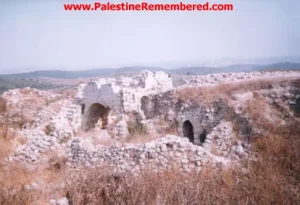
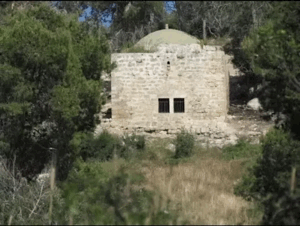
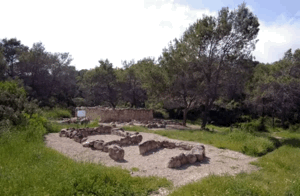
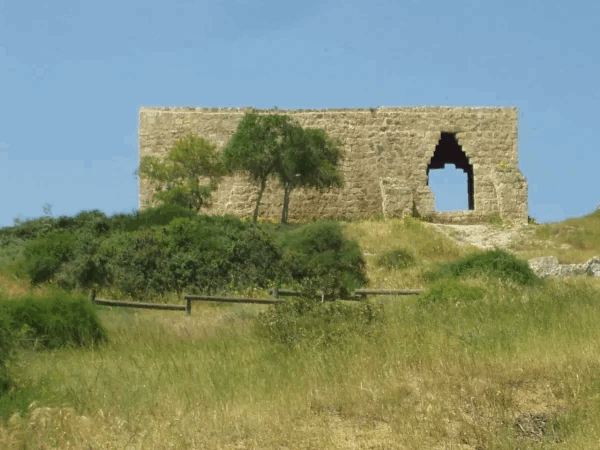
According to the field documentation used by Walid Khalidi, only a shrine, a fortress, an ancient well, and several houses remained from the Palestinian village.
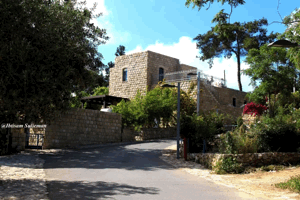
```One of the surviving buildings, the al-Yahya family house, bears an inscription indicating that it was built in 1882.
Date palms and cactus plants remained scattered across the site, while much of the area was converted into a recreational zone with swimming facilities.
Most of the village's built-up area was destroyed, although describing al-Tantura as having disappeared completely would be inaccurate because several buildings and historic landmarks survived.
This description reflects the condition of the site during the field documentation relied upon by Walid Khalidi and should not necessarily be interpreted as a comprehensive survey updated to 2026.
```Sources
- PalQuest – Interactive Encyclopedia of the Palestine Question: al-Tantura.
- Institute for Palestine Studies, Mustafa al-Wali, “The Tantura Massacre, 22–23 May 1948.”
- Institute for Palestine Studies, “Eyewitness Accounts of the Tantura Massacre.”
- Journal of Palestine Studies, Ilan Pappé, “The Tantura Case in Israel: The Katz Research and Trial.”
- Walid Khalidi, All That Remains, entry on al-Tantura.
- Palestine Remembered: al-Tantura, Haifa District.
- Government of Palestine, censuses of 1922 and 1931.
- Government of Palestine, Department of Statistics, Village Statistics, 1945.
Photo gallery


Photos from the village's people
Photos sent in by visitors and published after review.
Add a photo of this village
Log in to add photos of this village.
Other villages from Haifa

More from the archive
 Download Our Palestine App
The whole archive in the palm of your hand: depopulated villages, the Nakba, the massacres and Al-Aqsa — free, with no ads to erase the story.
Download Our Palestine App
The whole archive in the palm of your hand: depopulated villages, the Nakba, the massacres and Al-Aqsa — free, with no ads to erase the story.
Comments
No comments yet — be the first to write one.
Add your comment
Name and email are optional. Comments appear after review.