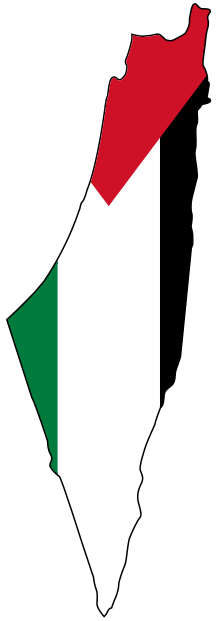
The depopulated village of 'Ayn Ghazal / District of Haifa
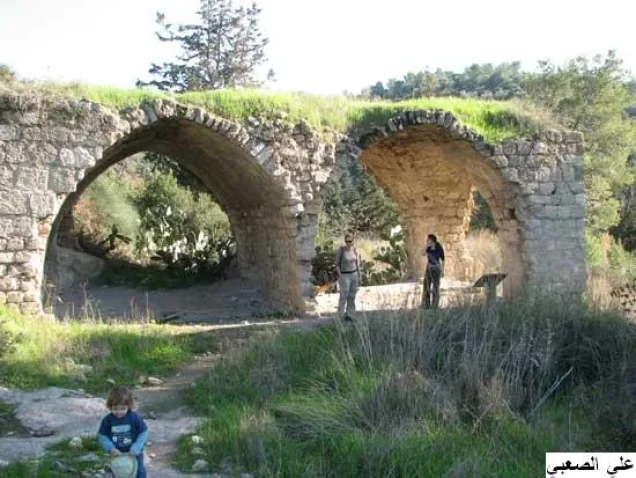
'Ayn Ghazal
About the depopulated village of 'Ayn Ghazal
- District
- Haifa
- Date 'Ayn Ghazal was occupied
- 26 July 1948
- Population in 1948
- 2,520
- Military operation
- Operation Shoter (“Policeman”)
- Brigade that carried it out
- Alexandroni Brigade، Golani Brigade، The Carmeli Brigade
- Who defended the village
- Local Arab militia and some ALA volunteers
- Distance from the governorate centre
- 21 (km) South of Haifa
- Elevation above sea level
- 100 m
- Cause of displacement
- Military assault by Zionist troops
- Extent of destruction
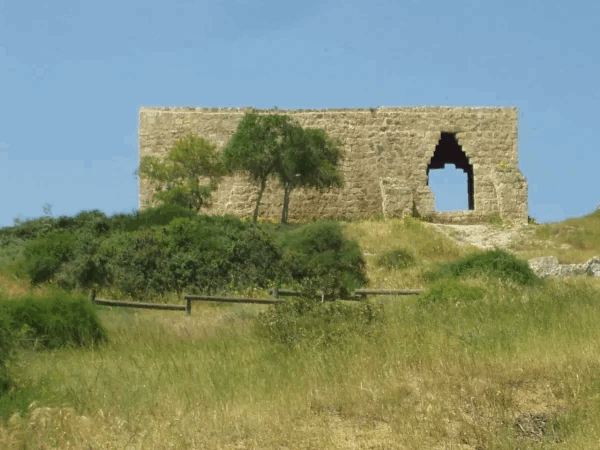
- The village has been mostly destroyed with the exception of the village shrine.
- Ethnic cleansing
- 'Ayn Ghazal inhabitants were completely ethnically cleansed.
- Settlements built on the built-up area of 'Ayn Ghazal after 1948
- Ofer
Hover a dot to read the village name, or click to open its card.
Borders of the depopulated village of 'Ayn Ghazal
Ayn Ghazal: A Depopulated Palestinian Village in the Haifa District
Ayn Ghazal was a Palestinian village in the Haifa District, located about 21 kilometres south of the city of Haifa on the upper slopes of Mount Carmel, at an average elevation of approximately 110 metres above sea level. Together with Ijzim and Jaba', it formed an area known as the “Little Triangle.” The three villages resisted several attempts to occupy them before falling during Operation Shoter in late July 1948, and their inhabitants were displaced during the Nakba and the occupation of Palestine in 1948.
- Subdistrict
- Haifa
- Distance from district center
- 21 km South of Haifa
- Average Elevation
- 100 meters above sea level
- Population in 1931
- 1,439 inhabitants - Official census including al-Sawamir
- Number of Houses in 1931
- 247 houses - Official census including al-Sawamir
- Population in 1944/1945
- 2,170 inhabitants - Government of Palestine statistics
- Estimated Population in 1948
- About 2,517 inhabitants - a later demographic estimate, not an official census
- Total Land Area in 1945
- 18,079 dunams
- Attack and Depopulation
- Ayn Ghazal was subjected to several attacks before its final occupation. PalQuest, drawing on contemporary Palestinian, British, and foreign press reports, records an attack on the village on 10 March 1948, followed by another attack on 14 March that destroyed four houses and, according to the British police, killed one Palestinian woman and wounded five men.
- Final Israeli Control
- 26 July 1948
- Military Operation
- Operation Shoter (“Policeman”)
- Military Unit
- Alexandroni Brigade, Golani Brigade, The Carmeli Brigade
- Cause of Depopulation
- Military assault by Zionist troops
- Settlements Documented on Village Lands
- Ofer
Location
Ayn Ghazal was built along the edge of a valley on the upper slopes of Mount Carmel. It lay close to the main coastal road connecting Haifa with areas to the south, giving the village considerable strategic and military importance in 1948.
The lands of Ayn Ghazal bordered those of several Palestinian villages, including Ijzim, Jaba', Kafr Lam, al-Sarafand, and al-Tantura. Khirbat al-Sawamir lay south of the village and was statistically associated with Ayn Ghazal in the 1931 census.
In the late nineteenth century, Ayn Ghazal was described as a small village built of stone and mud, with an estimated population of approximately 450.
Population
The population of Ayn Ghazal was 1,046 in the 1922 census. In the 1931 census, the population stood at 1,439, with the figure also including the inhabitants of Khirbat al-Sawamir.
In the 1944/1945 Village Statistics, the population of Ayn Ghazal was 2,170.
The figure of approximately 2,517 inhabitants for 1948, published by Palestine Remembered, is a later estimate of the population shortly before displacement and not an official Government of Palestine census. The same applies to the estimate of 15,458 refugees and descendants in 1998.
Population of Ayn Ghazal
- Late nineteenth centuryAbout 450Historical estimate
- 19221,046Official census
- 19311,439Official census including al-Sawamir
- 1944/19452,170Government of Palestine statistics
- 1948About 2,517Estimate published by Palestine Remembered
- 199815,458Estimate of refugees and their descendants
Number of Houses
The 1931 census recorded 247 houses in the statistical unit that included Ayn Ghazal and al-Sawamir. The figure of 432 houses for 1948, published by Palestine Remembered, is a later estimate.
Number of Houses in Ayn Ghazal
- 1931247Official census including al-Sawamir
- 1948About 432Later estimate
Education and Public Facilities
Ayn Ghazal had an elementary school for boys established around 1886 during the Ottoman period, as well as an elementary school for girls.
The village also had a cultural and sports club. Its inhabitants were Muslims, and the village contained a local shrine dedicated to Shaykh Shahada.
During the 1940s, a well was dug near the village, and water was pumped from it to the houses through pipes.
Land of Ayn Ghazal
According to the 1944/1945 statistics, the total land area of Ayn Ghazal amounted to 18,079 dunams.
Arab ownership amounted to 14,628 dunams, Jewish ownership to 424 dunams, while 3,027 dunams were classified as public land.
Land Ownership in Ayn Ghazal in 1944/1945
- Arab ownership14,628 dunums81%
- Jewish ownership424 dunums2%
- Public land3,027 dunums17%
Agriculture and Economic Life
The economy of Ayn Ghazal depended on agriculture and animal husbandry. Its proximity to Haifa also allowed some villagers to work in the service sector, including employment connected with the port and the city's commercial centre.
In the 1944/1945 statistics, a total of 8,896 dunams were devoted to cereals, including 8,472 dunams of Arab-owned land and 424 dunams of Jewish-owned land.
A further 1,486 dunams of Arab-owned land were irrigated or used for plantations. Sources reproduced by Walid Khalidi also indicate that approximately 1,400 dunams of village land were planted with olive trees.
The olive acreage formed part of the agricultural land and should not be added again to the overall land-use total.
Land Use in Ayn Ghazal in 1944/1945, in Dunams
- Arab
- Jewish
- Public
- Cereals8,896 dunums
- Irrigated and plantation land1,486 dunums
- Built-up area130 dunums
- Uncultivable land7,567 dunums
The Nakba and the Defense of Ayn Ghazal
Ayn Ghazal was subjected to several attacks before its final occupation. PalQuest, drawing on contemporary Palestinian, British, and foreign press reports, records an attack on the village on 10 March 1948, followed by another attack on 14 March that destroyed four houses and, according to the British police, killed one Palestinian woman and wounded five men.
Another attack took place on 20 May 1948, but the attacking forces were unable to establish control over the village.
Ayn Ghazal and the “Little Triangle”
Together with Jaba' and Ijzim, Ayn Ghazal formed a Palestinian enclave south of Haifa that became known as the “Little Triangle.” The three villages continued to resist after the occupation of Haifa and large parts of the Palestinian coastal region.
The area was of considerable military importance because it overlooked the coastal road between Haifa and Tel Aviv. The defenders of the three villages were able to disrupt Israeli military movement and transportation along this route.
PalQuest records that Israeli forces attempted to occupy the three villages on 18 June 1948, but the defenders repelled the assault. A second attempt on 8 July also failed.
Operation Shoter and the Occupation of Ayn Ghazal
The Military Operation
The final assault on Ayn Ghazal, Jaba', and Ijzim was carried out during Operation Shoter, meaning “Policeman,” which was launched during the Second Truce.
The operation was officially presented as a “police operation,” but sources reproduced by Walid Khalidi and PalQuest describe it in practice as a large-scale military operation.
Participating Units
The special force that attacked the villages of the Little Triangle was composed of units drawn from three Israeli brigades:
- Golani Brigade.
- Carmeli Brigade.
- Alexandroni Brigade.
Bombardment and the Final Assault
The final assault began on 24 July 1948. The villages were subjected to intense artillery and aerial bombardment for approximately a day before the ground forces advanced.
Despite the intensity of the bombardment, Israeli forces did not immediately capture the three villages, and the fighting continued for about two days.
Date of Occupation
Palestine Remembered records 24 July 1948 as the date of Ayn Ghazal's occupation. PalQuest, however, provides a more detailed sequence indicating that 24 July marked the beginning of the final assault and that the three villages did not fall under Israeli control until approximately two days later.
It is therefore more precise to distinguish between 24 July 1948 as the date on which Operation Shoter and the final attack on Ayn Ghazal began, and 26 July 1948 as the approximate date by which Israeli forces had completed their military takeover of the village and the Little Triangle.
Displacement and Human Losses
The occupation of Ayn Ghazal resulted in the displacement of its Palestinian inhabitants. PalQuest reports that Israeli forces continued firing on inhabitants of the three villages as they fled the area.
PalQuest also reproduces differing accounts concerning the killing of defenders in Ayn Ghazal and reports of burned bodies after the occupation. Contemporary reports alleged that a massacre had taken place, while Israeli authorities denied those claims.
A United Nations investigation did not find conclusive evidence establishing that a massacre had occurred in Ayn Ghazal. It later estimated that approximately 130 people were killed or missing from Ayn Ghazal, Jaba', and Ijzim combined. A specific casualty figure for Ayn Ghazal alone should therefore not be presented as a definitive or universally agreed number.
These accounts are included on the basis of the material reproduced by PalQuest and Walid Khalidi rather than through direct reliance on the Israeli sources cited within some of those accounts.
The United Nations and the People of the “Little Triangle”
The attack on Ayn Ghazal, Jaba', and Ijzim drew international objections because it was carried out during the Second Truce.
United Nations mediator Count Folke Bernadotte condemned what he described as the “systematic” destruction of Ayn Ghazal and Jaba'. He reported that approximately 8,000 people had been expelled from the three villages and had moved toward the Jenin area in search of refuge.
Bernadotte called for the refugees to be allowed to return to the three villages and for damaged houses to be repaired or destroyed houses rebuilt at Israel's expense.
On 13 September 1948, he issued an order to this effect. Israel refused to implement it, and the inhabitants of Ayn Ghazal were not permitted to return and re-establish their village.
Fate of the Population and Buildings
The Palestinian population of Ayn Ghazal was completely displaced during the Nakba. Many fled eastward toward the Jenin area, while others became refugees elsewhere.
The village was extensively destroyed after its occupation. PalQuest documents the United Nations' condemnation of the destruction of Ayn Ghazal and Jaba' following the assault.
Over time, most of the village's built-up area disappeared, leaving only limited remains of its original structures.
Occupation and Depopulation Chronology
- Not specified precisely
The Military Operation
The final assault on Ayn Ghazal, Jaba', and Ijzim was carried out during Operation Shoter, meaning “Policeman,” which was launched during the Second Truce. The operation was officially presented as a “police operation,” but sources reproduced by Walid Khalidi and PalQuest describe it in practice as a large-scale military operation.
- 24 July 1948
Bombardment and the Final Assault
The final assault began on 24 July 1948. The villages were subjected to intense artillery and aerial bombardment for approximately a day before the ground forces advanced.
- 24 July 1948
Date of Occupation
Palestine Remembered records 24 July 1948 as the date of Ayn Ghazal's occupation. PalQuest, however, provides a more detailed sequence indicating that 24 July marked the beginning of the final assault and that the three villages did not fall under Israeli control until approximately two days later.
Israeli Settlements on the Lands of Ayn Ghazal
Ofer
The settlement of Ofer was established in 1950 on the lands of Ayn Ghazal, approximately 2 kilometres southeast of the village site.
Ein Ayala
Ein Ayala was established in 1949 approximately 3 kilometres southeast of the village site.
Walid Khalidi and PalQuest state that, contrary to some published accounts, Ein Ayala was not established on the lands of Ayn Ghazal itself.
- 1950Ofer
Established on the lands of Ayn Ghazal
- 1949Ein Ayala
Located near the village but not on the lands of Ayn Ghazal according to Walid Khalidi and PalQuest
The Site of Ayn Ghazal After the Nakba
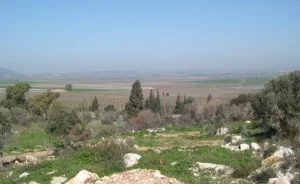
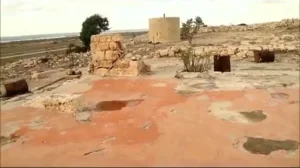
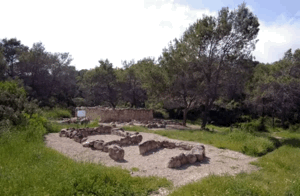
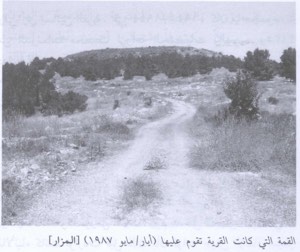
According to the field documentation published by Walid Khalidi, the only structure still standing at the village site was the shrine of Shaykh Shahada, which was already in a deteriorated condition at the time of documentation.
Ruined walls and piles of stones were scattered throughout the site, alongside pine, fig, and pomegranate trees and cactus plants.
The site had been fenced for use as cattle pasture, while the nearby level lands were cultivated with vegetables, bananas, and other fruit crops. Almond trees were planted on some of the surrounding slopes.
This description reflects the period of field documentation used by Walid Khalidi and should not necessarily be interpreted as a comprehensive field survey of the site in 2026.
Sources
- PalQuest – Interactive Encyclopedia of the Palestine Question: Ayn Ghazal.
- Palestine Remembered: Ayn Ghazal, Haifa District.
- Palestine Remembered: Ayn Ghazal.
- Walid Khalidi, All That Remains, entry on Ayn Ghazal, as reproduced by PalQuest and Palestine Remembered.
- Government of Palestine, Department of Statistics, Village Statistics, 1945.
- Palestine censuses of 1922 and 1931, with the note that the 1931 census figure for Ayn Ghazal includes al-Sawamir.
- Reports of the United Nations mediator and observers concerning the villages of the Little Triangle, as reproduced by PalQuest in its entry on Ayn Ghazal and by Walid Khalidi.
Photo gallery


Photos from the village's people
Photos sent in by visitors and published after review.
Add a photo of this village
Log in to add photos of this village.
Other villages from Haifa
More from the archive
 Download Our Palestine App
The whole archive in the palm of your hand: depopulated villages, the Nakba, the massacres and Al-Aqsa — free, with no ads to erase the story.
Download Our Palestine App
The whole archive in the palm of your hand: depopulated villages, the Nakba, the massacres and Al-Aqsa — free, with no ads to erase the story.
Comments
No comments yet — be the first to write one.
Add your comment
Name and email are optional. Comments appear after review.